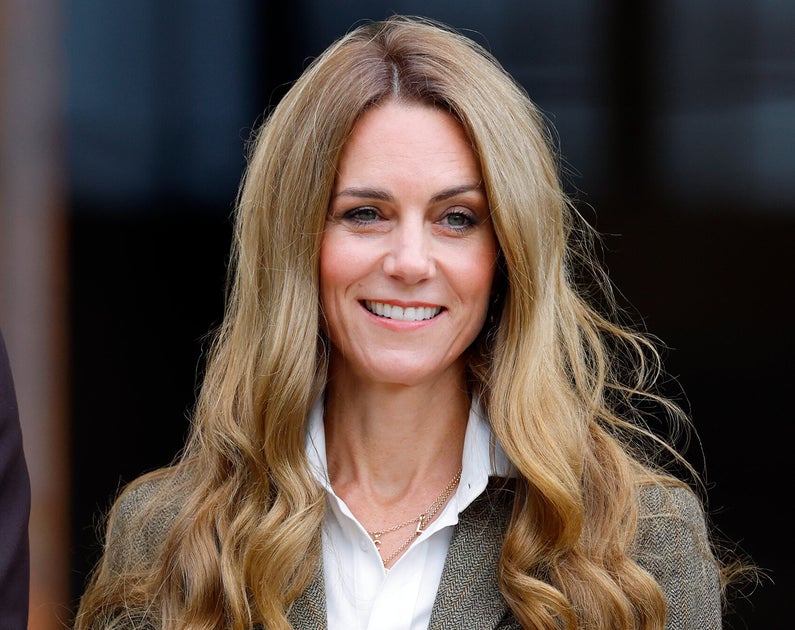

When Kate Middleton visited London’s Natural History Museum last week, much of the internet fixated on her hair.
The Princess of Wales debuted a much lighter hue than her usual brown locks, and there appeared to be more length and volume as well. Some royal watchers applauded the fresh change, praising its vibrancy and warmth, while others declared their distaste for the look and speculated about wigs and extensions in comment sections across the internet.
The response took such a nasty turn that Princess Diana’s hairdresser was compelled to post a response to the haters on Instagram, where he reminded the public of the royal’s cancer treatment and recovery.
“I’m sure she would rather be away from the public arena,” Sam McKnight wrote. “She has brilliantly and quietly, unselfishly represented our country, the soft power we still have as a nation. Cancer affects individuals differently, but is life-changing for everyone. So FFS LEAVE HER ALONE. SHAME ON YOU.”
It wasn’t the first time the Princess of Wales ― or any woman in the public eye ― has been picked apart for her hair, and it won’t be the last. But it exemplifies a larger pattern of our time: the tendency for ordinary people to lob mean-spirited comments toward and about public figures online.
HuffPost asked psychologists about this unique kind of online cruelty and the deeper dynamics of how the internet changes human behavior. Read on for a breakdown of why people feel comfortable saying such mean comments online.
Many of these commenters are part of ‘the online disinhibition effect.’
“People are more comfortable saying mean things online than in person due to a combination of factors particular to online commenting,” Caitlyn Oscarson, a licensed marriage and family therapist, told HuffPost. “For one, anonymity. Often online communities are separate from our personal lives which can create a sense of distance and reduced accountability.”
Basically, the internet allows commenters to be removed from the consequences of their actions.
“When someone hides behind a screen name or avatar, the usual social pressures and cues that would stop them from lashing out in person are stripped away,” said board-certified psychiatrist and “Practical Optimism” author Dr. Sue Varma. “This ‘invisible shield’ lowers inhibitions, which makes it much easier to criticize or attack a public figure like Duchess Catherine.”
Indeed, there’s even a term for this phenomenon: the online disinhibition effect.
“Offline, if one person was to say to another ‘You’re an absolute idiot, and the world would be better off if you hadn’t been born’ or ’You should be ashamed of yourself for wearing that outfit in public,” that abusive language would have a real world impact,” said Kathryn “Nin” Emery, a licensed professional counselor with Thriveworks.
The speaker would see the hurt on the other person’s face and then might even feel that hurt personally out of guilt or empathy.
“Other people that we may know in earshot could hear us and would now view us as less safe to be around,” Emery added. “Online, we don’t see the other person cry or wince ― we just see pixels and sentences on a screen. We may get a reply, maybe some emojis, but they can’t see us and we cannot see them.”

Furthermore, abusive behavior in online comment sections often goes unreported and might only result in a temporary ban from a particular platform at worst.
The negative impulse can stem from a very human place.
“Negative commenting can serve as an outlet for emotional displacement,” Varma said. “Frustrations from daily life ― such as midlife stress, work dissatisfaction or strained relationships ― get channeled into online interactions. Instead of confronting the true source of their stress, people unconsciously redirect it toward an easier, more distant target.”
In this way, a mean comment says less about the public figure and more about the commenter. Varma compared it to a mirror that reflects people’s deeper insecurities, low self-esteem and need for community.
“Famous people are an easy point of projection,” said licensed therapist Natalie Moore. “If you have negative feelings about yourself in a particular area, it’s easier to point out that perceived flaw in someone else than it is to face the pain you have about recognizing it in yourself.”
Critical comments might offer a fleeting self-esteem boost, a distraction from your insecurities or a sense of superiority.
“Celebrities represent power,” Moore noted. “They have wealth, fame and influence, which the vast majority of people won’t experience in their lifetime.”
Thus, criticizing a celebrity can be a way to feel a sense of control or power over that individual.
“Tearing someone else down can also come from a need to be perfect, so they hold everyone to unattainably high standards,” Emery noted.
She added that this kind of toxic commenting might stem from past trauma and learned behavior as well.
“Negative commenting can also be a way to get attention from others,” Oscarson said. “It can even be a bonding activity, a way to feel connected to others by being ‘against’ the public figure.”
In this way, online criticism can satisfy a social need tied to tribalism. The more negative and judgmental comments you see, the more acceptable this behavior may seem ― and the more tempted you may feel to join in on the action.
“When fandoms split into ‘teams’ like Team Conrad vs. Team Jeremiah [from ‘The Summer I Turned Pretty’] in fictional debates, people gain a sense of belonging by defending their ‘side,’” Varma explained. “Attacking the out-group strengthens their in-group identity, giving them validation and purpose.”
People overlook the real-world impact of their mean comments about public figures they don’t know.
“Criticizing a public figure feels safer because it creates emotional distance,” Varma said. “People tell themselves, ‘They’ll never see this’ or ‘They’re too powerful or famous to be hurt by my words.’ Unlike criticizing a friend or colleague, where there’s an immediate risk of damaging a real relationship, attacks on celebrities or royals feel inconsequential.”
It’s easy to forget that those famous faces are people, too.
“We don’t see celebrities and other public figures living everyday life ― being parents, doing their jobs, having everyday struggles ― which can make them feel like characters in a movie without real emotions or inner lives,” Oscarson said. “Celebrities may also be seen as ‘fair game’ for criticism if they have chosen to be in the spotlight.”
We might roll our eyes at the cheesy ‘Stars ― They’re Just Like Us!’ magazine spreads, but the truth is that celebrities do have real lives, real families and real feelings that can be deeply affected by the words and judgments of strangers.
“No one is completely impervious to criticism, no matter how often they experience it,” Moore said. “Most people think of celebrities as existing in a class of their own, and that they somehow don’t need to be treated with dignity or respect online.”
This phenomenon leads people to underestimate the real-world impact of their cruel commentary.
“Public figures do read comments, and negative online sentiment ― especially when it snowballs ― can affect their mental health, their family life and even public perception on a much larger scale,” Varma said. “The digital distance makes it easy for people to forget there are real humans on the receiving end.”
There are also bigger cultural implications that impact everyone.
“While it may feel trivial in the moment, each negative comment contributes to a broader culture that normalizes cruelty and erodes empathy,” Varma said.
This brings to mind the popular meme construction ”[Celebrity] won’t see your mean tweets about [specific criticism], but your friends [who have that same characteristic] will.”
Although the format is often exaggerated for humor, the underlying message is true: Even if a celebrity doesn’t see your critical comment online, others will. And it can touch on their insecurities, normalizing this kind of harmful thinking and behavior.
“It’s easy to get caught up in this type of negative commenting,” Oscarson said. “If people find that they are engaging in this type of behavior, it’s OK to have some self-compassion. Slow down and take a moment to understand your motivation, and think before you post.”
Recognizing this toxic dynamic can go a long way toward minimizing online harm. Moore recommended asking yourself a simple question.
“Any time you leave a comment online, do a check-in with yourself and ask ‘Would I say this to them in person?‘” she advised. “And if the answer is ‘no,’ think again.”