

That bottle of rice vinegar pushed to the back of the pantry, the one you bought for one stir-fry recipe two years ago, is almost certainly fine. Vinegar is one of the few condiments that’s genuinely hard to ruin. But “hard to ruin” isn’t the same as “identical to plain vinegar,” and if your bottle is the seasoned kind, the rules shift a little.
Does rice vinegar go bad?
The short answer: Plain rice vinegar is acidic enough to be self-preserving and, according to the Vinegar Institute, has an almost indefinite shelf life whether opened or not. Manufacturers still print a best-by date, typically around 2 years, and recommend refrigerating after opening for the best flavor. Seasoned rice vinegar is different: because it has added sugar and salt, Nakano lists a shorter shelf life for it, around 1 year, and recommends refrigeration after opening. Neither type needs the fridge for safety, but both benefit from it for quality.
For general pantry rules, check the food storage guide. If you’re comparing rice vinegar to a similar pantry staple, the apple cider vinegar and soy sauce guides cover related ground.
📋 Does Rice Vinegar Go Bad: At a Glance
| Plain rice vinegar, unopened | About 2 years on the label, safe well beyond it |
| Plain rice vinegar, opened | Best quality for 1 to 2+ years, safe indefinitely |
| Seasoned rice vinegar, unopened | About 1 year on the label |
| Seasoned rice vinegar, opened | Best quality for several months to a year, refrigerated |
| Refrigeration required for safety? | No, but brands recommend it after opening for freshness |
| Biggest real risk | Mold in seasoned bottles left uncapped or cross-contaminated |
| Cosmetic, not spoiled | Cloudiness, sediment, darker color, “mother” forming |
Key Takeaways
- Rice vinegar is acidic enough to be self-preserving, so it’s one of the least likely condiments in the pantry to actually spoil.
- Plain (unseasoned) rice vinegar and seasoned rice vinegar are not the same product for storage purposes. Seasoned versions have added sugar and salt and a shorter printed shelf life.
- Cloudiness, sediment, a darker color, or a stringy “mother” forming are cosmetic changes, not spoilage.
- Refrigeration isn’t required for safety on either type, but the major brands recommend it after opening to preserve flavor, and it’s worth following for seasoned bottles especially.
- Real spoilage signs (visible mold, a rancid or otherwise wrong smell) are rare but do happen, mostly in seasoned vinegar that’s been contaminated by a dirty spoon or left uncapped.
- An expired best-by date doesn’t mean the bottle is unsafe. It’s a quality marker, not a safety cutoff.
Why Rice Vinegar Almost Never Spoils
The science: acidity does the preserving
Rice vinegar is made through a two-step fermentation: sugars from rice become alcohol, then that alcohol becomes acetic acid. All vinegar sold at retail in the US must be at least 4% acidity under FDA rules, according to the Vinegar Institute. Rice vinegar tends to sit at the lower end of that range. Nakano lists its natural rice vinegar at 4.2% acidity and its seasoned rice vinegar at 4%, both milder than white distilled vinegar, which the Vinegar Institute puts as high as 7%. That acid content is what makes vinegar self-preserving without refrigeration. It’s a different mechanism than what protects honey from spoiling, which relies on low water content rather than acidity, but the practical result is similar: very little for bacteria to grow in. The Institute’s own studies found vinegar’s shelf life to be “almost indefinite.” White distilled vinegar stays visually unchanged the longest, while other types, rice vinegar included, sometimes show color or clarity changes that are cosmetic rather than a safety issue.
Seasoned rice vinegar changes the equation slightly. It’s still rice vinegar at its core, but brands add sugar and salt to it. That’s exactly why Nakano lists a shorter shelf life for its seasoned rice vinegar (about 1 year) than for its plain, unseasoned one (2 years). Sugar is a food source that plain vinegar’s acidity doesn’t have to compete with. It’s a reasonable place for slow degradation to start if the bottle is contaminated or left open too long.
How Long Rice Vinegar Actually Lasts
Plain (unseasoned) rice vinegar
An unopened bottle carries a printed shelf life of around 2 years, based on what Marukan and Nakano list on their labels, and it stays safe well beyond that date. Once opened, both brands recommend refrigerating for the best flavor, though neither treats this as a safety requirement. If your bottle has sat in a cabinet, unrefrigerated, for a year or two after opening, that’s normal use, not a red flag.
Tip: follow the label if it says refrigerate
Brand instructions vary slightly, and some specifically say to refrigerate after opening for freshness. When a bottle gives that instruction, it’s worth following, not because the vinegar is unsafe otherwise, but because it slows the gradual flavor mellowing that all opened vinegar experiences.
Seasoned rice vinegar
Seasoned rice vinegar (the kind with added sugar and salt, often labeled for sushi rice or as a ready-to-use dressing) has a shorter shelf life on paper: about 1 year unopened, per Nakano’s own FAQ, versus 2 years for plain rice vinegar. Nakano recommends refrigerating it after opening. It contains sugar, so it’s worth taking that instruction more seriously than with plain rice vinegar, or with a related pantry staple like cooking wine. Sugar gives any stray contamination something to work with that plain vinegar’s acidity alone doesn’t provide.

Warning: mold is rare but is a real reason to discard
Unlike most vinegar issues, which are purely cosmetic, visible mold on the surface or floating in the bottle is not something to strain out and use anyway. It’s uncommon. It’s more likely in seasoned rice vinegar that’s been left uncapped, stored warm, or contaminated by a used utensil, than in plain vinegar. If you see it, discard the bottle.
See also

What’s actually just cosmetic
Most of what looks alarming in an older bottle of rice vinegar is harmless. A cloudy or hazy appearance, a thin layer of sediment at the bottom, and a stringy, slimy substance called “mother” are all normal. They come from natural vinegar bacteria interacting with air once the bottle is opened, similar to how sesame oil can change appearance without being unsafe. The Vinegar Institute is explicit that these are aesthetic changes, not spoilage, and that the vinegar remains safe and usable. Color can also darken slightly with age and light exposure.
Tip: straining fixes the look, not a problem
If cloudiness or “mother” bothers you, pour the vinegar through a coffee filter or fine-mesh strainer. This is a cosmetic fix for a cosmetic issue. The vinegar was already safe to use before straining it.
How to Store Rice Vinegar
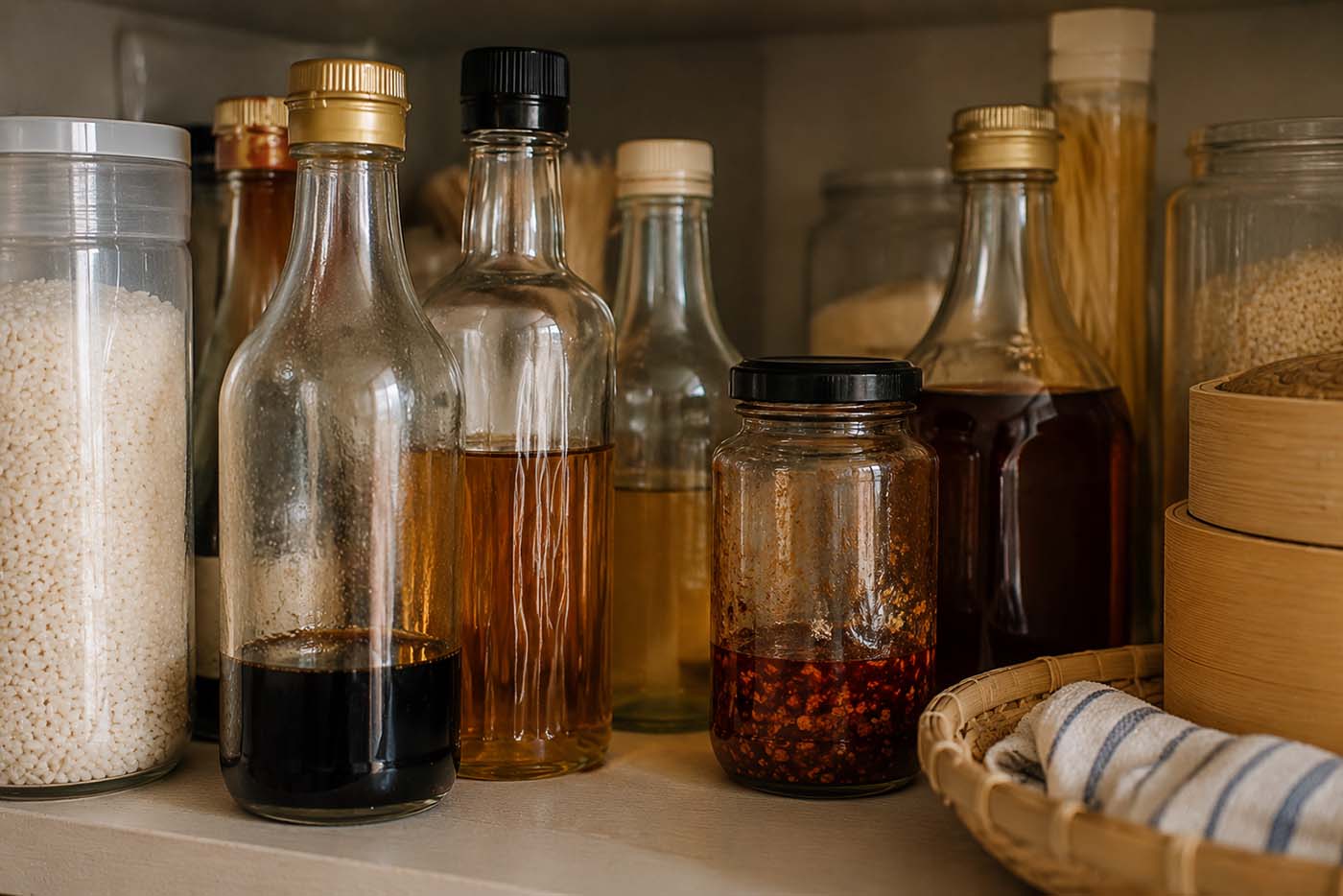
Keep the cap tightly sealed between uses and store the bottle in a cool, dark cabinet away from the stove. Heat and light are what push flavor loss along fastest, more than time itself, the same rule that applies to olive oil and soy sauce. Refrigeration isn’t required for either plain or seasoned rice vinegar. It’s a reasonable default once opened, especially for seasoned bottles, and it costs nothing but a little fridge space. Use a clean, dry spoon or pour directly from the bottle. Freezing isn’t necessary. Vinegar is already shelf-stable at room temperature, and freezing offers no real benefit while taking up freezer space you probably want for something else.
| Type & Storage | Shelf Life |
|---|---|
| Plain rice vinegar, unopened | About 2 years on the label; safe well beyond |
| Plain rice vinegar, opened, pantry | Best quality 1 to 2+ years; safe indefinitely |
| Plain rice vinegar, opened, refrigerated | Slower flavor loss than pantry storage |
| Seasoned rice vinegar, unopened | About 1 year on the label |
| Seasoned rice vinegar, opened, refrigerated | Several months to a year, per brand guidance |
| Frozen | Not recommended; no benefit over pantry storage |
Frequently Asked Questions
No, not for safety. Its acidity makes it self-preserving at room temperature, similar to how Worcestershire sauce doesn’t need the fridge either. Brands like Marukan and Nakano recommend refrigerating after opening for the best flavor, and that’s worth following, especially for seasoned rice vinegar, but an unrefrigerated bottle isn’t unsafe.
How long does rice vinegar last after opening?
Plain rice vinegar stays at good quality for 1 to 2 years or more and remains safe well beyond that. Seasoned rice vinegar has a shorter practical window, generally several months to a year once opened and refrigerated, because the added sugar and salt make quality fade faster.
What’s the difference between rice vinegar and seasoned rice vinegar?
Plain rice vinegar is just fermented rice and water, with no added sugar or salt. Seasoned rice vinegar has sugar and salt added, giving it a lightly sweet, ready-to-use flavor that’s common in sushi rice and quick dressings. The seasoning is also why seasoned versions carry a shorter printed shelf life.
Usually, yes. The Vinegar Institute describes vinegar’s shelf life as almost indefinite because of its acidity. The date on the bottle is a quality marker, similar to how many foods last well past their printed date, not a hard safety cutoff. Check for the real warning signs below before using an old bottle.
Why is my rice vinegar cloudy?
This is almost always harmless. Once opened and exposed to air, naturally occurring vinegar bacteria can cause cloudiness or a stringy “mother” to form. It doesn’t affect safety and can be strained out with a coffee filter if the look bothers you.
What is the stringy stuff in my rice vinegar?
That’s “mother of vinegar,” a harmless cellulose substance produced by natural acetic acid bacteria. It’s the same organism responsible for turning alcohol into vinegar in the first place. It’s not mold, and the vinegar is still safe to use with or without straining it out.
It’s rare but possible, mostly in seasoned rice vinegar that’s been contaminated with food particles from a used utensil or left uncapped for extended periods. Visible mold, unlike cloudiness or sediment, is a genuine reason to throw the bottle out rather than strain and use it. The same logic applies across most expired condiments: cosmetic changes are fine, visible mold isn’t.
Does rice vinegar lose its acidity over time?
Its acetic acid content is chemically stable and doesn’t meaningfully break down in a sealed, properly stored bottle. What does fade over time, especially once opened, is the brighter, sharper flavor notes, which is a quality change rather than a change in the vinegar’s preserving power.
Is rice vinegar the same as rice wine vinegar?
Yes, these terms are used interchangeably. The Vinegar Institute classifies “rice or rice wine vinegar” as one category, made through fermentation of sugars from rice.
Is rice vinegar the same as mirin?
No. Rice vinegar is acidic and tangy, made through fermentation into acetic acid. Mirin is a sweet, low-alcohol rice wine used for glaze and gloss in dishes like teriyaki. They’re both made from rice but serve different roles in a recipe and aren’t interchangeable without adjusting a dish’s other ingredients.
Can I freeze rice vinegar?
You can, but there’s no real reason to. Rice vinegar is already shelf-stable at room temperature indefinitely, so freezing doesn’t extend its usable life in any meaningful way and just uses up freezer space.
Further Reading
Rice vinegar shows up constantly once you start looking for it. Use it to brighten healthy coleslaw, whisk it into carrot ginger dressing, fold it into the sauce for teriyaki pork bowls, splash it over tuna tostadas or bbq shrimp tacos, add it to rainbow spring rolls dipping sauce, use it in Chinese chicken lettuce wraps, work it into honey sriracha shrimp tacos or green chile chicken tacos, or finish gluten-free crab cakes with a light drizzle.
Image prompt: A softly lit, close-up editorial food photograph of a clear glass bottle of rice vinegar with the cap off, next to a small ceramic dish with a splash of pale golden vinegar in it. A wooden spoon rests beside the dish. Warm, natural side lighting, shallow depth of field, a neutral kitchen countertop slightly out of focus in the background.
Better Living may earn commissions through affiliate links and may occasionally feature sponsored or partner content. If you make a purchase through our links, we may receive a small commission at no cost to you.