
President Biden announced on Tuesday a sharp increase in tariffs on an array of Chinese imports, including electric vehicles, solar cells, semiconductors and advanced batteries, in an effort to protect strategic American industries from a new wave of competitors that he said were unfairly subsidized by Beijing.
The president also officially endorsed maintaining tariffs on more than $300 billion worth of Chinese goods that were put in place by President Donald J. Trump. Mr. Biden criticized those tariffs as taxes on American consumers during his 2020 run for the White House.
Mr. Biden’s moves were the latest trade-war escalation from a president who initially pledged to repeal at least some of the Trump tariffs but now has refused to cede any ground to his rival in a tough-on-China appeal to swing voters in the industrial Midwest and beyond.
They also reflect Mr. Biden’s efforts to build on Mr. Trump’s consensus-defying trade confrontation with China while focusing it on sectors of strategic importance to the United States, like clean energy and semiconductors.
In remarks at the White House, Mr. Biden said his administration was “combining investments in America with tariffs that are strategic and targeted.”
Standing before a crowd that included the leaders of several labor unions and representatives from steel, aluminum and other manufacturers, Mr. Biden contrasted his approach to that of Mr. Trump.
“My predecessor promised increased American exports and boosted manufacturing,” the president said. “But he did neither. He failed.”
Asked by a reporter after the speech about Mr. Trump’s claim that China is now “eating our lunch” economically, Mr. Biden shot back. “He’s been feeding them for a long time,” Mr. Biden said.
In a sign of the newly scrambled politics of trade, labor leaders, many Democratic lawmakers, some industry groups and even environmentalists praised Mr. Biden’s decision, while the Republican National Committee slammed it — complaining that Mr. Biden was not being tough enough on China.
The National Retail Federation, which represents many companies that source or sell Chinese products, called on Mr. Biden to reverse course and lift tariffs. “As consumers continue to battle inflation, the last thing the administration should be doing is placing additional taxes on imported products that will be paid by U.S. importers and eventually U.S. consumers,” David French, the group’s executive vice president of government relations, said in a release.
Only a few politicians, including the Democratic governor of Colorado, Jared Polis, followed suit. “This is horrible news for American consumers and a major setback for clean energy,” Mr. Polis wrote in a social media post. “Tariffs are a direct, regressive tax on Americans and this tax increase will hit every family.”
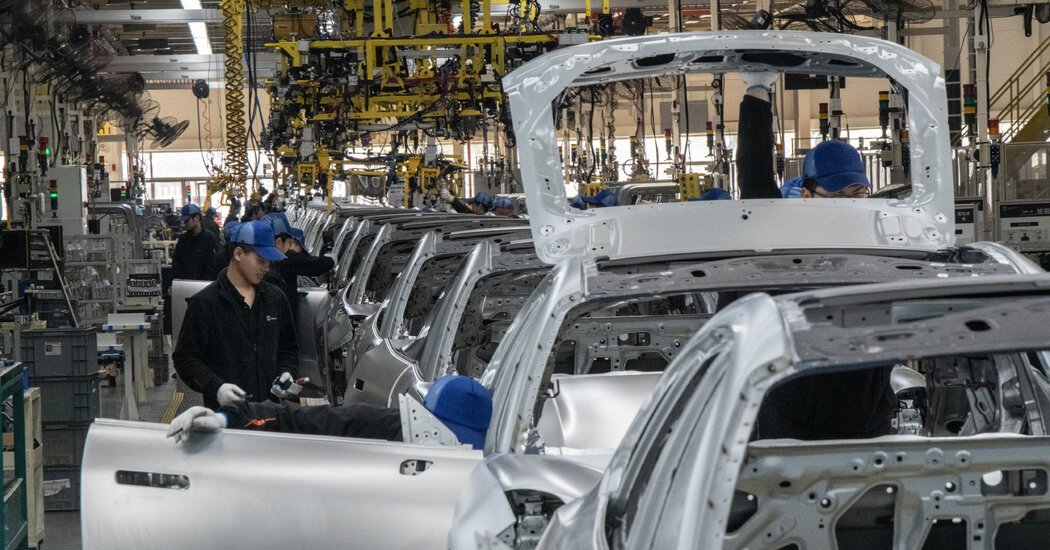
The increased tariffs will apply to about $18 billion worth of annual imports from China, White House officials said. The biggest increase will be the quadrupling of tariffs on Chinese electric vehicles to 100 percent from 25 percent. That move is aimed at shielding a corner of the American automotive industry that is in line to receive hundreds of billions of dollars in federal subsidies to help the United States transition to a clean-energy future.
Mr. Biden is betting on his efforts to use government investments in heavy manufacturing, including electric vehicles and other green technologies, to create middle-class jobs and help win the swing states that are home to parts of those industries. Biden aides nodded to the politics of trade before the announcement, singling out states they expected to benefit from the tariffs.
“We know China’s unfair practices have harmed communities in Michigan and Pennsylvania and around the country that are now having the opportunity to come back due to President Biden’s investment agenda,” Lael Brainard, the director of the White House National Economic Council, told reporters.

Ms. Brainard also criticized the Trump administration for what she called a “failed” effort to force China to change unfair trade practices.
Treasury Secretary Janet L. Yellen, who previously criticized tariffs as taxes on consumers, said the new levies were justified because China’s excess industrial capacity posed a threat to the United States and its allies and to emerging markets. She said the Biden administration would not allow cheap Chinese exports to harm American workers.
“President Biden and I have seen firsthand the impacts of surges of certain artificially cheap Chinese imports on American communities in the past, and we will not tolerate that again,” Ms. Yellen said, explaining that the tariffs were not intended to be “anti-China.”
China’s Ministry of Commerce criticized the tariffs in a statement, saying that China “firmly opposes this.” The statement called the Biden administration’s decision “typical political manipulation” that would “seriously affect the atmosphere of bilateral cooperation.”
China called on the United States to rescind the decision, saying that “China will take resolute measures to defend its rights and interests.”
Administration officials had long debated reducing some of Mr. Trump’s tariffs — which applied to a large swath of products including apparel and home lighting — while raising levies in more strategic areas. But officials pointed to a long-awaited mandatory review by Mr. Biden’s trade representative, released on Tuesday, that concluded that China’s flouting of international trade rules necessitated keeping all the tariffs in place.
Officials said this week that they believed American companies that sourced products and components abroad had adjusted to those initial tariffs or made use of an official process to request tariff exclusions.
The relative value of the goods subjected to Mr. Trump’s original tariffs, compared with the much smaller value of the ones targeted by Mr. Biden, reflects a crucial difference in their competing approaches to trade with China.
Mr. Trump favored broad tariffs as a means of wielding leverage with China, given that its export economy remains highly dependent on the American consumer. While in office, he tried to use tariffs as a club to negotiate more favorable terms of trade between the countries and bring manufacturing jobs back to America, with little success.
Mr. Trump has promised to go even further if he wins in November — restricting investment between the two countries and banning some Chinese products from the United States entirely. He has also promised to apply that approach more broadly by subjecting all imports, regardless of their origin, to an additional 10 percent tariff.
Trade experts noted that the political calendar was likely a consideration in the timing and scope of the tariffs.
“The zero-sum game of industrial policy that both countries are engaged in, coupled with the looming U.S. election season, has reached its inevitable culmination in the form of escalating tariffs on selected imports from China,” said Eswar Prasad, the former head of the International Monetary Fund’s China division.
Mr. Biden opted to increase Chinese tariffs in areas his administration has targeted for growth and where the United States has invested huge sums of money, including for clean energy technology and semiconductors.
The rate on Chinese solar cells will double to 50 percent. The rate on certain advanced batteries, along with critical minerals needed to build them, will rise to 25 percent. Semiconductor tariffs will double to 50 percent. Some of those increases will be delayed in an apparent effort to allow domestic companies time to ramp up their own production and find other sources outside China.
Other tariffs will affect industries in important swing states, including heavy metals. Rates for certain imported steel and aluminum products will triple to 25 percent.
The tariffs were praised by some of the industries that have been hit hardest by cheap Chinese exports.
“As America works to build out manufacturing in key clean energy supply chains to reduce the country’s reliance on China’s supply chains, we need to use every tool at our disposal to boost the U.S. solar manufacturing industry,” said Mike Carr, the executive director of the Solar Energy Manufacturers for America Coalition. “The administration made the right decision to strengthen protections for solar components we seek to build in the U.S.”
Mr. Biden will also increase tariffs on some medical equipment that officials call essential for pandemic response, including face masks and surgical gloves.
U.S. officials cast those increases as an appropriate counter to “unfair, nonmarket practices” by the Chinese government, including state subsidies of factories and what officials call theft of innovative ideas from foreign competitors.
“China’s forced technology transfers and intellectual property theft have contributed to its control of 70, 80 and even 90 percent of global production for the critical inputs necessary for our technologies, infrastructure, energy and health care — creating unacceptable risks to America’s supply chains and economic security,” U.S. officials said in a fact sheet distributed before the announcement.
A spokesman for China’s foreign affairs ministry, responding to a question about reports of the tariffs, said at the ministry’s daily news conference on Tuesday that China “will take all necessary measures to safeguard its legitimate rights and interests.”
Many economists oppose tariffs because they tend to act as an effective tax on domestic consumers, by raising prices. U.S. officials said this week that they did not expect the increased tariffs to add to price growth — which is already uncomfortably fast for many consumers — because they are narrowly targeted.
Union leaders and Democratic lawmakers were expected to cheer the announcement, though some Democrats, like Senator Sherrod Brown of Ohio, have already urged Mr. Biden to go further and ban Chinese electric vehicles.
The embrace of tariffs, first by Mr. Trump and now by Mr. Biden, reflects a growing awareness — in and outside Washington — of Chinese trade practices that have cost American workers their jobs, said Adam Hodge, a managing director at the communications firm Bully Pulpit International in Washington and a former spokesman for Mr. Biden’s trade representative and National Security Council.
“We’ve gotten wise to it,” Mr. Hodge said. “It’s smart politics because it’s responsive to what Americans are seeing in communities across the country.”
Siyi Zhao contributed research from Seoul.