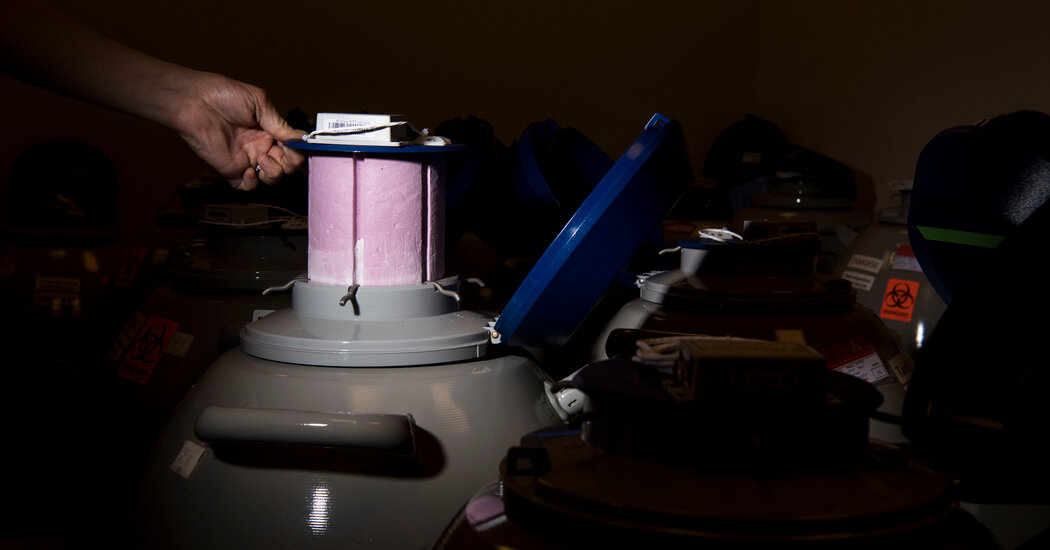

To the fertility patients whose embryos were destroyed at an Alabama clinic, the circumstances must have been shocking. Somehow, a patient in the hospital housing the clinic had wandered into a storage room, pulled the embryos from a tank of liquid nitrogen, and then dropped them on the floor — probably because the tank was kept at minus 360 degrees.
The bizarre episode was at the center of lawsuits filed by three families that eventually reached the Alabama Supreme Court. On Friday, a panel of judges ruled that the embryos destroyed at the clinic should be considered children under state law, a decision that sent shock waves through the fertility industry and raised urgent questions about how treatments could possibly proceed in the state.
Yet the accident in the Alabama clinic echoes a pattern of serious errors that happen all too frequently during fertility treatment, a rapidly growing industry with little government oversight, experts say. From January 2009 through April 2019, patients brought more than 130 lawsuits over destroyed embryos, including cases where embryos were lost, mishandled or stored in freezer tanks that broke down.
Those errors have taken on new gravity as the anti-abortion movement aims to extend “personhood” to fetuses and embryos conceived through in vitro fertilization, arguing that they are “unborn children” and bringing cases to an increasingly polarized judiciary open to considering the idea.
“When things go wrong with I.V.F., it opens a window for this kind of strategy,” said Sonia Suter, a law professor at George Washington University who has studied in vitro fertilization litigation. “To the extent that there is little regulation, it does provide an opportunity to promote the personhood agenda.”
Denise Burke, senior counsel with the Alliance Defending Freedom, which opposes abortion rights, called the Alabama decision “a tremendous victory for life” that protected “unborn children created through assisted reproductive technology.”
“No matter the circumstances, all human life is valuable from the moment of conception,” Ms. Burke said in a statement.
Patients often turn to the courts when fertility treatment goes wrong, leaving judges to decide what clinics owe in situations where emotional, physical and financial losses are at play. Lawsuits against clinics typically claim that negligent behavior led to embryos’ destruction.
But in the lawsuits against the clinic, the Alabama Center for Reproductive Medicine, the couples who lost embryos took a different tack, arguing that the accident resulted in wrongful deaths under state law.
One couple’s complaint described the embryos as “cryopreserved embryonic human beings” and contended that the storage room should be viewed as a day care, which state regulations required to be “secured and closely guarded,” because “small children, including embryos, cannot protect themselves.”
The state Supreme Court agreed, ruling that the plaintiffs could pursue a wrongful death claim on behalf of an embryo, a fertilized egg that has grown for five or six days before being implanted in a patient or stored in tanks of liquid nitrogen.
“The text of the Wrongful Death of a Minor Act is sweeping and unqualified,” Justice Jay Mitchell of the Alabama Supreme Court wrote, referring to the state law. “It applies to all children, born and unborn, without limitation.”
Lawyers for the Alabama Center for Reproductive Medicine did not respond to a request for comment.
More than 2 percent of infants born in the United States every year are conceived with assisted reproductive technology. In 2021, more than 97,000 infants were born following I.V.F.

While clinics in the United States do not report the number of embryos they store, a frequently cited RAND Corporation study from 2002 (when I.V.F. was far less common) estimated that nearly 400,000 embryos were frozen in tanks across the country.
Experts who study the fertility industry said they were not surprised to see the Alabama clinic apparently operating with lax safeguards, as is common at many clinics.
“This kind of case surprises me zero,” said Dov Fox, director of the Center for Health Law Policy and Bioethics at the University of San Diego School of Law. “This is a perfectly avoidable result.”
One of the largest negligence cases to date involved the 2018 failures of two major embryo freezer tanks — one in California and another in Ohio — that each destroyed thousands of eggs and embryos.
In the Ohio case, the clinic admitted to shutting off an alarm system that should have alerted staff members that the tank was no longer functioning. More than 4,000 embryos were destroyed.
One affected couple who sued tried to make a personhood argument, contending that “the life of a person begins at conception.” The case eventually settled out of court.
“This has been an ongoing debate — is this property, is this a person, or is this something special that isn’t either one of those things?” Dr. Suter said of frozen embryos.
More recently, eight couples filed lawsuits against the medical device company CooperSurgical, claiming that a liquid the company makes, which is meant to help fertilized eggs grow into embryos, was defective and caused their embryos to stop developing.
Collectively, the patients say they lost more than 100 embryos that had been bathed in the botched product. Experts estimate thousands more patients may have been affected. The company declined to comment.
Other lawsuits have been more similar to the Alabama case, brought by families alleging that an act of negligence led to their embryos’ destruction. One case involved an embryo that was thawed so it could be transferred to a patient’s uterus, but was then lost. In another, a shipping company opened a package containing frozen embryos to inspect it, inadvertently letting them thaw.
“These are not aberrations,” said Mr. Fox, who noted that the very first I.V.F. lawsuit, filed in 1995, involved two Rhode Island couples whose clinic had lost their nine embryos.
It’s difficult to know how often embryos are inadvertently destroyed during fertility treatment because, unlike countries such as Britain, which has a health agency dedicated to overseeing I.V.F., no regulator or government body tracks that information in the United States.
While federal rules require hospitals to report and track serious errors, fertility clinics are not subject to those requirements. They do report some data to the government, such as how many patients they see and their patients’ pregnancy success rates, but not accidents or errors.
Many errors do not even make it to court, because some clinics have patients sign contracts requiring them to use private arbitration instead. “That keeps everything secret and minimizes public awareness of the scope of the problems,” said Sarah London, an attorney in San Francisco who specializes in fertility litigation.
Professional guidelines for how to securely store frozen embryos are relatively sparse. The American Society for Reproductive Medicine’s 2022 guidance, published after the Alabama accident, states that I.V.F. laboratories should have “the ability to limit access through badge readers or similar method.” It does not mandate that the laboratories consistently lock their doors or secure their freezer tanks.
In Alabama, “a stranger chose to open the tank and look and see what was inside of it and take it out,” said Amy Sparks, the in vitro fertility laboratory director at the University of Iowa and a former president of the Society for Assisted Reproductive Technology.
“It’s a tragedy that it wasn’t adequately secured and clearly brings it to everyone’s attention, including mine.”
Dr. Sparks, who has given presentations on fertility laboratory safety and toured clinics across the country, said it wouldn’t be unusual for a clinic to sometimes leave the door to embryo storage unlocked.
Laboratory workers are constantly carrying sloshing, shoe-box-size containers filled with liquid nitrogen. They might prop open a door sometimes rather than risk spilling the freezing liquid onto their arms, she said.
Even advanced monitoring systems, like the ones Dr. Sparks has installed in her freezer tanks to monitor temperature and liquid nitrogen levels, would not have alerted staff quickly enough to prevent the problem in Alabama.
Other problems that harm embryos can crop up in routine medical practice, Dr. Sparks said, like an embryo adhering to the side of a pipette, or a biopsy not going well.
The new ruling in Alabama could raise the stakes for fertility providers across the country, she added.
“I’m very concerned about the patients and the care providers in Alabama, but it is not necessarily going to be limited to the borders of that state,” said Dr. Sparks, who is based in Iowa, where a six-week abortion ban is being challenged in the courts.
On Wednesday, the University of Alabama at Birmingham health care system announced that it would be pausing all in vitro fertilization treatments aside from egg retrievals while it weighed the possible liability of continuing to do so.