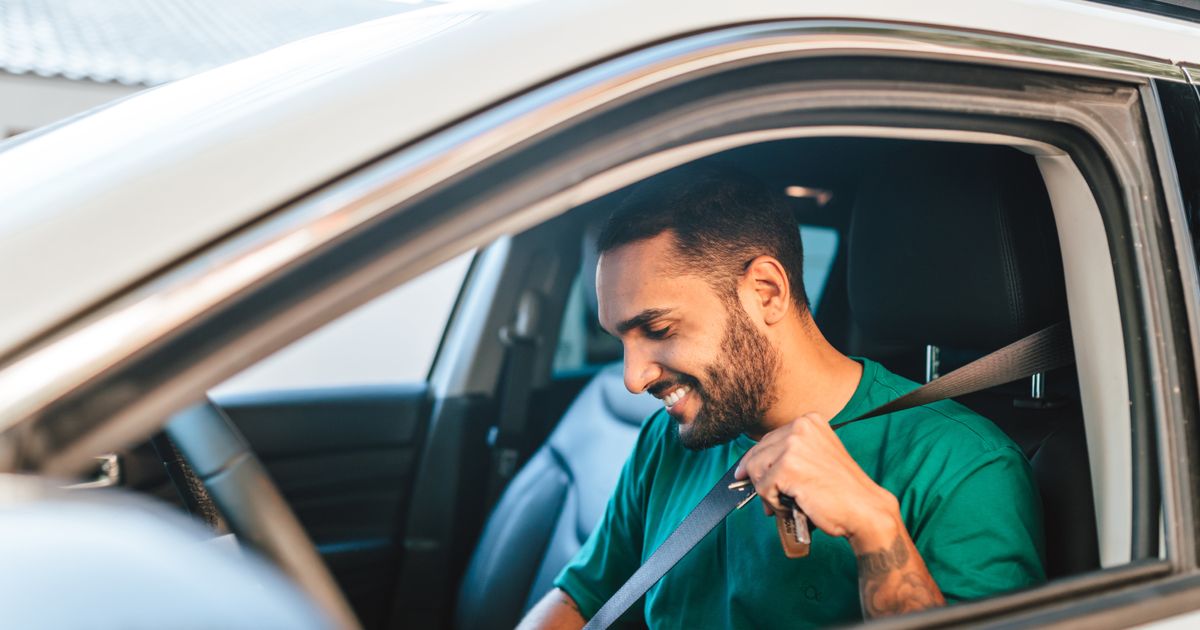

If you consider yourself a safe driver, perhaps you’ve thought about signing up for a car insurance program that rewards you for your careful behavior on the road.
Smart driving, also known as “usage-based auto insurance” or a “telematics” program, is a way for drivers to pay for their car insurance based on how they drive. If you choose to enroll in a program like this either through a company like State Farm or Allstate, an app on your phone or a device installed in your car will monitor your driving behavior. These trackers can measure factors like how fast you accelerate or how quickly you brake.
Insurers say if your driving is judged to be safe, you can get a discount on your monthly premiums. Critics of the programs say the insurers could use the data in ways that benefit them, not you. So, is it a good idea to opt in?
Here’s what we know and what we don’t:
Smart driving programs look at a variety of driving habits and combine those with other information to give you a score.
If you decide to participate, your insurer will track your driving through a mobile app or through a piece of hardware ― often a plastic box slightly smaller and thicker than a deck of cards ― which you’ll need to mount on your windshield, dashboard or elsewhere inside your car.
It depends on which insurance company you use, as smart driving programs vary from one insurer to the next. But generally, car insurance providers that offer this option will measure your speed, acceleration, braking and cornering (how quickly or sharply you make turns).
When these behaviors are measured, the insurance company combines those results with other factors ― like your age, zip code and record of prior accidents ― and then calculates a score for you. If your score is favorable enough, you might earn a discount on the amount you pay for your car insurance every month (your premium).
The time of day that you drive matters, too. Some smart driving programs, like Geico’s and Allstate’s, recommend not driving late at night. After all, research shows most fatal accidents occur when the sun is setting or has already set. In the fall and winter, the peak time for fatal crashes was 4 p.m. to 8 p.m., according to the National Safety Council, a nonprofit safety group. And in the spring and summer, when the sun sets later, fatal crashes tend to peak between 8 p.m. and midnight.
Insurers also typically measure your annual mileage. As Gina Morss-Fischer, a representative from State Farm, explained to HuffPost, this is because “the more you’re on the road, the more likely an accident could occur.”

Igor Alecsander via Getty Images
Smart driving consists of behaviors like following speed limits and controlled acceleration.
“Smooth and consistent driving” is what State Farm is assessing when deciding whether to give a driver a discount, Morss-Fischer said. Specifically, she said to be careful of quick acceleration, which can make a car hard to control, and fast stops, which can indicate you’re driving too fast or following another vehicle too closely.
When it comes to speeding, the old maxim of “10 miles an hour over the speed limit or less won’t get you in trouble” isn’t true in this case. State Farm’s mobile app will register when you’re going 8 miles per hour or more over the speed limit.

Importantly, Morss-Fischer noted that not all of these behaviors affect your premium, but the State Farm app is measuring and tracking them, and will show those measurements to you in the app. Other insurance companies make similar claims: A lot of your behaviors will be logged, but may not necessarily count against you.
When I emailed my own car insurance representative to ask what constitutes “safe” driving, he summed it up in a satisfyingly simple sentence: “Think of it like driving with a cup of coffee in your console, he said. “You don’t want to slam on the brakes or floor the accelerator so the coffee spills.”
Insurance providers can also monitor if you’re using your phone while driving.
A lot of the time when you opt in to a smart-driving program, your insurer will be able to see if you’re using your phone while you’re on the road.
Generally speaking, the device-based programs, where your driving isn’t measured by an app, are not able to detect whether you’re using your phone while in motion. But the app-based programs, which are increasingly replacing the device-based programs, are able to see this.
Distracted driving is “one of the highest predictors of accidents,” Morss-Fischer said, adding that State Farm’s “Drive Safe & Save” app will register phone distraction if the following is true: the vehicle is moving, the phone moves locations within the car, and the phone’s screen is on. Importantly, she noted that all three of these things have to happen at the same time for the app to register it as a “distraction.”
State Farm isn’t the only company that registers phone distraction: So do Allstate, Geico, Progressive, Travelers and other auto insurance providers.
Of course, the best thing to do is not use your phone while the car is in motion. If you absolutely must, use “hands-free” or Bluetooth technology so you can control your phone with your voice.
Our phones are full of sensors that can detect even small movements. Cristobal Cheyre Forestier, an assistant professor at Cornell Information Science who researches the economic effects of the technologies that shape society, said that, for example, “your phone has proximity sensors, so if you put it next to your ear, it knows that it’s next to your ear.”
In my car, I have a mounting bracket stuck to my dashboard like an Uber driver. That lets me do basic tasks on the phone like accepting or declining an incoming call. And since the phone isn’t moving, at least by State Farm’s definition, I should technically be able to use it all I want while I’m driving without being penalized.

Luis Alvarez via Getty Images
The discount you get depends on a few factors, but it can be up to 30%.
It depends on which smart driving program you’re using, but typically, insurers offer 10-30% discounts off your monthly premium if you enroll in their smart-driving programs and your driving is deemed to be “safe.”
Some insurers, like Allstate, will give you a discount just for enrolling in the program, which is probably because Allstate says people who opt in to their program are 25% less likely to have a severe collision than those who don’t.
Some insurers claim to provide larger discounts than others for smooth and consistent driving. For example, Travelers claims that one of the smart-driving programs it offers can give drivers a discount as high as 37%. Meanwhile, safe drivers enrolled in Allstate’s “Drivewise” program can save “up to 25% and even more with other safe driving discounts,” according to William Miller from Allstate’s public relations department.
State Farm says discounts for drivers can be upwards of 30%. But even discounts from the same company can vary by state. For example, State Farm says its smart-driving discounts are not available in California, Massachusetts or Rhode Island.
HuffPost reached out to Geico, Allstate, Progressive and Travelers to ask how big the discounts are, but did not hear back by the time of writing.
Third-party review sites like AutoInsurance.com and Compare.com give exact rates for each individual program, but these rates should always be confirmed directly with your insurance provider.
There’s a chance you could experience higher rates for ‘risky’ driving, but that also might depend on how often you do it.
State Farm says its program is discount-only. Geico says most drivers will be able to save based on their safe driving habits, but that riskier drivers may see a higher rate depending on the state they live in. Allstate told HuffPost that most customers save money, but it’s possible that repeated dangerous driving over a prolonged period could lead to higher rates. Travelers also said that riskier drivers may pay more.
It may come down to how often you exhibit risky driving habits. After all, sometimes it’s necessary to accelerate rapidly. Imagine you’ve changed lanes on the highway, and a truck is getting rapidly larger in your rearview mirror. You floor it for a second or two to avoid getting rear-ended. Does that count against you?
Depends on whom you ask. The insurance companies say no, but critics of the programs say maybe.
My car insurance rep, the same one who gave me the handy “cup of coffee” metaphor, told me that the company looks at an average of my overall driving behaviors, so unless I’m continually gunning my engine, a rapid acceleration here or there likely wouldn’t affect my rate.
And generally speaking, insurance companies calculate whether or not you’ve earned a discount at the time of policy renewal, which is usually once every six months. That means it’s unlikely that a one- or two-second rapid acceleration a few times during that period is going to make much of an impact.
Still, it’s hard to know how any individual behavior might impact your monthly payment because there’s not as much transparency as there could be.
We Need Your Support
Already contributed? Log in to hide these messages.
“There’s not always much public information on the algorithms that the insurance companies use to create your score,” said Thorin Klosowski with the Electronic Frontier Foundation.
“We might know that a full start or a slam brake or a too-fast acceleration is a certain number, but we don’t always know how that affects your overall score,” Klosowski said. “It can be hard to suss out how individual behaviors like this actually affect you, other than just opting into the program and looking at how your premiums change or don’t change over the course of a certain number of months.”
Privacy experts also say insurance companies lack the full, real-world context required to know whether a driver is behaving safely or not in a given moment.
“It’s all based on probabilities,” said Helen Nissenbaum, a professor of information science at Cornell Tech who’s authored research on digital privacy, location tracking and similar topics. “The insurance companies are talking as if they can reliably infer safe driving from whatever the sensors in our phones happen to generate without consideration for context. In many cases, fast acceleration is a sign of a good driver. Needing to accelerate quickly to avoid getting rear-ended is exactly a case of that.”
So, smart-driving programs may offer an opportunity for careful drivers to save money on their auto insurance. But keep the potential drawbacks in mind. Concerns about data privacy and the potential for incomplete or misinterpreted data to influence premiums highlight the need for transparency and informed participation.