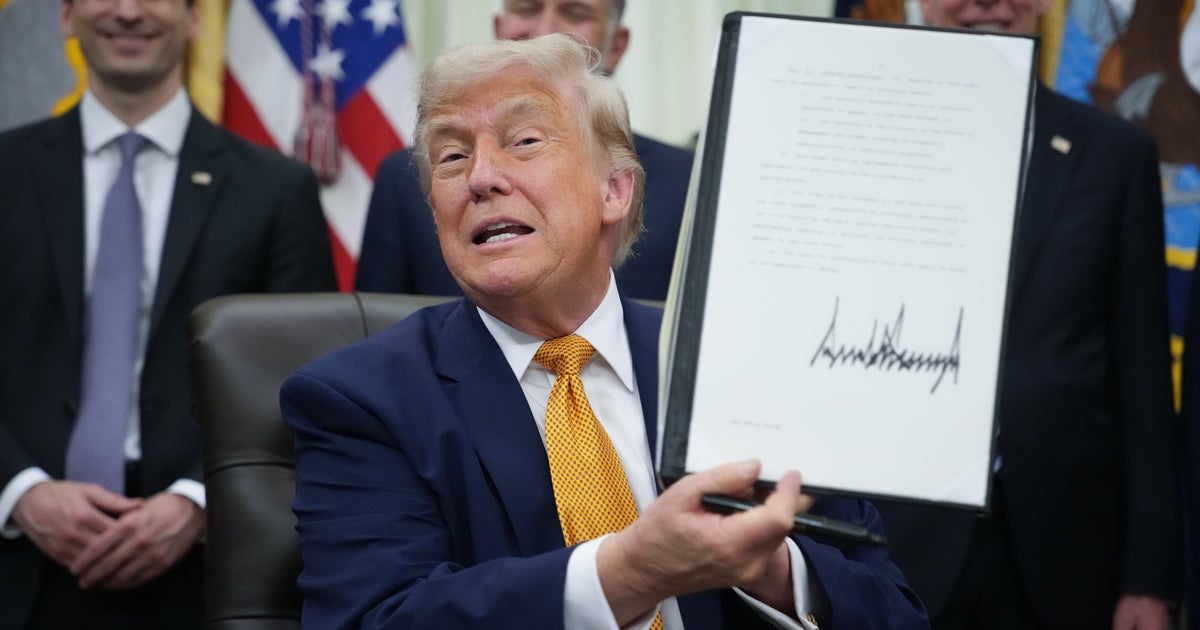

On Monday afternoon, President Donald Trump told reporters in the Oval Office that the United States has “the strongest economy we’ve ever had” ― but economists aren’t exactly sure what the president is talking about.
When Wall Street Journal reporter Philip Wegmann asked Trump if he was willing to risk an economic catastrophe in the war with Iran, Trump said, “Nuclear weapon supersedes depression.”
“The way we’re doing it, we have the opposite of a depression,” the president continued. “We’re doing really well. The numbers are incredible; the oil is at a level that nobody’s ever seen before; oil prices are way down.” (Oil prices have fluctuated due to the conflict in Iran, and dropped on Monday after the U.S. Treasury Department authorized Iranian crude sales through August.)
When Wegmann asked whether Iran has leverage, Trump said, “They’re gone,” while Americans are “setting records.”
“We have the strongest economy we’ve ever had,” he said. “We have 18 to 19 trillion dollars being poured into our country.” Trump does not specify what he is referring to in this statement, but has repeatedly claimed the U.S. has secured trillions of dollars in investment pledges from foreign governments since returning to office. The White House website, as of reporting, says it’s $10.6 trillion, although economists have also disputed that number.
Trump has said “we have the strongest economy we’ve ever had” multiple times across both presidencies. Last Wednesday, he said it at the Group of Seven (G7) summit in Évian-les-Bains, France. He also said it in the Oval Office in May 2019; at a Turning Point USA event in July 2019; and while campaigning in March 2020. The Washington Post estimated that he said some variation of the phrase at least 40 times in a three-month period during his first term in 2018.
The phrase has almost become a reflex for the president to detach whatever the economy is actually doing at any given moment, Jared Bernstein, an economist and former chairman of the Council of Economic Advisers during the Biden administration, told HuffPost.
“It’s not a recession, that’s for sure, but to a lot of people, it kind of feels like it,” Bernstein said. “Having the president say everything’s fine when large majorities of Americans are very clear that everything is far from fine in their economic lives — it’s a great way of talking past everyone.”
There is a disconnect between what Trump says and what Americans say about the economy. The costs of healthcare, housing and consumer goods like food are among Americans’ top economic concerns, a Pew Research study found in February. The general American view of the U.S. economy has been negative for the last six years, though; according to Pew, 49% of Republican-identifying survey participants now rate the economy more positively since the start of Trump’s second term.
“[Trump is] showing when it comes to the economy, he lives in this gilded castle, quite detached from how most people experience their economic lives,” Bernstein said.
Although the current economy is not in a disaster, the U.S. is not in a recession, let alone a depression; GDP and productivity are growing. But Justin Wolfers, an economist at the University of Michigan, told HuffPost this is not a standout achievement — it simply reflects how modern economies work.
“The eternal fact is that economies tend to grow,” he said. “With the exception of periods in recession, which is when the economy shrinks, it’s the nature of things that we have: More people employed every quarter. It’s also the nature of things that we tend to have higher prices each and every quarter as well.”
However, describing the economy as “the opposite of a depression” is inaccurate, Wolfers argued.
“There’s an honest conversation where you could say the world’s not as bad as many of the president’s critics suspect it is,” Wolfers said. But “by no means is this the opposite of a depression.”

The University of Michigan Consumer Sentiment Index plunged to a historic low in May, reflecting economic stress driven by inflation, tariff concerns and rising energy prices. While it increased by 9% in June, it’s still about 19% lower than a year ago.
Joanne Hsu, the director of surveys, said in a statement that the general view of the economy is “relatively dour” and that Americans are “burdened by the recent escalation in inflation and worry.”
“It looks great for Elon Musk right now, but if you’re a young person trying to buy a house, it looks pretty tough,” Bernstein said.