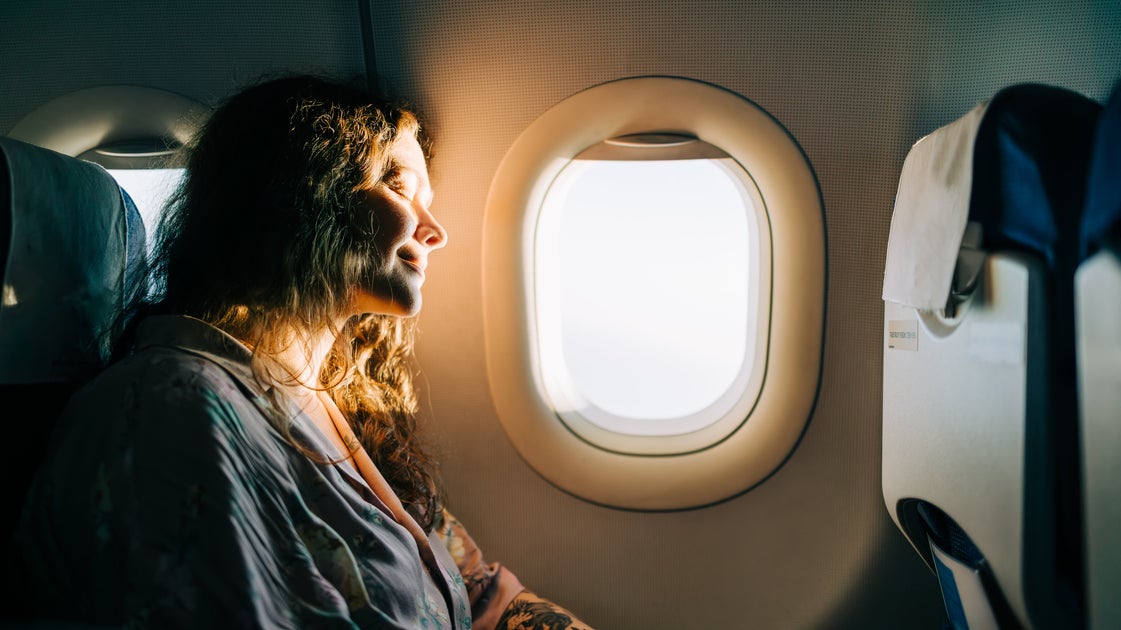

Certain air travel rules are well-known and straightforward. Keep your seat belt fastened, stow your tray table for takeoff and landing, put your seat in the upright position and other such instructions are almost second nature to frequent flyers.
But one area where the rules seem to be all over the place ― and where passengers seem most confused ― is window shades. Sometimes, flight attendants ask you to close them. At other times, the request is to keep them open. And on many flights, nobody mentions them at all.
“In many parts of the world, open window shades during takeoff and landing are required by airline operating procedures and are widely considered an industry best practice,” Yuvraj Datta, the chief supply and revenue officer at the travel tech company Fareportal, told HuffPost. “The primary reason is safety. Open shades allow flight attendants and passengers to quickly assess outside conditions ― such as fire, smoke, debris, water or other hazards ― if an emergency occurs.”
From a safety perspective, the beginning and end are the most critical phases of flight. Boeing’s latest data shows that roughly 70% of fatal aviation accidents occur during takeoff, initial climb, final approach and landing.
In the case of an emergency, visibility can be incredibly valuable, noted Jay Robert, a senior flight attendant and the founder of A Fly Guy Travels.
“If we’re placed on alert, one of our primary responsibilities is to evaluate what’s happening outside before opening an exit,” he said. “The viewing windows built into aircraft doors are often very small and provide only a limited view. That’s why cabin crew are trained to use the passenger windows to assess conditions around the aircraft. For example, if I’m working at the front of the cabin and we’re instructed to prepare for an evacuation, I’ll use the passenger windows to look back toward the engines to check for fire, smoke, leaking fuel or whether an engine is still running.”
If the crew determines a particular exit isn’t safe or has external obstacles, they’ll block it and redirect passengers to usable exit points.
“Let’s say there’s an engine fire on the right side of the plane,” said Dan Bubb, a former airline pilot and professor in residence in the honors college at the University of Nevada, Las Vegas. “The flight attendants have to be able to look out the window to see that so they can evacuate everybody on the left-hand side.”
Another important factor is improving passengers’ vision in an emergency situation.
“If the cabin lights are on during landing but fail in an emergency, open window shades can help passengers’ vision adjust faster to ‘natural’ lighting conditions outside the plane,” said Henry Harteveldt, president and airline industry analyst at Atmosphere Research Group. “While this is important for all passengers, it is especially important for passengers sitting at over-wing exits and by exit/cabin doors.”
This practice is particularly helpful for nighttime situations as well.
“If you have to evacuate the plane at night, if you have the window shades up, your eyes are already adjusted to the darkness,” Bubb said. “So if you have to evacuate and you go out into the darkness, you’re not going to need any time to adjust. Otherwise, you could run into somebody, you could fall over something. You don’t want to injure yourself in that situation.”
Throughout your flight, you may notice the crew making changes to the cabin lighting for similar reasons.
“Cabin lighting is often dimmed for a nighttime departure or brightened during a daytime departure so that the lighting inside the cabin more closely matches the conditions outside,” Robert said. “If an evacuation were necessary and passengers needed to assess conditions before opening an over-wing exit, their eyes would already be adapted, making it much easier to see hazards outside.”


Olga Pankova via Getty Images
Passengers can play an important role when it comes to aviation safety, even beyond simply following instructions.
“There have been numerous occasions where passengers have spotted smoke, fuel leaks, damage or other abnormalities outside the aircraft and immediately alerted the crew, allowing action to be taken more quickly,” Robert said.
“Open shades during takeoff and landing expand the number of eyes on the exterior of the aircraft,” echoed AirAdvisor founder and CEO Anton Radchenko. “If something develops on an engine at rotation, a window seat passenger will often identify it before any instrument registers it. Crew cannot monitor the aircraft exterior from inside the cabin. During those phases, passengers function as part of the situational awareness system, whether they’re aware of it or not.”
It’s not just about seeing out of the plane but seeing in as well. Keeping the window shades up during critical moments can also assist personnel on the ground.
“Open window shades also help firefighters and emergency responders assess conditions inside the cabin from outside the aircraft, allowing them to identify smoke, fire or injured passengers more quickly,” Robert said.
So the open-shade rule makes sense for takeoff and landing, during the phases of flight when risk is greatest. But what about during the rest of the flight?
“Some airlines ask passengers to close their window shades on longer flights when the sun is shining brightly and people may want to sleep, rest or watch movies or other entertainment programming,” Harteveldt said.
He added that this tends to be optional, so window seat passengers may keep their shades open during the cruising portions of the flight if they prefer (though this sometimes creates conflict with seat mates).
“Closed shades help keep the cabin cooler by reducing heat from direct sunlight, minimize glare on entertainment screens and create a darker, more relaxing environment for passengers who are trying to sleep,” Robert said.
Anyone who has experienced a ground delay in peak temperatures knows the value of reducing the heat from the sun on the plane.
“Delta flight attendants sometimes ask customers to lower window shades before deplaning, especially during hot summer months,” a representative for Delta Air Lines told HuffPost. “When a plane is parked at the gate, direct sunlight can quickly heat up the cabin. Lowering the shades helps keep the interior cooler while the aircraft is powered down or waiting for the next boarding ― ultimately reducing the load on the aircraft’s air conditioning systems and making boarding more pleasant for the next group of travelers.”
The rep noted that this is not a formal policy but rather “a common operational courtesy” based on weather and airport conditions. Certain aircraft features can impact window shade practices as well.
“On long-haul flights, many airlines use sophisticated cabin lighting programs designed to help reduce the effects of jet lag,” Robert said. “Modern aircraft feature advanced LED lighting systems that gradually change throughout the flight to support passengers’ natural body clocks, and keeping the window shades closed during certain periods helps those lighting programs work more effectively.”
As many passengers have noticed, window shade policies vary significantly by airline and country, which leads to confusion as the rules seem to shift from flight to flight.
“Having worked in the United States, the Middle East and now Europe, I’ve found that U.S. airlines often give passengers more flexibility with certain cabin procedures than European carriers,” Robert said. “It’s not unusual for passengers connecting from a U.S. airline onto a European airline to question our instructions by saying, ‘They let me do this on my last flight.’”
Passengers also mix up window shade policies around takeoff and landing with the cruising portion of the flight.
“Closing shades mid-flight comes down to comfort, rather than safety,” Radchenko said. “These two instructions get conflated regularly, and that confusion explains most of the pushback crew get on the takeoff rule. Passengers treat it as the same kind of preference call when the reasoning behind each may have nothing in common. The friction almost always traces back to the same gap ― the passenger reads the instruction as arbitrary, and crew running a full pre-departure checklist don’t have space to explain the operational reasoning behind it.”
Still, he believes the pushback disappears once passengers understand the actual purpose of the open window shade.
Robert observed that on many airlines in the U.S., the instruction to keep the window shades open during takeoff and landing seems “more like a suggestion” than a strict requirement for safety reasons.
“I’ve frequently taken off and landed on U.S. carriers with the window shades closed,” he said. “Outside of the U.S., however, it’s much more common for airlines to require window shades to be open during takeoff and landing.”
In Europe and Asia, there are more explicit policies around window shades, but commercial aviation in the U.S. is more lax in this department. And while there is no FAA regulation requiring shades to be open, flight attendants may ask passengers ― especially those seated in exit rows ― to keep them up during takeoff, landing or other critical moments.
The sense of inconsistency frustrates even aviation experts.
“It honestly drives me crazy when I fly,” Bubb said. “I wish airlines were more consistent. Also, I like to be able to see when we’re actually going to touch down on the runway because it allows me to brace for a hard landing so that my body doesn’t feel the full impact.”
Whatever your preference for window shades, the important thing is that you pay attention to flight attendant instructions.
“Just because something was permitted on one airline doesn’t mean it’s permitted on another,” Robert said. “Cabin crew aren’t making up rules or trying to inconvenience anyone. We don’t negotiate with safety procedures. They exist because they’ve been developed through decades of accident investigations, certification testing, research and real-world experience, all with one goal: protecting everyone on board.”
Paula S. Adams, a former crew member for Etihad Airways who now works as a private flight attendant, emphasized the importance of trusting the trained safety professionals on board and the research-backed procedures airlines employ.
She put it simply: “If a crew member asks you to open or close your shade, there’s usually a practical reason behind it, even if it’s not immediately obvious.”