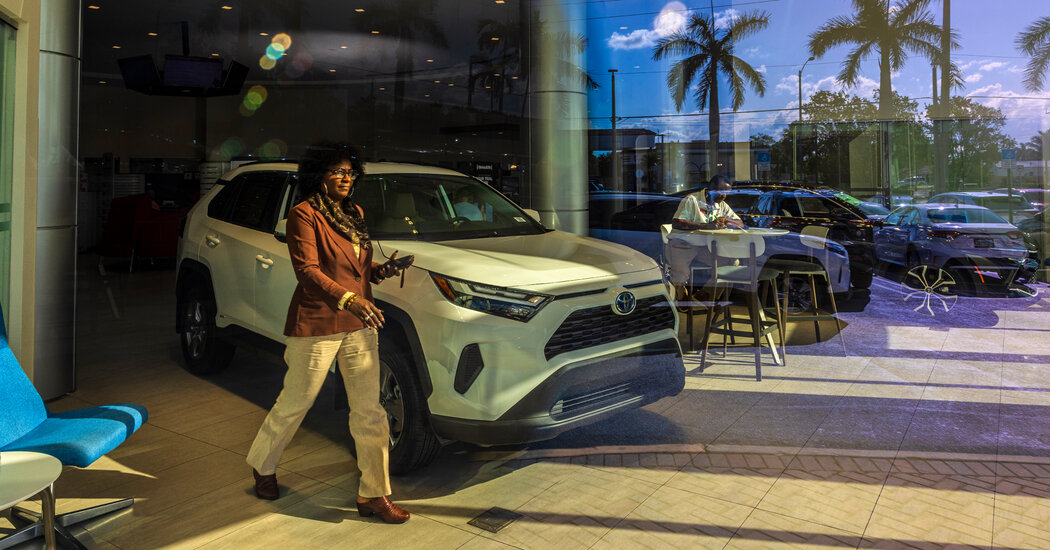

In today’s high-tech, high-stakes auto industry, fortunes can change quickly, and there’s no better example of that right now than Toyota Motor.
Not long ago, it looked as if Toyota had fallen dangerously behind in electric vehicles. Tesla, the electric car pioneer, has grown rapidly and become the world’s most valuable automaker. Seeing Tesla’s success, other companies, such as General Motors and Ford Motor, concluded that large numbers of consumers were poised to switch to battery-powered cars and trucks and began investing tens of billions of dollars to catch up.
Toyota, however, was more deliberate — or lethargic, its critics would say. It has introduced just two fully electric models in the United States so far, betting that its gas-electric hybrids and plug-in hybrid vehicles, which it has become known for, would remain popular and were sufficient to address climate change for now.
Amid all the enthusiasm for electric vehicles in the last few years, it seemed Toyota just didn’t get it.
“I was shocked when I first heard about Toyota’s strategy because I could see what Tesla was doing,” said Earl Stewart, a Toyota dealer in Lake Park, Fla., who also enjoys driving his Tesla Model S.
But in the last six months, sales of electric vehicles have slowed, and American car buyers looking to cut their fuel bill and tailpipe emissions have been flocking to hybrids. Now Toyota’s sales are booming, and the company is reporting huge profits.
“It’s not the first time Toyota has proved me wrong, and it won’t be the last, either,” Mr. Stewart said.
Toyota’s sudden strength is a reminder of how profoundly the auto industry is changing. Developing technologies like electric vehicles, advanced microchips and software are turning what was once a steady, slow-moving sector into a dynamic industry in which even fast-moving and well-run manufacturers can be knocked off course.
Toyota, a Japanese company, is the world’s largest automaker; it sold more than 11 million vehicles in 2023, more than six times as many as Tesla. The company climbed the ranks of the industry slowly over a half century, first exporting small cars to the United States, then building factories across the South and Midwest, adding a luxury brand and expanding into the segments dominated by its Michigan-based rivals, like full-size pickup trucks.
A few times along the way, Toyota has bucked the industry’s conventional wisdom. The introduction of its upscale Lexus brand, in 1989, seemed like a risky bet until it zoomed ahead of BMW and Mercedes-Benz in sales. Twenty-one years ago, Toyota introduced the Prius, a small car with a compact gasoline engine and an electric motor powered by a battery.
The combination allows the Prius to go 50 or more miles on a gallon of gas, and a plug-in hybrid model can make short trips without using any gasoline. Other automakers dismissed the car as a curiosity, but the Prius was a hit, and before long G.M., Ford and others developed their own hybrids.
Tesla’s chief executive, Elon Musk, scorns hybrids, saying it makes no sense to have two propulsion systems under the hood. Consumers don’t seem to care. Toyota offers more than two dozen hybrid or plug-in hybrid models, and they make up almost 30 percent of its sales, much higher than at most other automakers. Last year in the U.S. market, Toyota sold 2.2 million vehicles — more than every automaker except G.M.
In January and February, Toyota’s U.S. sales rose 20 percent, powered by an 83 percent rise in sales of its hybrids and plug-in models.
“We’re not saying E.V.s are not a good solution to carbon emissions,” said Jack Hollis, executive vice president of Toyota’s North American arm. “They are. They’re just not the only solution, and a lot of our customers have been telling us they want choice — hybrids, plug-ins, and E.V.s.”

The strategy is paying off. In the nine-month period starting last April, Toyota made $27 billion in profit, roughly double its earnings from the same period a year earlier. By comparison, Tesla’s $15 billion profit in 2023 was about 19 percent higher than its 2022 figure.
Investors have taken notice. The stock market now values Tesla at less than half its peak market capitalization of $1.2 trillion in November 2021 in large part because its sales are growing more slowly and the profit it makes on each car has been falling. Over the same period, Toyota’s valuation has risen by roughly a third, to about $400 billion.
Mike Ramsey, an analyst at the research firm Gartner, said Toyota’s hybrid strategy is strong and based on long-term logic, but shifts in technology or the market could undermine the company’s future performance and standing.
“Toyota seems to swing between dullard and genius, depending on the current state of thinking about technology,” he said. “But no matter what, they still seem to sell more cars and trucks than anyone else.”
One big market where Toyota is struggling is China, the world’s largest car market. A lot of Chinese car buyers are opting for electric vehicles, helping domestic automakers like BYD gain market share from Toyota, Volkswagen and other foreign manufacturers.
Toyota has other problems, too. The company’s Daihatsu subsidiary, which makes small cars, temporarily stopped all production in Japan in December after revealing that it had cheated on safety tests.
For now, however, Toyota’s deliberate pace seems to be working overall and several other large automakers have moved closer to the company’s path.
Mercedes-Benz, which had been hoping to phase out internal combustion models by 2030, said last month that it had pushed that goal back by at least five years. Ford has lowered production targets for electric vehicles and is slowing construction on plants that are supposed to produce batteries for electric vehicles.
G.M., which had stopped selling hybrids in the United States to focus on electric vehicles, has delayed the introduction of a few battery-powered models. It is also now planning to reintroduce hybrid and plug-in hybrid models, which dealers had pushed for.
“Deploying plug-in technology in strategic segments will deliver some of the environmental benefits of E.V.s as the nation continues to build its charging infrastructure,” G.M.’s chief executive, Mary T. Barra, said in February.
Electric vehicles have so far failed to win over many car buyers because they are generally more expensive than combustion or hybrid models even after taking into account government incentives. The challenges of charging electric vehicles, worries about range and their performance in cold weather have also caused some people to hesitate.
Hybrids don’t face many of those issues. Some hybrids cost only a few hundred dollars more than similar gasoline cars — a premium that owners can quickly recoup in fuel savings. In addition, regular hybrids never have to be plugged in.
Plug-in hybrid models, some of which can travel on just electricity for more than 40 miles and have a gasoline engine for longer trips, have much smaller batteries than electric vehicles and can be recharged relatively quickly. But these vehicles, which make up a small part of the market, may not be as beneficial financially or environmentally when driven long distances on just gasoline.
Toyota has plans to significantly increase hybrid production and sales. A hybrid version of its Tacoma pickup is rolling out. A redesigned Camry sedan, due this spring, will be available only as a hybrid.
The company will offer a range of electric vehicles, too, said Mr. Hollis, the Toyota executive. About 30 models will arrive by 2026, when Toyota hopes its U.S. electric vehicle sales will have risen to about 1.5 million vehicles a year. Last year it sold about 15,000.
In Florida, new Toyotas that arrive at Mr. Stewart’s dealership in South Florida barely hit the lot before they are sold. At the beginning of March, he had only about 150 vehicles in inventory, down from the 500 he used to carry before the pandemic.
That hasn’t deterred customers who have become accustomed to waiting months after ordering vehicles. At one point last year, he had 1,300 vehicles on order, and customers for all of them.
“I’ve been selling Toyotas since 1975, and business is better than ever,” he said. “People are lining up to buy from me.”