
In late 2022, I was invited to go to Ghana with a friend researching work by the Ghanaian artist Ibrahim Mahama, who first made a splash at the 56th Venice Biennale in 2015. We were going to Ghana to learn about the context of his work and also to understand the emerging contemporary art scene in the country.
Over the past few decades, the art world has opened up beyond Europe and North America to create a more globalized market. In recent years artists like Mr. Mahama, and the fellow Ghanaians El Anatsui and Amoako Boafo have risen to prominence. We wanted to learn how that attention had affected contemporary art in Ghana.
We planned to spend most of our time in Accra, the capital and where most of the country’s established galleries are, and then to travel north, first to Kumasi, home to the country’s prestigious Faculty of Art at Kwame Nkrumah University of Science and Technology (KNUST) and the former seat of the Ashanti Kingdom, and then even further north still, to Tamale, where Mr. Mahama has opened several sites for contemporary art.
Touring Accra’s galleries
Our on-again, off-again home in Accra was the Accra City Hotel, which we chose because it has a swimming pool, was within our budget and is centrally located. We soon learned, however, that in Accra, “centrally located” doesn’t really exist. Getting oriented wasn’t exactly easy — or even possible. Public transportation is nonexistent, and we couldn’t make heads or tails of the speedy, privately owned minibuses known as tro tros (we were told that Accrans “just know” where they are headed). Since most days were over 90 degrees, Uber and taxis were our best bets for getting around.
The morning of our first day, we drove to the Nubuke Foundation, a small institution known for exhibits of works by Ghanaian artists. The taxi dropped us in front of a long gate that opened to low, concrete buildings hung with Asafo flags, the colorful regimental flags belonging to the Fante people, a Ghanaian ethnic group. It smelled of heat and greenery. An exhibition, “Like a Memory of Night,” showed work by Sika Amakye, a young Ghanaian artist who employs traditional beading traditions passed down matrilineally. Her sculptures, composed of curtains of brightly colored beads and fabricated limbs, were eloquently arranged throughout the Brutalist building.
From Nubuku we went to the Noldor Artist Residency, which hosts several artists at a time. The Noldor building is striking and has exhibitions and active studio spaces where the artists generously allowed us to interrupt their days and chat about art.
We ended our day at Dikan Center, the country’s first photography gallery, where an exhibition about Ghana’s 1957 liberation from the British was on view. Black-and-white photographs of the revolution’s key players, including the Ghanaian nationalist leader and later president Kwame Nkrumah, lined the walls alongside images of smiling schoolchildren, soldiers and archival newspapers. The space is small but tranquil, which gave the historical photographs room to breathe.
For two vegetarians, Ghanaian food wasn’t the easiest. After filling up on fruit and yogurt at breakfast, lunch could be a bit of a tossup. Some days we had wraps at Vida e caffe, an African chain; others, we went to the Purple Café in Osu, a hip neighborhood to the east of our hotel. Searching for reliable food, we ate multiple dinners at Abyssinia Ethiopian Restaurant, Pomona, and Bistro 22, all in Labone, the center of expat life in Accra.
Other days were devoted to Accra’s past, spending time in Jamestown, its historical center, climbing up Black Star Gate, a monument commissioned by Nkrumah to mark Ghana’s independence with our guide, Salia Amara of Yenko Ghana Tours. There were also food markets to visit, as well as the W.E.B. DuBois Centre for Pan African Culture and the National Museum, and the hotel pool to relax by.
Mr. Amara also took us to Erico Carpentry Shop to see the abeduu adekai, or proverb boxes, fantastical handmade coffins that are designed to reflect the interests of the deceased. We saw pink fish, gleaming airplanes and chile peppers. Under commission was a taxicab for a New Yorker who had initially ordered a coffin in the shape of the Guggenheim Museum, which, we all agreed, was not a particularly comfortable eternal resting place. The coffin-maker Eric Kpakpo Adotey walked us through the process and regaled us with stories from his apprenticeship. Here was art that felt rooted in the country even as it was being sold abroad.
Kumasi, Ghana’s second city
On a Tuesday afternoon, Africa World Airlines flight 108 landed promptly at Kumasi’s small, immaculate airport. There was only one check-in desk, and the baggage claim was a single, eight-foot track.
We had flown to Kumasi to visit the Department of Painting and Sculpture at KNUST, an expansive campus in the west of the city and probably the greenest university I have ever seen. The department serves as the hub for blaxTARLINES, a platform for artists, curators, and teachers who together have radically reshaped how art is taught, envisioned and conceived at KNUST — and thus in greater Ghana.
The name is a nod to Marcus Garvey, the activist and political leader who helped to establish the Pan-African activist organization, the Universal Negro Improvement Association & African Communities. As part of the organization, Garvey founded the short-lived Black Star Line shipping company.
Kumasi may be Ghana’s second largest city, but there is little tourist infrastructure. A driver from our hotel met us at the airport, and we sped to the Golden Bean, arriving at the hotel complex and tropical garden. We were pleased to find that the double room we had booked came with a sitting room, and that the staff was some of the kindest that we encountered in all Ghana. Given our dietary requirements and the heat, we ate most meals at the hotel, and everyone made sure we were well fed. It was at the Golden Bean that we were introduced to kelewele, a spicy dish of fried plantains served with peanuts, which was a delicious mix of sweet and fiery.

Under the leadership of Prof. karî’kachä seid’ou, KNUST has become the country’s pre-eminent art department with more than 500 students. The curriculum encourages students to find their own venues in and around Kumasi, be that an abattoir or an auto repair shop, so that their art becomes part of the city.
Exhibitions are spontaneous affairs, publicized on social media, the department’s website and blaxTARLINE’s Instagram account, though visiting the student studios felt a bit like an exhibition itself. We saw Piloya Irene’s pulverized bark sculptures, Dennis Addo’s painted curtains and Gideon Hanyame’s textiles woven from water filter nets. People moved in and out of each other’s studios chatting and helping to show work in various stages of completion.
Not wanting us to forget Kumasi’s rich cultural history — it has been the capital of the Ashanti empire since the 17th century — Kwaku Boafo Kissiedu, a senior lecturer at KNUST, took us to visit the Kente weavers in the nearby town of Bonwire. These textiles were historically worn by royalty but are now used to mark celebrations and special occasions; each pattern has a different meaning. Men work the looms at almost incomprehensible speeds, and from the buildings in Bonwire hang woven cloths of kaleidoscopic color.
Tamale, home of Ibrahim Mahama
Although home to more than 300,000 people, Tamale feels small, more remote. The climate is tropical, and the lush road in from the airport was dotted with round mud huts interspersed among the houses and fields of grazing cattle. There are few hotel options, and we stayed at Little Afrika Lodge, which had been recommended to us by members of Mr. Mahama’s studio. The small, family-run inn is convivial, with most of the guests visiting Tamale for research projects. The rooms are spare and pristine, though the mattresses were so hard we checked to see if they were actually wood planks.
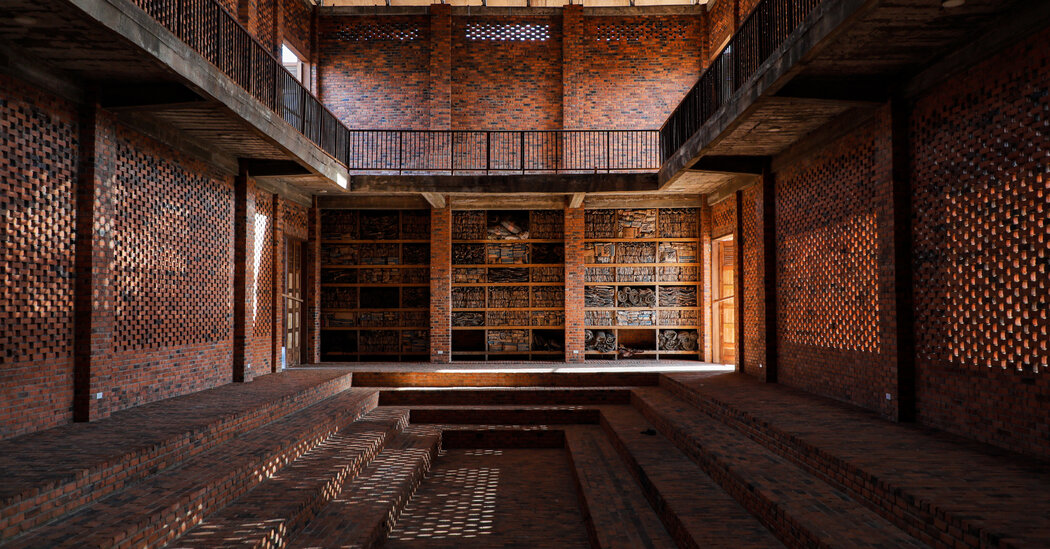
Mr. Mahama, who is known for his monumental installations often using discarded objects, is the reason Tamale now has an art scene: Over the past few years, he has funded the construction of the Savannah Centre for Contemporary Art, a project-space and research hub; the stunning expansion of his studio known as Red Clay; and Nkrumah Volini, which is housed in a defunct grain silo and, pending renovations, will serve as an extension of SCCA.
Save for the car we took in from the airport, the rest of the time we hopped tuks tuks, which Ghanaians call yellow yellows, to get around Tamale. We zipped over to SCCA first, a soaring, open space. Although it was between exhibitions, the door was open, and we were invited inside to look around the building and at the upcoming installation. There is a rotating program of exhibitions and events, and each year features a retrospective by a Ghanaian artist.
SCCA may resemble the spare, white-walled galleries of New York or London, but Selom Kudjie, the director, assured us it is far from a duplication of the Western gallery model. “The base of what we do is arts education, but not purely for art,” he said. “We want artists to be brave because art making is not an island.”
The apex of this anti-island vision is Red Clay, Mr. Mahama’s studio, though that is far too reductive a description. The complex houses brick-latticed spaces showing some of Mr. Mahama’s best-known installations including “A Grain of Wheat,” for which several hundred upright medical stretchers lean against the gallery walls. Instead of fabric slings between their poles, they have materials sourced from West African fish smokehouses. Nearby is “Non-Orientable Nkansa,” a mammoth structure built from the boxes used to hold tools for polishing and repairing shoes, which Mr. Mahama created with migrant workers.
There is also a rotating program of exhibitions; a cinema used for dance performances, community meetings and graduations; and an array of decommissioned railway carriages and airplanes, some of which have been transformed into classrooms. The planes are also an attraction in themselves, serving as a backdrop for Instagram shoots and drawing people to Red Clay who otherwise might not have visited. Everything is free and marketed by word of mouth.
Other institutions are beginning to crop up, notably, Nuku Studio in the city center. The building was formerly home to a newspaper printing factory and inside the long hall was the exhibition “A Retrospective: Northern Ghana Life.” Video and photography by international artists filled the industrial space, together presenting a portrait of the region, considering the production of shea butter, Dagomba rituals and Tamale’s middle class, among other subjects.
Part of the appeal of SCCA, Red Clay and Nuku Studio is their deep attachment to Ghana. Mr. Kudjie and Mr. Mahama, like the faculty at KNUST, want people outside the art world to be involved in growing these institutions and they try as much as possible to include local communities in their plans. The aim, explained Mr. Kudjie, is not to compete with the global art world but rather to “build a certain art history locally.” And that is how the most successful arts spaces in Ghana felt. Process is integral to the work and programming isn’t determined by the West’s agenda.
We spent more than two hours wandering around Red Clay, investigating the airplanes and speaking with Mr. Kudjie and other staff members. Conversation — getting to know people — and chance discovery were as much the point as any of the art itself, and people there were happy to show visitors around and to talk about the works on view. Toddlers crawled around in the shadow of Mr. Mahama’s installations. Two people snapped pictures under an airplane’s wings.
Red Clay is a bit of a drive from Tamale center and our yellow yellow didn’t want to wait around while we explored. The thick, airless sky turned dark as it began to rain, and we hopped in Mr. Kudjie’s van for a ride home.
Follow New York Times Travel on Instagram and sign up for our weekly Travel Dispatch newsletter to get expert tips on traveling smarter and inspiration for your next vacation. Dreaming up a future getaway or just armchair traveling? Check out our 52 Places to Go in 2024.