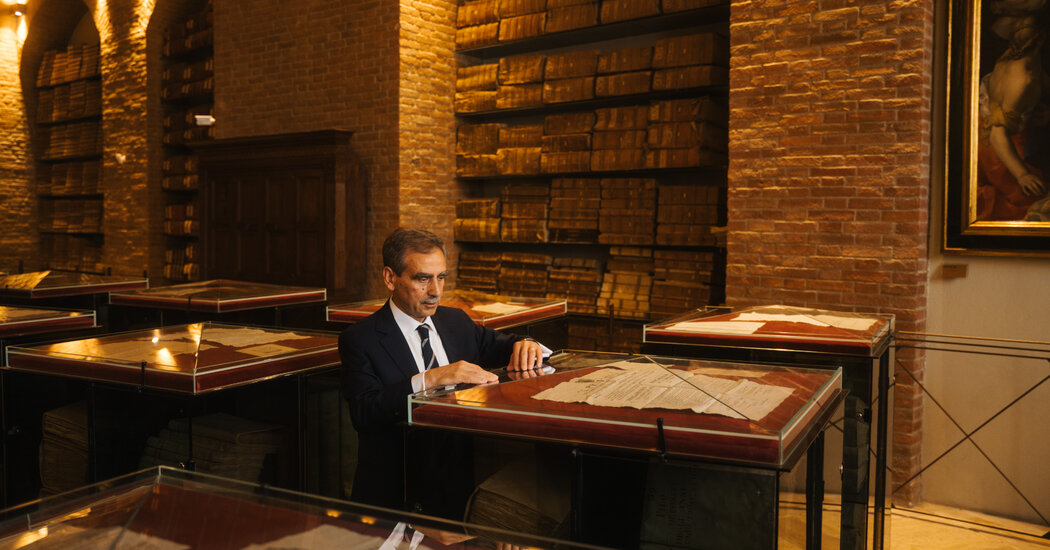

Banca Monte dei Paschi di Siena is the world’s oldest bank. It has survived the rise and fall of the Medici, regional and world wars and its own near-death experiences — including a 5.4-billion-euro bailout in 2017 and a derivatives scandal that made the lender a byword for mismanagement.
But under Luigi Lovaglio, the chief executive, who was recruited by the Italian government in 2022 to engineer a turnaround, Monte dei Paschi has grown into one of Europe’s healthiest financial institutions. Now, it’s a takeover target.
Sitting in Palazzo Salimbeni, the bank’s fortresslike 14th-century headquarters in Siena’s historic center, Mr. Lovaglio reflected last week on the bank’s latest challenge. The Tuscan lender is being pursued by its biggest rival in an increasingly combative contest.
“I’m working around the clock to find the best solution,” said Mr. Lovaglio, who survived a bruising board battle this spring to stay on the job.
In June, the ball started rolling when Milan-based Banco BPM proposed a “merger of equals” with Monte dei Paschi. The next day, Intesa Sanpaolo, Italy’s biggest bank, announced a hostile €35 billion ($40 billion) cash-and-shares takeover bid for Monte dei Paschi, which has some €240 billion in assets on its balance sheet.
The Intesa plan is somewhat convoluted. It involves teaming up with Unipol, an Italian insurer, which would acquire roughly half of Monte dei Paschi’s branch network — some outposts still operate in tiny Tuscan towns, including on the island of Giglio — cleaving the Siena name off the door. Intesa is after Monte dei Paschi’s crown jewels: its Mediobanca investment bank and wealth management unit, and its stake in Generali, the $77 billion insurer.
Monte dei Paschi acquired those assets last year in a stunning David-taking-over-Goliath bid of its own. Further complicating things, Banco BPM said in a statement on Friday that it had terminated merger discussions with Monte dei Paschi, putting the talks in limbo.
“It’s definitely got a ‘Game of Thrones’ quality to it,” Johann Scholtz, a banking analyst at Morningstar, said of the competing interests lining up for Monte dei Paschi.
While European politicians, regulators and banking officials are fixated on the Italian lender UniCredit’s swooping in to buy Germany’s Commerzbank — a hostile advance that briefly grew into a diplomatic spat between Rome and Berlin — a consolidation frenzy is remaking Italy’s domestic banking sector.
Europe’s banks are growing at the healthiest clip since before the 2008 global financial crisis, powered by years of high interest rates, a surging stock market and bumper wealth-management fees. But protectionist tendencies remain entrenched in national capitals. That’s despite a push by the European Union and Mario Draghi, a former European Central Bank president and an ex-prime minister of Italy, to encourage consolidation across borders and industries. Only then, he argued, can Europe think of building superbanks to better compete with American behemoths like JPMorgan Chase and Goldman Sachs. (JPMorgan is an M.&A. adviser to Intesa.)
Italy has embraced the idea of combining financial institutions. “Italy’s banking sector is on the brink of a new M.&A. era,” analysts at S&P Global Ratings, a ratings firm, wrote in a report in June after the Intesa bid was announced.
Much more than a bank
The prospect of a takeover of Monte dei Paschi, founded in 1472, has sent shock waves through Tuscany. The people of Siena, including the mayor, have come out especially hard against the Intesa bid, fearing it would mean the beginning of the end for their beloved bank.
For ages, the bank has been the region’s primary employer and a major backer of local enterprise. Its once-powerful charitable foundation funded social services, community organizations and the arts, including a hospital expansion in Siena and the city’s famed Palio, a bareback horse race pitting rival neighborhoods against one another for winner-take-all bragging rights.
“Monte isn’t just a bank. It is history, it’s culture and the economy,” said Claudio Marignani, a retired Monte dei Paschi employee. In 2012, he founded Sena Civitas, a community organization. He has called for his fellow senesi, as the locals are called, to rally publicly to show their support for Monte dei Paschi’s independence.

“We have great faith in Lovaglio, and around Lovaglio, there is great support from the community,” Mr. Marignani said in an interview at a bar in the city’s main square, Piazza del Campo. “But there is also fear for jobs, and for the identity of Siena.”
The Roman Catholic church, too, has put the dealmakers on notice, saying any tie-up must protect the livelihoods of Italian families. Siena’s archdiocese wrote an open letter in July saying it will monitor negotiations, “trusting that even in market matters some degree of justice and charity is to be expected.”
Seeing the community rally around the bank is motivating, Mr. Lovaglio said. But ultimately the company’s fate lies in the hands of shareholders, the most powerful of which are far from Siena.
Contrasting world views
The senesi have been here before. Five years ago, the bank was a nationalized lender and on life support. A white-knight deal, brokered by Rome, fell through. Then, in February 2022, an official in the Draghi government asked Mr. Lovaglio to take the top job. “When I was asked, I made the decision in five minutes,” Mr. Lovaglio said.
Eight months later, he and his team pulled off a €2.5 billion capital-raise that finally put Monte dei Paschi on sure financial footing, lowering Rome’s stake from roughly 64 percent. (It’s less than 5 percent today.) Shares in the bank are up more than 475 percent since then, far outperforming the broader European banking sector.
In a banking career that spans six decades, Mr. Lovaglio, 70, has never seen anything like the merger mania gripping the sector, he said, or the reaction the Intesa bid has prompted.
He listed his and the board’s objections: The proposed buyout undervalues Monte dei Paschi, would break up the ancient bank’s branch network and would hobble competition in the lending and insurance sectors.
“How can you make an offer to break up the oldest bank in the world, a bank that was in the middle of a turnaround?” Mr. Lovaglio said, his voice rising only slightly. He continued, “I am concerned about too much concentration, and whether it would impede the growth of small and medium-sized businesses.”
Carlo Messina, Intesa’s chief executive, sees it differently. He told investors in June that the acquisition would create a European banking giant, and be a win for customers and shareholders. He said the Mediobanca unit would transform Intesa into “the Italian UBS,” a reference to the giant Swiss bank.
Mr. Lovaglio questions Mr. Messina’s pitch. He and the board haven’t decided their next move, but they have made clear they’re eager to explore an alternative tie-up. Until Friday night, Banco BPM was looking like Monte dei Paschi’s preferred match.
Even if they get the deal talks back on track, there’s another big player that could demand a seat at the table. Banco BPM’s biggest investor is the French lender Crédit Agricole.
On Friday, Clotilde L’Angevin, Crédit Agricole’s chief financial officer, told Bloomberg that the French bank was not going to sit by idly should Banco BPM and Monte dei Paschi pursue a tie-up.
“We’re not necessarily the ones who are going to decide,” she said, “but nothing can be done without us. And nothing can be done against us.”
Mr. Lovaglio won’t tip his hand as to the bank’s next move. But the drama playing out around the bank has reinforced his belief that “in order to be in a safe position, to be in a safe harbor, you should be bigger,” he said.
As the afternoon wore on, Mr. Lovaglio left his advisers behind for some air. He headed to Siena’s Palazzo Pubblico, the stately brick town hall that houses the famous 14th-century frescoes by Ambrogio Lorenzetti depicting the effects of good and bad government.
On one wall, the artist painted an orderly world where the allegorical figures of Justice, Temperance, Prudence, Strength and Peace stand watch. Next to it is a dire landscape. A devil-like figure presides over allegorical baddies, including Discord, War, Fraud and Anger.
Mr. Lovaglio said he was always moved by looking at Lorenzetti’s contrasting worldviews, the bleak versus the bright. “I find this really inspiring and motivating,” he said, staring intently as he considered his next move.