
The first time Dr. Peter Hackett saw a patient with frostbite, the man died from his wounds. It was in Chicago in 1971, and the man had gotten drunk and passed out in the snow, his fingers so frozen that gangrene eventually set in.
Dr. Hackett later worked at Mount Everest Basecamp, on Denali, Alaska, and now in Colorado, becoming expert in treating cold-weather injury. The experience was often the same: There was not much to do about frostbite, except rewarm the patient, give aspirin, amputate in severe cases and, more often, wait and accept that six months later the patient’s body might “auto-amputate” by naturally shedding a dead finger or toe.
His mentor in Anchorage used to say, “Frostbite January, Amputation July,” remembered Dr. Hackett, clinical professor at the Altitude Research Center at the University of Colorado’s Anschutz Medical Campus. “For centuries, there was nothing else to do.”
This month, the Food and Drug Administration approved the first therapy for treatment of severe frostbite in the country. The drug, iloprost, is given intravenously for several hours a day over a little more than week. It works by opening blood vessels to improve circulation, limiting inflammation and stopping the formation of platelet clumps that can stop circulation and kill tissue. Most at risk are a person’s toes, fingers, ears, cheeks and nose.
The approval of the treatment is as much scientific novelty as it is pharmaceutical industry moneymaking bonanza. Experts say there is not good data on how many people suffer severe enough frostbite to receive this therapy. But the cases could be as few as several dozens of people a year in the United States, according to Dr. Norman Stockbridge, head of the F.D.A.’s division of cardiology and nephrology in the agency’s Center for Drug Evaluation and Research, which approved the drug.
“When you get down to people who get really frostbitten and really at risk of losing digits, it’s pretty uncommon,” Dr. Stockbridge said. Still, “it’s better to have a drug for this than nothing.”
In fact, approval of the frostbite medication highlights an unspoken reality of the severe form of the injury: It’s rare.
Most at risk are high-altitude climbers, people who work outdoors without proper gear and people who are homeless, particularly those with poor circulation. Frostbite happens in “extremely cold temperatures,” according to the Centers for Disease Control and Prevention, with injury often occurring during the thawing process as vessels become damaged by clots and inflammation, strangling blood flow.
About two-thirds of overall frostbite cases are milder, sometimes known as frost nip, and are not likely candidates for this drug, according to Allison Widlitz, the vice president of medical affairs for Eicos Sciences, a startup in San Mateo, Calif., that received the F.D.A.’s approval to sell the drug. She estimated that the U.S. market for iloprost would be fewer than 1,000 people a year.
“Albeit a small market, this is an important new option,” she said. Eicos, which has seven employees, hasn’t set a price yet for the drug, Ms. Widlitz said.
Many infusion therapies for such rare conditions are very expensive. Treatment with iloprost would involve IVs for six hours a day, and up to eight days.
Ms. Widlitz added that the company was formed to explore iloprost and drugs for other unmet medical needs.
This is not the first use of the drug. An inhaled version of iloprost was first approved in 2004 by the F.D.A. to treat pulmonary hypertension. Over the last decade, the IV version has been approved for severe frostbite in many European countries after a French physician, Dr. Emmanuel Cauchy, showed its effectiveness in treating frostbitten mountain climbers.
Last year, a paper in The International Journal of Circumpolar Health, a publication devoted to health issues affecting people living in the Arctic Circle, found similar results in subsequent research. It noted that use of iloprost “demonstrated a decrease in amputation rates relative to untreated patients.”

By way of example, a paper in 2018, published in Wilderness & Environmental Medicine, examined treatment with iloprost in five Himalayan climbers and found that the drug prevented tissue loss in two of them, and limited tissue loss in two others. Those case studies found the drug effective when given 48 to 72 hours after onset of the injury, an important wrinkle because climbers often are not able to receive immediate treatment.
In cases where frostbite is caught more immediately, a stroke drug called tissue plasminogen activator, or tPA, can be used to limit clot formation and reduce the risk of amputation. However, that drug, if not administered within hours, can lead to severe complications and death. Unlike iloprost, tPA is not approved by the F.D.A. for severe frostbite, but doctors have resorted to it in an off-label way.
Dr. Hackett said the universe of people who suffer severe frostbite includes “mountaineers, snowmobilers getting stuck out, mushers, the military” and other people working in frigid conditions, along with those who are homeless and “people with drug and alcohol problems who are exposed to cold for long periods.”
This was how Jennifer Livovich, a resident of Boulder, Colo., who was homeless, contracted severe frostbite one extremely cold night in December 2016.
She remembered that she had been drinking heavily, and that the weather the day before was OK: “Then I woke up the next day, covered in snow, and my shoe had come off while I was sleeping — maybe I kicked it off — and my left foot was stuck to the ground.”
“I kept walking around and I could tell that my foot felt different, but I just thought I was cold,” she said. Five days later, she wound up in a detox unit, where, as she warmed and her foot thawed, “I experienced excruciating pain.”
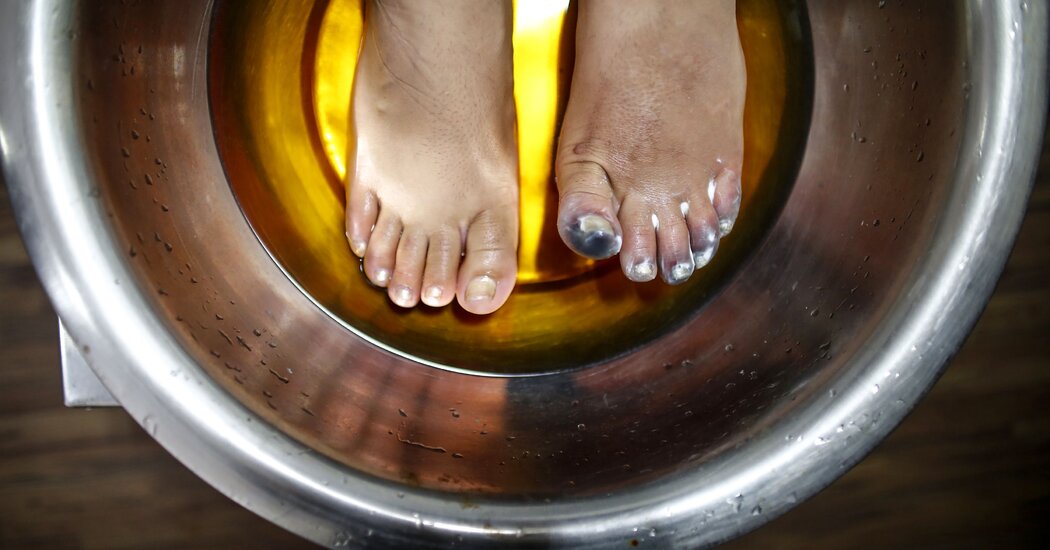
The thawing stage is when the damage starts to set in and capillaries deteriorate, sometimes beyond repair. “Different parts of my foot went from a black color to a light blue,” she said.
In a doctor’s care, she tried lukewarm water soaks and elevated her foot, putting gauze between her toes so rejuvenating skin cells would not fuse together. Chunks of skin fell off, and she lost all her toenails. When doctors were finally satisfied the foot had healed as much as it might, “they shaved — that’s what they call it, ‘shaved’ — a quarter-inch off my big toe,” she said.
The shaving occurred in the summer, roughly fitting the six-month timeline in the adage of Dr. Hackett’s mentor: injury in early winter and amputation by summer.
So as small as the market might be for the new drug, Dr. Hackett hopes it might save a few digits.
“It’s fabulous,” he said. “It might change the old adage.”