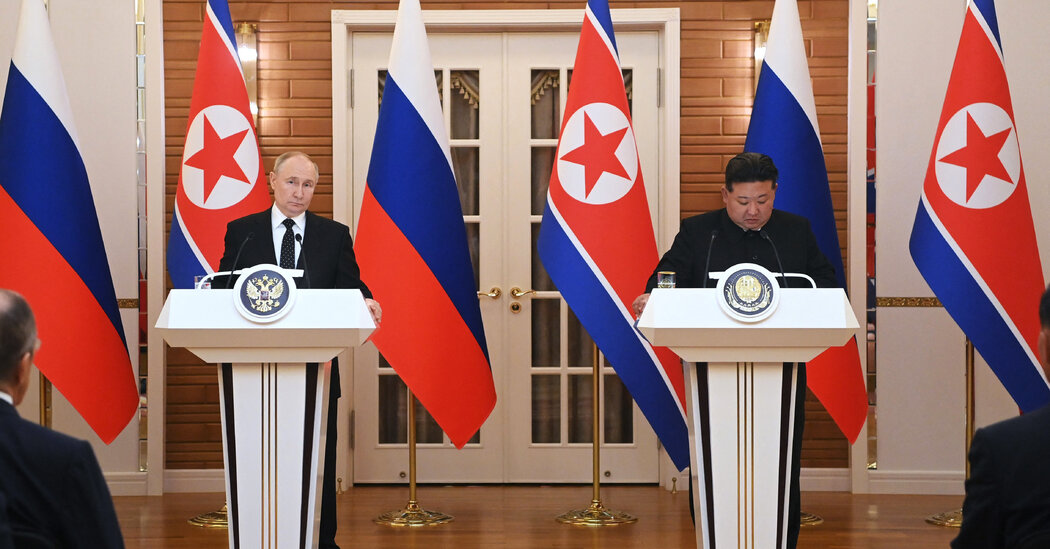

As Vladimir V. Putin’s Russia and Xi Jinping’s China deepened their confrontation with the West over the past decade, they were always united with the United States on at least one geopolitical project: preventing North Korea’s nuclear arsenal from growing, or becoming more accurate.
That is, until the war in Ukraine broke out two years ago.
In one of the starkest back-to-the-Cold War moments yet, Mr. Putin’s visit Wednesday to Pyongyang — and the announcement of a pact to provide “mutual assistance in the event of aggression” — underscored that efforts by the world’s three biggest nuclear powers to halt nuclear proliferation by North Korea had been dying for some time. Mr. Putin and Kim Jong-un, the North’s leader, just presided over the memorial service.
Mr. Putin did far more than drop any semblance of a desire to ensure nuclear restraint. He promised unspecified technological help that — if it includes the few critical technologies Mr. Kim has sought to perfect — could help the North better target its many adversaries, starting with the United States.
Nowhere in the statements made Wednesday was there even a hint that North Korea should give up any of its estimated 50 or 60 nuclear weapons. To the contrary, Mr. Putin declared: “Pyongyang has the right to take reasonable measures to strengthen its own defense capability, ensure national security and protect sovereignty” — though he did not address whether those measures included further developing the North’s nuclear weapons.
While the shift has been clear-cut, what it could portend is stunning. “This is a renewal of Cold War-era security guarantees, no doubt,” said Victor Cha, who worked on North Korea issues during the George W. Bush administration. He was referring to a now-defunct 1961 mutual defense treaty between Pyongyang and Moscow.
This time, however, the agreement “is based on mutual transactional needs — artillery for Russia and high-end military technology” for North Korea, he said, adding: “They are united not by ideology, as in the Cold War, but in common opposition to the U.S. and the Western liberal order.”
As the threat from North Korea grows, Mr. Cha said, the new pact is almost certain to solidify an increasingly formal security alliance between Japan, South Korea and the United States.
The Russians signaled what was coming 18 months ago.
Desperate for more artillery to press the war effort in Ukraine, Mr. Putin turned to Mr. Kim for some modest help with ammunition in late 2022. That trickle has now reportedly turned into a flood: five million rounds of ammunition, by the estimates of Western intelligence services, and a growing array of North Korea-made ballistic missiles, jammed into what the State Department said were 11,000 shipping containers full of arms.
It is a reflection of the fact that North Korea now has, for perhaps the first time in its history, a valuable bargaining chip that one of its allies in its standoff with the West needs: It is a prodigious arms producer.
At first, Mr. Kim was happy to receive oil and food in return. But in the intelligence assessments circulating in Washington and Europe, officials say, there is growing concern that the North Korean leader is now determined to surmount the last big technological hurdle in making his country a full-fledged nuclear weapons state — the capability to reach any American city with his nuclear weapons.
Russia holds the keys; the question is whether it is willing to hand them over.
“Russia’s need for support in the context of Ukraine has forced it to grant some long-sought concessions to China, North Korea and Iran,” Avril Haines, the director of national intelligence, told Congress in March, “with the potential to undermine, among other things, long-held nonproliferation norms.”

In closed, classified sessions, she was far more specific, taking key members of Congress through the array of technologies Mr. Kim has not yet shown he can master. Most of them involve keeping a nuclear warhead aloft for 6,000 miles and making sure it can survive, and accurately hit its target, on re-entry to the atmosphere.
That is the step a series of American presidents have said they cannot live with. Before the conclusion of this week’s meeting in Pyongyang, Mr. Cha wrote that the prospect of Russian help to the North “presents the greatest threat to U.S. national security since the Korean War.”
“This relationship, deep in history and reinvigorated by the war in Ukraine, undermines the security of Europe, Asia and the U.S. homeland. Amid front-burner issues like the wars in Ukraine and Gaza,” he contended, the “administration relegates this problem to the back burner at its own peril.”
Of course, Washington has faced so many warnings about the dangers of North Korea’s arsenal — dating to its first nuclear test 18 years ago — that it has become almost the background music of geopolitical upheaval.
A seemingly endless series of United Nations financial sanctions has failed to cripple either the nuclear expansion or the North’s closely related missile program. American efforts at sabotage have worked, but not for long.
So that leaves the United States dependent on the cold calculus of Cold War deterrence: reminding the North, with exercises of long-range bombers, that a strike on the United States or its allies would almost certainly result in the destruction of the country. But a credible security pact with Moscow would complicate that calculus, with its suggestion that Russia could potentially strike back on the North’s behalf. The terms of Wednesday’s agreement, however, were not clearly spelled out.
Mr. Putin’s announcements on Wednesday were also a reminder that North Korea’s continued success in pursuing nuclear weapons marks one of Washington’s greatest bipartisan failures. It began in the Clinton administration; faced with an emerging crisis with the North in 1994, the administration considered taking out its emerging nuclear program before it produced a single weapon.
President Bill Clinton pulled back, convinced that diplomacy was the better route — the beginning of three decades of on-again, off-again diplomacy. China and Russia helped, joining in the “Six Party Talks” with North Korea that sought to buy off its program.
When that collapsed, there were sanctions and a United Nations monitoring group that was supposed to make public evidence of sanctions evasion. When the monitoring operation came up for renewal at the United Nations recently, Russia led the charge to get rid of it.