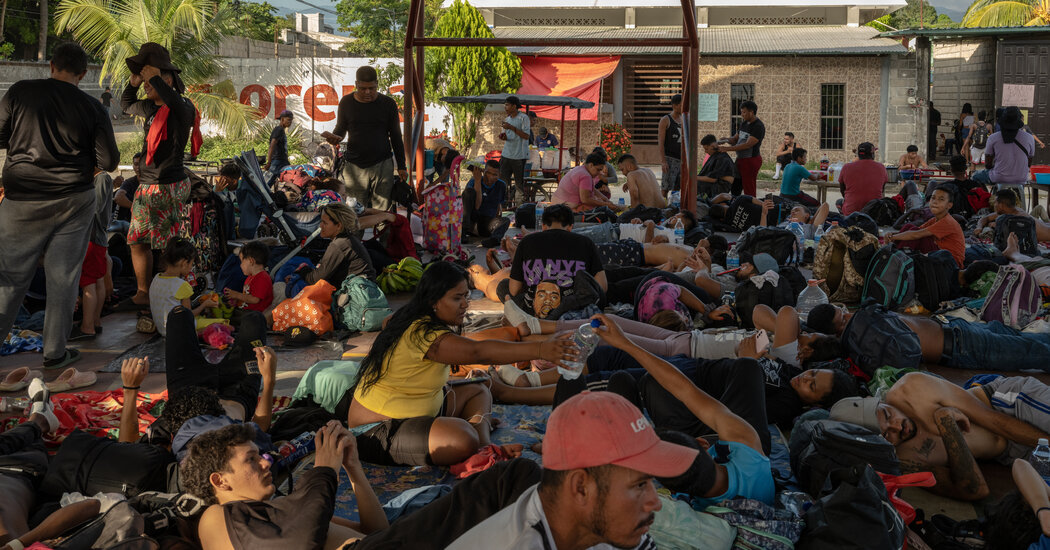

Crossings into the United States from Mexico have dropped sharply since last year. But countries south of the U.S. border are waiting nervously to see if President-elect Donald J. Trump orders mass deportations.
The possibility that millions of undocumented immigrants could be expelled — what would be the largest deportation program in American history — has sent shock waves through Latin America and sowed confusion among migrants and asylum seekers.
“We see dark times coming for the migrant community,” said Irineo Mujica, the Mexico director of People Without Borders, a transnational advocacy group. “Anyone who falls prey to the Trump administration is now going to be devoured, chewed up and spat out.”
What is the situation at the U.S.-Mexico border?
Mr. Trump has said that Mexico is allowing an “invasion” of migrants into the United States. But the current situation on the ground tells a different story.
Unlawful crossings at the U.S.-Mexico border have been declining since June, when President Biden issued an executive order to essentially block undocumented migrants from receiving asylum at the border.
That month, U.S. Border Patrol officials recorded 130,415 apprehensions of migrants — a sharp drop from the more than 170,710 recorded the previous month. The numbers in November were even lower: U.S. officials recorded 94,190 people.
That is a stark shift from a year ago. Illegal crossings for November 2023 rose above 242,300, a record at the time.
How have the U.S. and Mexico reduced crossings?
Critics who argue that asylum is legal and a basic human right say Mr. Biden’s move was a short-term fix for a complex issue.
As part of Mr. Biden’s order, restrictions are to be lifted when the number of people trying to cross illegally each day drops below 1,500 for one week. That has not happened. But it has sharply brought down border crossings and allowed officials to deport those who cannot prove they would be endangered if they returned to their countries.
Mexico has also clamped down on people heading to the U.S. border.
It has deployed National Guard troops to immigration checkpoints from north to south. More recently, the authorities have bused migrants farther south into Mexico — in what officials and scholars call a migratory merry-go-round. They have prevented them from hopping onto trains heading north and have broken up caravans, which no longer reach the U.S. border.
In 2023, Mexico paused the issuance of humanitarian cards that allowed asylum seekers to study, work and get access to basic services in Mexico. Under the law, they are supposed to stay in the state where they apply for asylum. But many use the cards to move north without being detained, officials say.
As a result of the stoppage, between Oct. 1 and Dec. 26, 2024, Mexican security forces said, they detained over 475,000 migrants, nearly 68 percent more than the number apprehended during the same period in 2023, government data show.
What is the status of migrants waiting in Mexico?
As Mexico’s strategy has shifted, many migrants have become stranded.

“By not giving them cards, they could no longer access public services or enter the legal market,” said Andrés Ramírez Silva, who until September was the head of the country’s Commission for Refugee Assistance.
The situation is unsustainable, advocacy groups warn. More migrants have become easy prey for organized crime groups, which extort them.
“Many people keep arriving” in Mexico, said Mauro Pérez Bravo, the former president of the citizen council of the National Migration Institute. But they live in “vulnerable conditions,” he added, working low-paid jobs or sleeping in shelters, junkyards, construction sites or on the street.
How is Mexico preparing for mass deportations?
Mexican border states have been working in coordination with the federal government to set up shelters to provide food and health services.
They have been making transportation arrangements for Mexicans who wish to return to their home states. In Tijuana, a border town south of San Diego, city officials have been coordinating with churches, bus companies and humanitarian groups to prepare for arrivals, said José Luis Pérez Canchola, director of the city’s migration services office.
He worries that mass deportations from the United States could further strain Tijuana’s resources for migrants, noting that many are likely to be unaccompanied minors or in need of medical attention.
Making sure people do not stay long in Mexican border cities like Ciudad Juárez is a major priority, said María Eugenia Campos, governor of Chihuahua state, which shares an extensive border with Texas and New Mexico.
“The state of Chihuahua cannot become a sanctuary state” for migrants and deportees, she said.
Until this month, Mexico’s president, Claudia Sheinbaum, had said the country would not accept foreign deportees. On Friday, she signaled otherwise.
“We are going to ask the United States that, as far as possible, the migrants who are not from Mexico can be sent to their countries of origin — and if not, we can collaborate through different mechanisms,” she told reporters, adding that her government had “a plan,” without offering details.
Have the factors driving migration changed?
Not really.
About 392,000 Mexicans were displaced as a result of conflict and violence in 2023, according to the Internal Displacement Monitoring Center, which compiles data from federal governments. That was the highest figure since record-keeping began in 2009.
The situation is somewhat similar in Central America. In some countries, criminal gangs and drug cartels have led many to flee.
Honduras had more than 240,000 people internally displaced because of insecurity by the end of 2022, according to a recent report by the International Organization for Migration.
In Guatemala, factors that drive people out — inequality, poverty, climate change, economic instability and violence — have not improved much despite the election of a new president, Bernardo Arévalo, an anticorruption crusader, said Aracely Martínez, a migration researcher at the Universidad del Valle in Guatemala City.
“We have a new government whose campaign proposed fundamental changes, but we still do not see direct results,” she said.
Still, the number of Guatemalans recorded at the U.S.-Mexico border decreased to nearly 8,000 in November from more than 20,000 in January 2024, when Mr. Arévalo took office, U.S. Border Patrol data indicate.
What is the situation elsewhere?
Venezuela and Cuba, which have faced harsh U.S. sanctions, are likely to refuse large numbers of deportation flights.
Honduras, Guatemala and El Salvador signed asylum agreements with the first Trump administration to require people, mostly asylum seekers from Latin America, to first take refuge in those three countries before applying in the United States, though the policy was not put in place in Honduras and El Salvador.
The most concrete pushback against Mr. Trump’s vow of mass deportations has come from President Xiomara Castro of Honduras, who said this month that bases housing U.S. military forces “would lose all reason to exist” in her country if he carried out his promise.
In Guatemala, the government denied as “fake” reports that officials were open to receiving deported foreigners.
Panama in December reported 4,849 people migrating through the perilous Darién Gap — the stretch of jungle that has become a popular migrant route — the fewest numbers in more than two years. Some experts see that as a likely sign of migrants delaying their plans until after Mr. Trump’s election, as well as Panama’s efforts to limit undocumented migration taking effect.
“We can’t claim victory, but for the moment we are curbing — the figures say so — the flow of migrants,” Javier Martínez Acha, Panama’s foreign affairs minister, said in an interview.
In El Salvador, Mr. Trump may find an ally in President Nayib Bukele, who is close to members of the president-elect’s inner circle.
The Bukele administration has not spoken publicly about mass deportations. Asked about specific preparations for mass deportations, an operator with one of the call centers El Salvador set up to provide information to Salvadorans in the United States said, “We can’t get ahead of ourselves.”
Jody García contributed reporting from Guatemala City, Gabriel Labrador from San Salvador and Mary Triny Zea from Panama City.