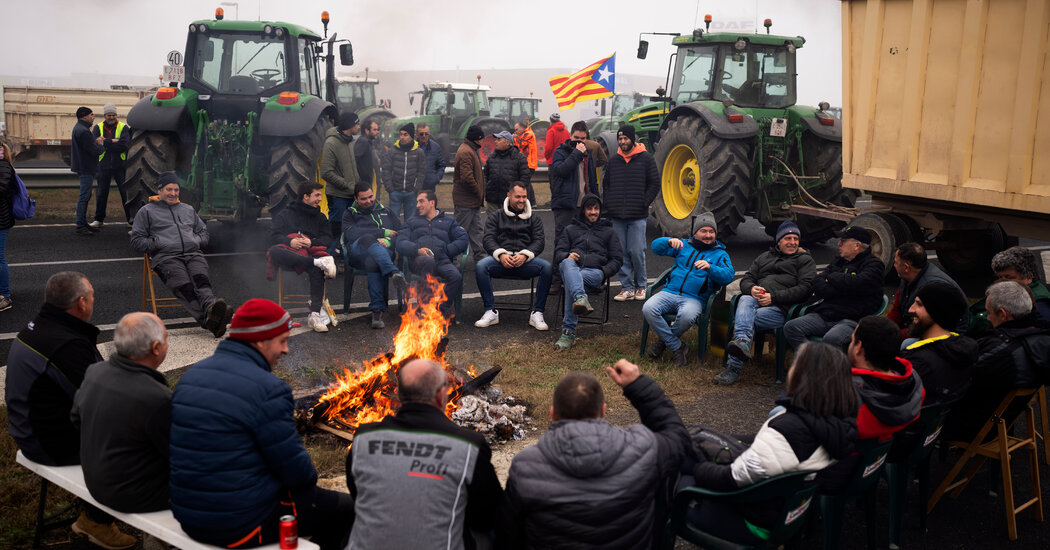

The farmers’ protests in Europe are a harbinger of the next big political challenge in global climate action: How to grow food without further damaging Earth’s climate and biodiversity.
On Tuesday, after weeks of intense protests in several cities across the continent, came the most explicit sign of that difficulty. The European Union’s top official, Ursula von der Leyen, abandoned an ambitious bill to reduce the use of chemical pesticides and softened the European Commission’s next raft of recommendations on cutting agricultural pollution.
“We want to make sure that in this process, the farmers remain in the driving seat,” she said at the European Parliament. “Only if we achieve our climate and environmental goals together will farmers be able to continue to make a living.”
The farmers argue they’re being hit from all sides: high fuel costs, green regulations, unfair competition from producers in countries with fewer environmental restrictions.
Nonetheless, agriculture accounts for 30 percent of global greenhouse gas emissions, and it’s impossible for the European Union to meet its ambitious climate targets, enshrined in law, without making dramatic changes to its agricultural system, including how farmers use chemical pesticides and fertilizers, as well as its vast livestock industry.
It also matters politically. Changing Europe’s farming practices is proving to be extremely difficult, particularly as parliamentary elections approach in June. Farmers are a potent political force, and food and farming are potent markers of European identity.
Agriculture accounts for just over 1 percent of the European economy and employs 4 percent of its population. But it gets one-third of the E.U. budget, mostly as subsidies.
Why are farmers protesting?
For weeks, a range of farmers’ groups have taken to the streets across Europe, blocking highways with tractors, throwing firecrackers at the police and erecting barricades that have caused major transportation disruptions in Berlin, Brussels and Paris.
They’re angry about many things. Some frustration is directed at national leaders and proposals to reduce agricultural diesel subsidies in France and Germany. Some of it is directed at E.U.-wide proposals, like cuts to use of nitrogen fertilizer (which is made from fossil fuels).
Farmers are also angry at trade deals that permit the import of agricultural commodities from countries that don’t have the same environmental protections. And some farmers want more government aid as they reel from the effects of extreme weather exacerbated by climate change.
The protests embody the failure to win over farmers on the road to more sustainable agriculture, said Tim Benton, who heads the environment program at Chatham House, a research institution based in London. “This is a wider case of how, if we are to transition to sustainability, we need to invest more in ‘just transitions’ to take people along and allow them to feel better off, not penalized,” he said.
How have leaders responded?
In Germany, the government has backtracked on some key policies, including delaying a cut on diesel subsidies for agricultural vehicles.
In France, the government has offered an aid package of 150 million euros, or $163 million, to livestock farmers, temporarily paused a national plan to reduce pesticide use, and banned the import of foreign produce treated with a pesticide outlawed in France.
But on Tuesday, Ms. von der Leyen announced the scrapping of a E.U.-wide bill to reduce pesticide use, because, she said, it had become “a symbol of polarization.”

Later in the day, the Commission issued its recommended 2040 climate targets. While they won’t be formally proposed or voted on until a new Parliament is elected this summer, they send a clear signal about the political priorities of Ms. von der Leyen’s incumbent European People’s Party. The targets aim to reduce overall emissions by 90 percent by 2040. But they recommend nothing specific on reducing agriculture’s emissions of methane, a powerful greenhouse gas that comes mainly from livestock, nor on reining in nitrogen fertilizers.
Both methane and nitrogen have to be slashed significantly in order to meet the bloc’s climate targets, according to scientists advising the European Union.
Following Tuesday’s announcements, one European farmers’ lobby group, known as COPA-COGECA, declared victory. “The E.U. Commission finally acknowledges that its approach was not the right one,” the group said on X.
Why is it politically risky?
The center-right European People’s Party, which is the largest group in the European Parliament, has long enjoyed the support of rural voters. Lately, some of its environmental and trade policies have raised the anger of that voting bloc. Far-right groups, ascendant in several countries on the continent, have seized on that discontent.
“The looming elections are creating the opportunity for populist parties, which are using it against the European green agenda,” said Simone Tagliapietra, a senior fellow at Bruegel, a Brussels-based research institute who studies European energy and environmental policies. “We all have someone in our family trees who was a farmer, and food is an important part of European identity.”