
For years, Iraq has managed to pull off an unlikely balancing act, allowing armed forces tied to both the United States and Iran, an American nemesis, to operate on its soil.
Now things are getting shaky.
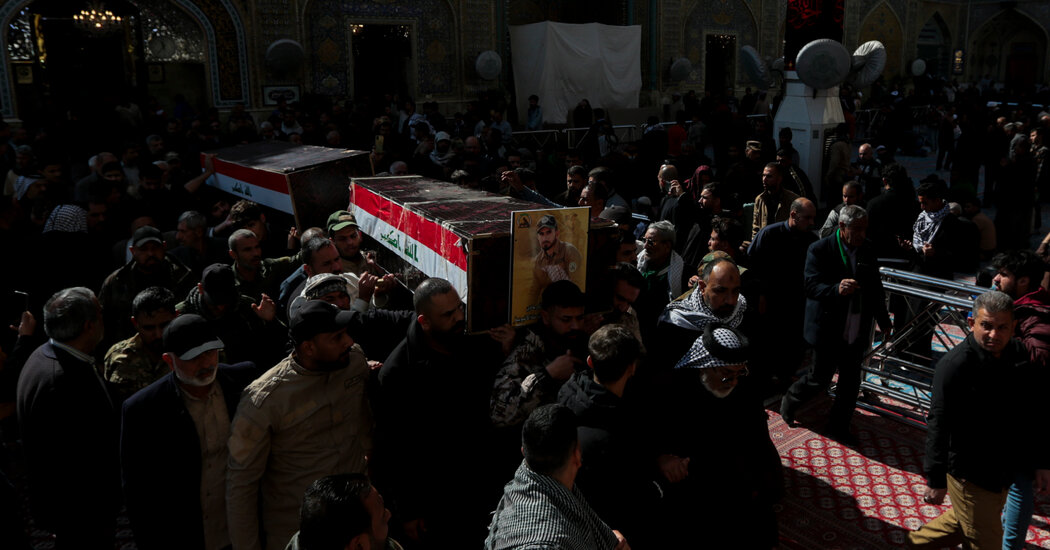
When Washington, Tehran and Baghdad all wanted the same thing — the defeat of the Islamic State terrorist group — the relationships were fairly tenable, but in recent months, as the war in the Gaza Strip sends ripples across the region, American and Iranian-backed forces have clashed repeatedly in Iraq and Syria. A U.S. strike on one of those militias last week killed 16 Iraqis, and Iraq is saying it has had enough.
“Our land and sovereign authority is not the right place for rival forces to send messages and show their strength.” the office of Prime Minister Mohammed Shia al-Sudani said in a statement on Sunday.
For many years, both Iran and the United States had their proponents within the Iraqi government, and the Iranian-backed armed groups and the American troops lived in a tolerable if uneasy balance.
That started to change in 2020 after the United States killed one of Iran’s top security and intelligence commanders, Gen. Qassim Suleimani, a widely revered figure at home, in a drone attack as he was visiting Iraq. The Iranians began pushing hard for the U.S. military to be ejected.
Iraqi leaders resisted, in part because of divisions over which country Iraq should lean toward. Even after 2022, when parties close to Iran were able to form a government, there was a notable distinction between what Iraq officials said about the United States publicly and what they said in private.
Now, Mr. Sudani’s government is sounding increasingly tough.
Its statement Sunday denouncing the fighting on its soil was particularly pointed in its criticism of the United States, describing last week’s attack in western Iraq as “a blatant aggression” that had jeopardized talks on reducing the number of American troops in Iraq. “Violence only begets violence,” the statement warned.
The comments reflected the thorny situation the Iraqi government finds itself in as it negotiates a withdrawal of the American troops that have been in Iraq off and on since 2003.
Iraq has been under pressure from Iran, which views the United States as a mortal enemy, to compel the complete removal of U.S. forces from its soil. But a number of military officials in Iraq and in the United States believe the country would benefit from a limited U.S. military presence focused on training and on tracking the remaining threat from the Islamic State.
The Iraqi government has deep political and military connections to Iran, and on Sunday it made only an elliptical reference to the Iranian-backed armed groups in Iraq that have attacked U.S. camps and bases more than 160 times since the war between Hamas and Israel began in October.
It was those attacks that prompted recent instances of U.S. retaliation, including the one on Friday that killed 16 Iraqi soldiers, angering many in the Iraqi government. It followed a drone strike on Jan. 28 by an Iranian-backed Iraqi militia that killed three U.S. soldiers at a base in northwest Jordan.
Analysts who follow Iraq closely suggested that recent events have put the two countries at an inflection point, potentially forcing a faster withdrawal of U.S. troops than the United States — and many in Iraq — might have hoped for.

“The problem for both the Iraqi and U.S. governments, said Renad Mansour, director of the Iraq Initiative at the London-based research group Chatham House, is “that neither wants an escalation and neither wants a continued presence of U.S. troops.”
Before the Hamas-led attack on Israel on Oct. 7 and Israel’s retaliatory bombing and invasion of the Gaza Strip, both Iraq and the United States had been “on the same page,” Mr. Mansour said, and hoped to negotiate a mutually beneficial troop withdrawal arrangement.
But now there are new pressures. Much as the two countries might want to go back to the pre-Oct. 7 discussions, “things are changing, and they are trying to deal with this new, emerging reality,” Mr. Mansour said.
Colin P. Clarke, the head of research for the Washington-based Soufan Group, an intelligence and security consulting firm, said he was concerned that over the past few days, the rhetoric from both the Americans and the Iraqis had spiraled. The danger, he said, is “that the war of words becomes a self-fulfilling prophecy, where the U.S. ratchets up its rhetoric and the Iraqi government does the same, and then it’s who’s going to flinch first.”
Mr. Clarke said he worried that the United States would withdraw its troops too quickly, a replay of the breakdown of negotiations in 2011, which resulted in the U.S. pulling all of its troops out of Iraq. Within two years, the Islamic State had taken over tranches of western Iraq and a year later, much of Iraq’s north, as well as precipitating a four-year war that cost tens of thousands of lives.
After the deadly American strike last week, Nuri al-Maliki, a former prime minister of Iraq who leads an influential Parliamentary party that supports the government, appeared at least publicly disinclined to give much room to the United States, saying it had targeted Iraqis “in cold blood.”
Hadi al-Ameri, one of the leaders of the Framework Coalition, which backs Mr. Sudani, went further. “We do not believe in negotiations,” he said, “and American forces must be removed immediately from Iraq.”
How the next few weeks unfold will depend on how Mr. Sudani navigates the twin pressures from Iran and the United States. The head of the Islamic Republic’s Security Council was in Baghdad on Monday, and the head of its Quds Force, Gen. Ismail Qaani, was there last week for meetings with Iraq’s security officials.
“Sudani has been undermined systematically for the last four months,” said Rend al-Rahim, the president of the Iraq Foundation, which promotes democracy and human rights in Iraq. The Iraqi leader, she said, has “done his utmost” to curb the Iranian-backed militias that have been targeting U.S. troops. “They haven’t listened to him,” she said.
“He was very angry,” Ms. al-Rahim said. “Then the U.S. strike came on top of this already building anger that now Iraq is an open field for the U.S. to settle scores with Iran.”
Mr. al-Sudani — much like President Biden and Iran’s leader, Ayatollah Khamenei — has domestic politics to consider, several Iraqi analysts said. “He worries that he now appears weak,” said Ehsan al-Shimmari, a political science professor at Baghdad University.
Beyond that, Mr. al-Shimmari said, the current situation has made clear the limits of his power. Even when it comes to one of the most major foreign policy decisions facing Iraq — the future role of the United States military there — it is not entirely up to him.
”He is waiting to hear what the Iranian position will be, and then, based on that, he will balance the considerations and make his decision,” Mr. al-Shimmari said. “but this makes him feel cornered.”
Falih Hassan contributed reporting from Baghdad.