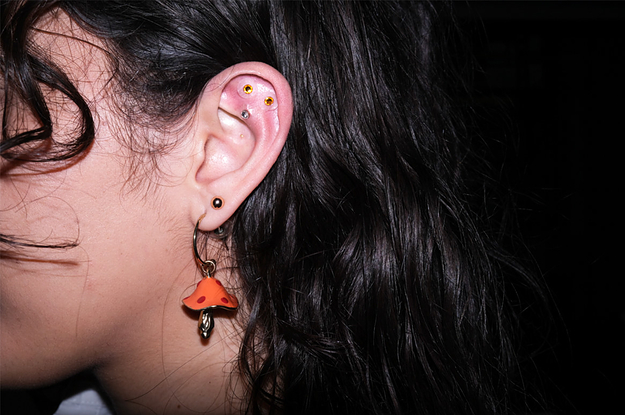

Ear seeding is the more than 2,000-year-old practice of sticking seeds from the Vaccaria plant onto specific points on the inside and outside of your ears. Today, most practitioners use tiny metal beads attached to adhesive stickers. The Chinese medicine treatment, formally known as auricular acupressure, is basically acupuncture without the needles: a plus, given that people can do the treatment at home. It’s based on a meridian (or channel) system in the body that’s like an energetic highway. Some cultures believe the vital life force flowing in these channels, known as qi (pronounced “chee”), is responsible for the functioning of your emotional and physical well-being.
While you might dismiss this as just another wellness trend, many studies suggest that ear seeding may decrease pain intensity, improve daily functioning, and reduce the use of pain medications like opioids among people with varying conditions like cancer-related fatigue, knee osteoarthritis, anxiety, insomnia, nausea, constipation, chronic headaches, brain injuries, and more.
Acupuncture in the ear (which focuses on the same points as acupressure) has been found to trigger changes in brain activity, providing evidence for the “body–ear–brain somatotopical connection,” according to at least two small studies that used functional magnetic resonance imaging.
From the Western medicine perspective, these brain changes may alter how your central nervous system processes pain and spur the release of your natural pain-relieving endorphins. This thinking is based on the gate control theory, which states that acupressure on specific points sends “pleasurable impulses to the brain at a rate four times faster than painful stimuli.”
As a health reporter, I started my own ear seed journey with a hefty amount of skepticism. So when I dug into the research, I was surprised to find few red flags and some positive findings. While most studies on auricular acupressure are randomized controlled clinical trials — the “gold standard” of scientific research design — they involve small sample sizes. Still, they include control groups that underwent “sham” treatments and exclude people undergoing other therapies to determine ear seeding’s true impact on pain relief.
However, the evidence behind the treatments’ mechanisms and benefits is still limited, according to Gudrun Snyder, who has a doctorate in acupuncture and owns Moon Rabbit, a Chicago-based clinic that offers Eastern medicine treatments and sells ear seed kits. Fewer studies have been done on ear seeding due to Western medicine’s hesitancy to fully welcome it, and many studies that do exist have yet to be translated into English, Snyder told me.
Social media may be changing that. The hashtag #earseeds has 130 million views on TikTok, where people document their appointments getting seeds placed by professionals and record themselves sticking them on at home.
“Acupuncture and acupressure are becoming more widely accepted, and so finally more studies are being done to show the credibility behind our medicine,” Snyder said. “Only now because of social media are people coming to my practice, asking for ear seeds, and wanting to know about the scientific benefits.”
I asked Dr. Ellen Rosenquist, a physician specializing in pain management at the Cleveland Clinic, for her opinion on ear seeding. She said she would recommend it for most pain conditions.
“Because the entire body is represented on the ear, almost any pain condition can likely be treated utilizing auricular acupuncture points,” Rosenquist wrote in an email. “Ear seeding is equally effective as traditional acupuncture and may be a better option in some situations.”
Rosenquist added that this kind of treatment, depending on the condition involved, should “absolutely” be considered before more invasive treatments or those that have more side effects.
How my ear seeding treatment went for back pain.
I’ve been dealing with a lower back injury since December that has prevented me from sitting for too long, exercising to my fullest capabilities, and even, at times, loading the dishwasher without an energy-sucking dull, achy pain.
I was given a set of ear seeds to try out, but they generally cost about $45 for a kit that includes about 40 seeds and a pair of tweezers. Before my first round of treatment, I studied an ear seed map to figure out where to put them, then cleaned my ears with alcohol. I used tweezers to place one seed on the pressure point that correlates to the lower back on both my ears, as well as points for stress and focus, for a total of six seeds. (Stimulating one point won’t undo the effects of another, even if they are close together.) I then applied pressure on each seed with my fingers for about 30 seconds.
Within five minutes, my ear seeds meant to address lower back pain became extremely sensitive, similar to the feeling of a fresh piercing. Any time I accidentally touched one when adjusting my hair or changing clothes, the pain was…bad, which meant that sleeping and wearing headphones were really uncomfortable.

I pushed through the discomfort for two more days until I had to remove them. My ears were just too sensitive; even smiling would hurt. The other spots on my ears were tender but manageable. And to my surprise, the seeds never lost their stickiness, even after washing my hair, exercising, and sleeping on them.
Snyder said everything about my experience was normal and a true indication that my back is injured to some degree. “The points we need the most are going to be the most uncomfortable, and sometimes we get worse before we get better in our healing journeys,” she said.
In a 2013 study, a research team from the University of Pittsburgh tested a four-week ear seeding treatment on 19 people (10 in the experimental group and 9 in a sham group) with chronic lower back pain. It found that those who received the therapy had a 70% reduction in worst pain intensity and a 75% reduction in overall pain intensity. These benefits lasted when they returned for a one-month follow-up. In contrast, people in the sham group had an 18% reduction in worst pain and 29% improvement in overall pain severity. Participants in both groups reported ear sensitivity and soreness, as well as itching and problems sleeping; however, they said that the discomfort was tolerable compared to their back pain.
To be honest, it was hard to tell if the ear seeds really helped — I’m also undergoing acupuncture treatments and physical therapy two times a week each, as well as daily full-body stretching. That said, I believe the seeds may have helped reduce the soreness and fatigue I typically feel after an acupuncture and physical therapy session, despite not noticing immediate pain relief when I attached them. As for my stress and focus, I didn’t feel too much of a difference, although I don’t normally have serious issues with it.
Ear seeds are technically an accessory treatment, meaning they’re best used in conjunction with other therapies. However, Snyder said they may still offer benefits when used alone: “Ear seeds are a light touch,” she said. “If you have chronic pain or difficulty sleeping for years and years, maybe ear seeds will help, but I would recommend seeking out other therapies because they’re not going to treat something that’s really deep-seated.”
After a two-day break, I applied new seeds on the same spots. Almost instantly, the painful sensitivity on both of my ears emerged, but I felt better able to handle it. I’ve been wearing them for four days now, and the pain has tapered over time (although sleeping remains awkward). I still haven’t noticed any change in my lower back pain, but it’s possible I need more time with the seeds.
Some research shows that people can experience pain relief within one to two minutes of applying ear seeds, but Snyder said some people may need two weeks or more to feel a difference. “Use them for as much or as little as you’re comfortable with. You can take a break to avoid overstimulation, but everyone is different,” she said.
Ear seeds, for the most part, are easy to use and adverse reactions are rare. Applying them incorrectly won’t result in injury, and at worst, people may experience an allergic reaction to the adhesive or metal in the seed. Plus, practically everyone can use them.
But there are always exceptions.
For example, I applied extra seeds to random spots on my ear just to be cute (some seeds come with Swarovski crystals on top so they look like earrings). Shortly afterward, I started feeling periodlike cramps; I wasn’t menstruating or ovulating, and cramps aren’t a common period symptom for me anyway. I didn’t immediately blame the seeds until later that night when the cramps intensified. Out of curiosity, I checked which point I placed those seeds on — it was for the uterus. So I removed the seeds, and within five minutes the cramping went away and didn’t return.
Snyder said that placing ear seeds on random points may cause “unintended side effects. That said, the likelihood of having such a strong reaction is extremely low. The low level of stimulus applied to the ear usually can only cause a low-level response.”
Or could I have imagined it all? Many people assume that benefits associated with traditional Chinese medicine are based on the placebo effect. When I asked my doctor for his opinions on acupuncture, he said any pain relief I might experience will most likely be “in [my] head.” (In fact, acupuncture has so far been the only treatment to offer me enough relief to do daily tasks with no pain.) Not all doctors agree. Rosenquist told me she doesn’t believe the placebo effect is the reason some people feel better after ear acupressure.
Even if it does, Snyder said, it doesn’t hurt to try, especially given how expensive healthcare has become. “If it’s low cost, something you enjoy, and has little to no side effects, why not do it if it makes your pain better? Whether it’s placebo or an actual scientific mechanism, I still think it’s worth it.” (Although Snyder doesn’t believe the placebo effect is at play either.)
The word “placebo” used to carry a much more negative connotation, but Western medicine is becoming more friendly to the concept, Snyder said. The placebo effect is now recognized as a powerful treatment on its own, which speaks to the importance of the mind–body connection.
As a science-driven person with moderate health anxiety, I’m always willing to try less invasive therapies before more invasive medications and injections that might have unintended side effects. (My doctor wanted me to get a steroid shot in my spine, which has been proven to provide pain relief, but no thank you!) It’s rare for any treatment to offer immediate pain relief, so my anticlimactic experience with ear seeds won’t necessarily stop me from trying the treatment again and for longer periods of time.
In case you want to try these for pain relief or any other reason, here’s some ear seeding advice:
- It was difficult to see inside my ear when applying the seeds, so I recommend having another person stick them on for you for proper placement. You can also have a professional apply them.
- Remember that you get what you pay for, Snyder said. Ear seeds that appear cheaper than the rest may have weaker adhesives or fake metal that may irritate your skin.
- Try ear seeding for at least a month to determine if they help you. Take any necessary breaks in between each treatment session if the pressure points are too overstimulated.