

Back when I started playing the search engine optimization (SEO) game, keyword stuffing actually worked. Since then, algorithm updates have spared only a few SEO best practices, like URL optimization.

Google’s algorithm updates have shaken up the scenery of SEO. However, URL optimization has stood the test of time. This is an essential element of on-page SEO that every content marketer should know.
To get you up to speed, I’ll share the ABCs of URL optimization and up-to-date best practices. I’ll also share tips I’ve learned from experts.
![→ Download Now: SEO Starter Pack [Free Kit]](https://no-cache.hubspot.com/cta/default/53/1d7211ac-7b1b-4405-b940-54b8acedb26e.png)
Table of Contents
What is a URL?
A URL (short for Uniform Resource Locator) is like a street address but for the internet. Instead of helping mail carriers deliver packages, it helps internet users find their destination webpage. A physical address includes the town, street, building number, and room. Likewise, URLs have hierarchical levels so users can find a specific page within sections of a website.
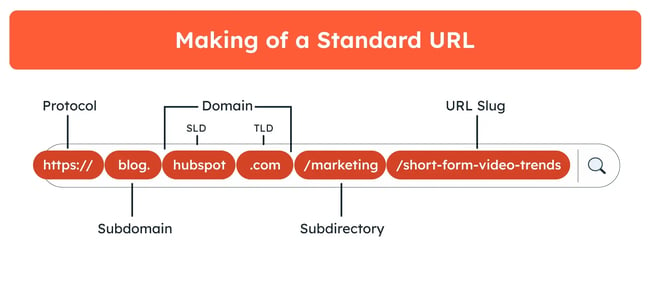
A typical URL consists of several parts: Protocol, subdomain, domain, subdirectory, and slug. A protocol can be HTTP or HTTPS — the latter signaling an encrypted connection. A subdomain is usually “www.” (World Wide Web), but custom subdomains like “shop.” and “blog.” aren’t uncommon.
Afterward, there’s the domain name, which consists of a top-level domain like “.com” and a second-level domain, which is usually a brand or project name.

The aforementioned parts will help you reach a home page. From there, you’ll likely go to a subdirectory — a folder inside the main website — and a slug, which identifies singular pages.
URL Example
Consider the following URL: https://blog.hubspot.com/marketing/url-best-practices-for-seo. It has the following parts:
- Protocol: HTTPS://
- Subdomain: blog.
- SLD: hubspot
- TLD: .com
- Subdirectory: /marketing
- Slug: /url-best-practices-for-seo
From this URL, I can tell that I’m on a blog about URL basics. It’s published by HubSpot and hosted using an encrypted connection.
Why URLs Are Important for SEO
URLs guide visitors to your digital doorstep. Plus, they establish your page’s keyword relevance for search engine crawlers. Beyond that, URLs make navigating the internet more accessible compared to numerical IP addresses.
These perks are only possible if we use SEO best practices for URLs. Let’s dig further into the reasons why good URLs are so impactful.
Ranking Factor
URLs are on Google’s confirmed search ranking factors, which help search engines decipher what each webpage contains. With that in mind, I add relevant keywords to my URLs to help Google understand my pages’ content, why I made it, and which searches it should rank for.
User Experience
Keyword stuffing is a thing of the past. SEO is now a delicate dance of pleasing both algorithms and flesh-and-blood readers. I now aim for a descriptive URL so users know what to expect from the page.
If someone sends my URL in a direct message, will the recipient feel confident they’re clicking into a relevant and valuable page? Reaching this ideal gets me more backlinks and sales.
Accessible Links
If there’s one thing I hate about LinkedIn, it’s how it handles external URLs. You can’t hyperlink an anchor text. Instead, you must add a bare link, which often appears ugly if you use non-descriptive links — like https://www.example.com/post/p123/.
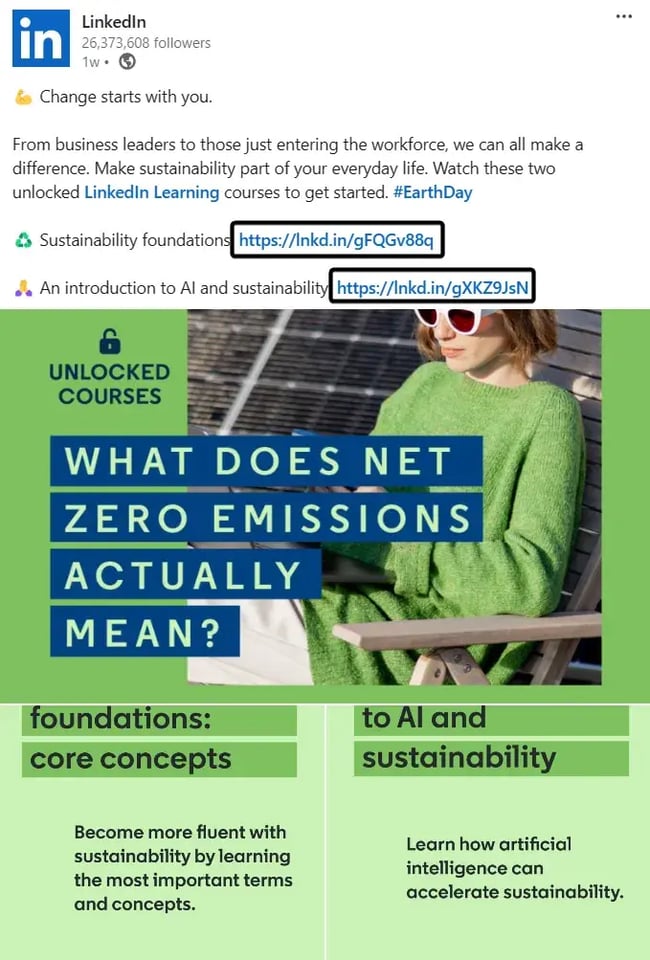
While I could use a link shortener to make it prettier, that’s an extra step. I avoid the issue altogether by using descriptive, well-formatted, and concise URLs.
We’ve talked about the ideals, so let’s go through the SEO best practices that will get you there.
Crafting the perfect URL is only one part of ranking in search. Looking to learn more? Check out our complete guide on-page SEO.
URL Best Practices for SEO
- Keep each URL as simple as possible.
- Standardize your URL naming conventions.
- Limit the URL structure to three hierarchical levels.
- Avoid adding dates.
- Take out non-essential words in the slug.
- Handle dynamically generated URLs with care.
- Include relevant keywords.
- No keyword stuffing.
- Make it reader-friendly.
- Separate words with hyphens.
- Use lowercase letters.
- Don’t use slugs that belong to other pages.
1. Keep each URL as simple as possible.
SEO is a Rubik’s Cube on steroids — complex and constantly shifting. Sometimes, my saving grace is Google’s guidelines on URL optimization. We’re told to “create a simple URL structure” and use “simple, descriptive words in the URL.”
While “simple” varies from person to person, opt for one of the following good URL structures, depending on the business.
- Content website: https://example.com/category/post-title
- Ecommerce website: https://example.com/product-category/product-name
- Service-based website: https://example.com/service-category/service-name
- Local business website: https://example.com/location/service
- Portfolio website: https://example.com/portfolio/project-name
2. Standardize your URL naming conventions.
While I recommend using one of the variations shared above, I occasionally brainstorm among my team members to see what works for us. As long as we have a standard and stick to it, we’re good.
“URLs are a stable foundation. Once set, changing them can cause more harm than good, leading to broken links and lost SEO juice — unless properly managed with redirects,” shares Ryan Ratkowski, founder of Cascade Interactive.
I think of it like a building’s plumbing system. I’d focus on getting the configuration right during setup rather than ripping out the walls five years in. Incorporate SEO best practices for URLs during the initial build of your website.
3. Limit the URL structure to three hierarchical levels.
The first time I set up a URL structure, I debated diving deep into subfolders and subcategories for everything and anything. My more experienced stance is to keep it simple and keep it logical.
Jacob Kettner, CEO of First Rank, recommends “a maximum of three hierarchical levels, ensuring clarity without unnecessary complexity.”
Why? “It strikes the perfect balance, offering categorization without overwhelming users,” he adds.
4. Avoid adding dates.
I think twice before slamming time stamps onto my URLs. It’s like adding an expiration date to my webpage. In contrast, users (and Google) prefer new content. Keep your URLs timeless, just like a classic black tee.
Maddy Osman, founder of The Blogsmith, agrees and adds: “In most cases, articles take anywhere from three to six months to appear in the top 10 on SERPs. You don’t want to restrict the potential of that ranking article by including the previous year in the URL slug.”
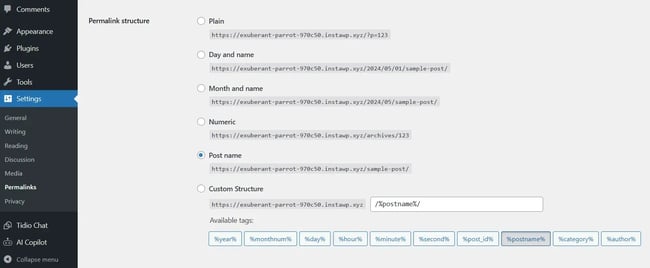
I use WordPress, so I head to “Settings” > “Permalinks” to make sure I haven’t enabled a permalink structure involving time information.
5. Take out non-essential words in the slug.
Pop quiz. Which should you use?
- /how-to-optimize-your-urls-for-search-quick-tip
- /how-to-optimize-urls-for-search
Writers and editors often ask me about this. Personally, I remove words that add little or no meaning to the URL — like “a,” “and,” and “that.” The latter URL without “your” and “quick-tip” conveys the same meaning without looking like a word soup, so I prefer that variation.
Plus, a 2023 Backlinko study found that shorter URLs tend to rank above longer URLs, so I use a limit of 60-70 characters to avoid long URLs.
To get an even shorter URL, I could also remove the words “to” and “for,” but I consider them better to keep since they make the URL more readable for humans. It’s a balance that comes intuitively, but I know you’ll get it with practice.
6. Handle dynamically generated URLs with care.
While a static URL remains consistent every time it’s accessed, I’ve run into website builders that automatically generate dynamic URL parameters when the webpage is loaded.
In such cases, I don’t have the complete customizability to change the URL, so I have to make do with URLs containing random symbols and numbers. Working with that can be a challenge, but I don’t lose sleep over it.
“As long as you‘re aware of your website’s limitations and can optimize the URL slugs you do have control over, you shouldn’t have to worry about parameterized URLs negatively impacting your SEO performance,” Lauren Galvez, an experienced SEO consultant, assured me.
7. Include relevant keywords.
Since the URL tells search crawlers what the webpage is about, I recommend including relevant keywords to instantly convey everything there is to your webpage.
This also improves my click-through rate (CTR) on the page. A 2023 Backlinko study found that webpages with URLs similar to search keywords enjoyed a higher CTR compared to webpages with URLs different from search keywords.
For instance, if users search for “ergonomic keyboards,” I opt for an SEO-friendly URL slug that contains “ergonomic keyboards” instead of “flexible keyboards.”
8. No keyword stuffing.
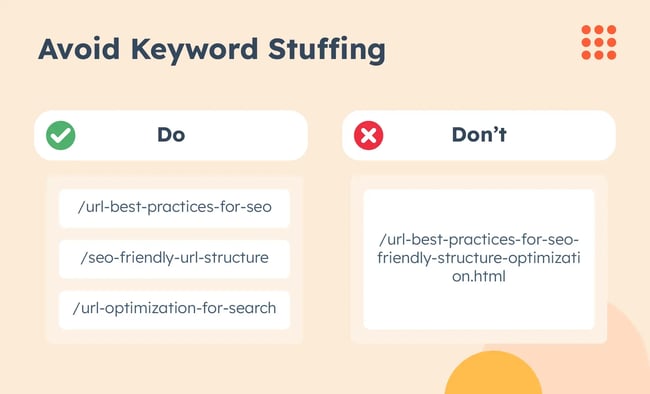
When an article is relevant to multiple main keywords, I don’t include all of them in the URL. Otherwise, I’m left with a mess like this:
https://blog.hubspot.com/marketing/url-best-practices-for-seo-friendly-structure-optimization.html
Wow, that looks ugly. Plus, it would take readers a few tedious seconds to understand what the webpage is about. In contrast, SEO best practices for URLs prioritize usability over almost everything else.
What I do is pick a single keyword for my URL and let my content do the talking.
9. Make it reader-friendly.
While I’ve mentioned it before, it’s worth reiterating that URLs should be self-explanatory to internet users. People should be able to instantly tell what they might find based on your slug.
With that in mind, sometimes I have to reorder my keywords. Other times, I have to omit words or add stop words. For instance, the URL slug “/google-algorithm-update-names” may be a mouthful for readers, so I’d change it to “/names-of-google-algorithm-updates.”
10. Separate words with hyphens.
URLs cannot contain spaces. So, to ensure I don’t end up with slugs like “/googlealogrithmupdatenames,” I use a separator. Google recommends that we use hyphens (-) instead of underscores (_).
11. Use lowercase letters.
While I’m all about proper capitalization (even in text messages), I have to accept the triumph of lowercase letters in URLs. For starters, it keeps things consistent. Plus, it avoids compatibility hiccups with any case-sensitive web server since a user might enter a URL with lowercase instead of uppercase letters.
12. Don’t use slugs that belong to other pages.
URLs need a unique slug — or Google sees the pages as duplicate content on your website, which can be penalized in some circumstances. To prevent my web pages from competing with each other in search engine results, I avoid similar URL slugs entirely.
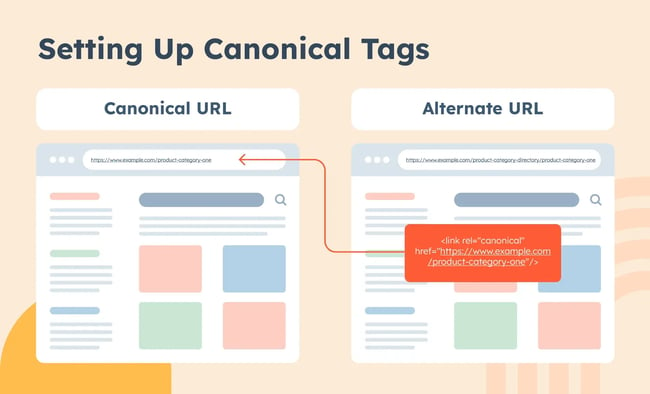
That being said, especially if you own an ecommerce store, you might realize you have two similar URLs like this:
- https://www.example.com/product-category-one
- https://www.example.com/product-category-directory/product-category-one
When that happens to me, I tell search crawlers which webpage I want to appear on Google Search. More specifically, I use canonical tags, a classic technical SEO practice.
Making the Most of URLs
When I’m scrolling on my phone, I’m not analyzing the URLs I click on. I just tap away. However, on the back end, great URLs lead to more traffic. While there’s a laundry list of tips to keep in mind, these best practices become second nature over time.
When you want to dig deeper into SEO essentials, such as link building, check out our SEO guide with all the juicy details.

Editor’s note: This post was originally published in April 2014 and has been updated for comprehensiveness.