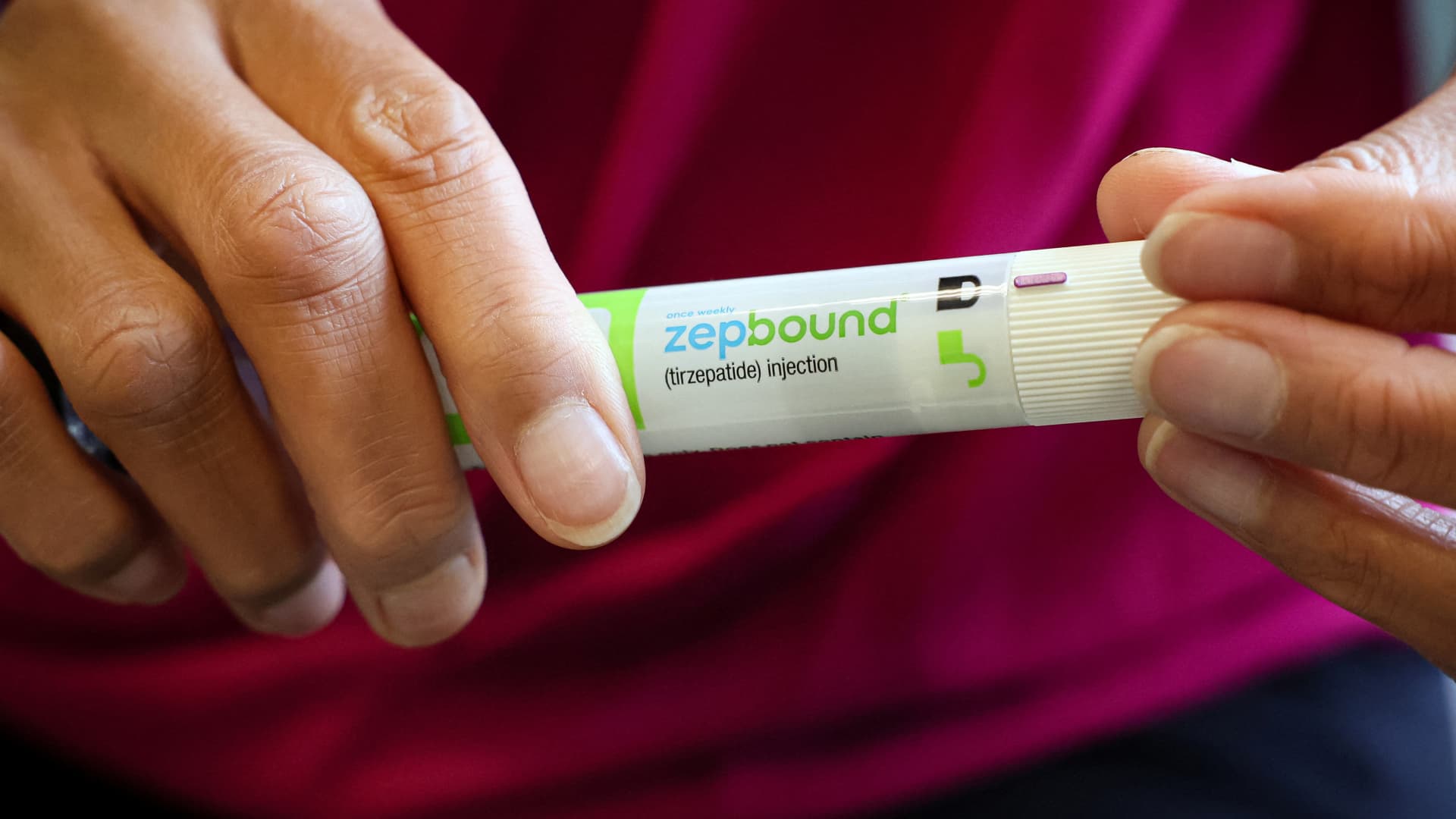

An injection pen of Zepbound, Eli Lilly’s weight loss drug, is displayed in New York City on Dec. 11, 2023.
Brendan McDermid | Reuters
Companies are increasing access to new blockbuster weight-loss drugs for employees, but size of employer may make a big difference in early access. Small businesses and their workers are often stuck between a rock and a hard place when it comes to this burgeoning health insurance coverage market.
Small businesses employ roughly half of the workers in the U.S. labor market, and they have been adding jobs at a faster pace than large employers. Since the first quarter of 2021, small-business hiring accounted for 53% of the 12.2 million total net jobs created across all employers, according to the U.S. Bureau of Labor Statistics, consistent with the longer-term trend.
The blockbuster obesity drugs, called GLP-1 agonists, cost roughly $1,000 per month on average — and they are typically taken for a long time. Access to these weight-loss drugs is coming from an increasing number of sources in the marketplace, drug makers are ramping up production, and use cases continue to increase, with clinical trials showing benefits for conditions from sleep apnea to heart disease risk. But many of the 100 million American adults who are obese can’t afford to pay out of pocket for drugs like Novo Nordisk’s Wegovy and Eli Lilly’s Zepbound, and are turning to their employers for help.
A survey last October of 205 companies by the International Foundation of Employee Benefit Plans found that 76% of respondents provided GLP-1 drug coverage for diabetes, versus only 27% that provided coverage for weight loss. But 13% of plan sponsors indicated they were considering coverage for weight loss. Covering these drugs, however, is harder for smaller employers, many of whom rely on off-the-shelf plans offered by their insurance carriers. While there are plans that cover GLP-1 drugs, the cost can be prohibitive for many small businesses.
There’s strong demand from employees for coverage and smaller employers would like to be able to do it, but there are trade-offs, said Shawn Gremminger, president and chief executive of the National Alliance of Healthcare Purchaser Coalitions, a nonprofit purchaser-led organization. Companies have to consider the impact on wages or other benefits they might like to offer. “The company money has to come from somewhere,” he said.

In some cases, small employers, even if they want to cover weight-loss drugs, are simply priced out of the market and they may have to accept they can’t offer the coverage they would like to.
“Given the price of these drugs, you have to do the cost-benefit analysis and for a lot of small companies — even some larger ones — they just can’t do it,” Gremminger said. “No matter how much they want to.”
Here are a few issues for small business employers and employees to understand in accessing expensive weight-loss drugs as part of job benefits.
Annual benefits deals are being brokered now. Open enrollment season for health insurance doesn’t occur until the fall, but employers should be having renewal discussions with their benefits broker or agent now, and that conversation should include weight-loss drugs. Small business employers should be telling a broker they would like to be able to provide weight-loss drugs for employees, and ask for help in finding the right carrier or the right plan, said Gary Kushner, chair and president of Kushner & Company, a benefits design and management company.
The market is changing quickly. Last year, an insurance carrier asked about covering weight-loss drugs may have said no, but it’s worth asking the carrier again because they may have been forced to make changes to their offerings for competitive reasons, said Kate Moher, president of national employee health and benefits for Marsh McLennan Agency, which advises employers on plan designs and benefits programs. “You should be asking the question every year,” she said.
Insurance premiums may rise. To gain access to weight-loss drugs, many small businesses may have to switch insurance carriers, and probably pay more. “It most likely will be more expensive if one is not covering the drugs and the other is,” Kushner said.

Employers also have to decide how much of that can be reasonably passed to employees, without unduly burdening workers who may never need these drugs. “If 20% of your population takes it, everyone’s premium goes up by whatever percentage that is to cover the cost,” Gremminger said.
Small businesses should consider a ‘captive health’ plan. Generally speaking, any business with at least 50 employees might consider working with a captive health insurance plan like Roundstone, ParetoHealth, Stealth and Amwins, Moher said. These businesses allow groups of companies who couldn’t self-insure — the approach most large corporations take — to pool resources and design a group health plan together.
This approach may allow a small business and its employees more flexibility, Moher said, but owners still have to weigh the costs and there are requirements to qualify. It’s also not something businesses can change every year like they could when working with a traditional insurance carrier. “It’s a long-term play; you can’t jump in and out,” Moher said.
These plans are designed for the long-term because, as member-owners, the participants all agree to spread the risk, an approach that can keep costs down over time and decrease volatility. But if business owners are looking for a quick-fix or prefer to wait and see how the market develops over the next year, it’s probably not the right model.
A GLP-1 drug standalone coverage option could also work for some small businesses. Companies like Vida Health, Calibrate, Found Health and Vitality Group provide these offerings separate from an employer’s primary carrier, Gremminger said. Employers need to do the math to determine whether it could be more cost effective, and whether the option truly suits their employees’ needs based on the offerings.
Use an FSA to help cover weight-loss drug costs. If insurance coverage options aren’t an effective solution today, small employers may have a few other ways to help employees defray the cost of weight-loss drugs. They might consider, for instance, making contributions to employees’ flexible spending accounts or health savings accounts. They could also consider a health reimbursement arrangement, or HRA, which is an employer-funded plan that reimburses employees for qualified medical expenses.
However, there are strict rules and requirements for each of these options. For example, with an FSA, the IRS limits an employer’s contribution based on how much the employee contributes, and this still isn’t likely to suffice to cover the cost of these drugs long-term. “Does it help? Sure. Does it solve the problem? No,” Kushner said.
It’s also not a move to make without first getting sign-off from legal counsel. “You need the guidance of your ERISA attorneys to make sure you meet all the criteria,” Moher said. “It’s a creative way of doing it, but you have to make sure you’re meeting all of your compliance requirements.”
Right now, the end result can be very discouraging for small businesses and their employees given the costs and limited options, but it’s also important to know that there are 20 or so drugs in the approval pipeline. Once they get approved, costs are likely to come down, Moher said. “This is something that may be a short-term thing until we get more GLP-1 drugs approved.”