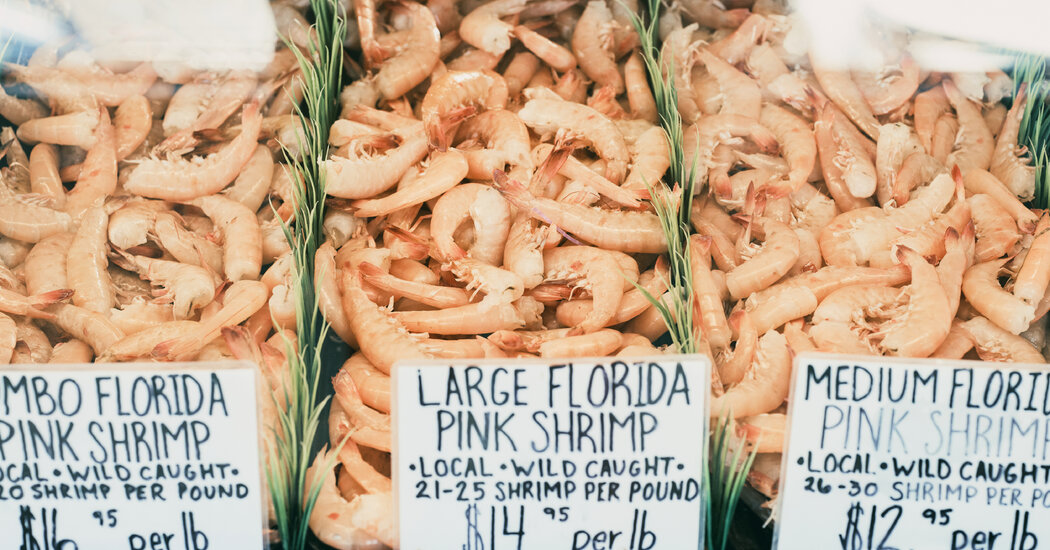

In December, Frank Parker upgraded to a bigger shrimp boat.
For the Mississippi shrimper, it was a good trade with an older fisherman who was looking to scale back. But the driving force behind acquiring a boat that would allow Mr. Parker to stay in deeper waters for two weeks at a time was President Trump’s return to the White House, and his promise to tax nearly all imports.
When Mr. Trump followed through on that promise and levied tariffs across the world this week, Mr. Parker, 52, said it felt “like the sun coming out of the tunnel.”
It had been years since he had felt even a sliver of optimism about the shrimping industry, which his family has been in since his ancestors moved to Biloxi, Miss., in 1842. Gulf Coast shrimpers have been pummeled in recent years by natural and man-made disasters, as well as rising fuel costs.
But Mr. Trump’s tariffs, Mr. Parker and several other shrimpers said last week, could go a long way toward quashing perhaps their biggest financial threat: the cheap, farm-raised imported shrimp flooding the American market. Now, the biggest exporters of shrimp, like Vietnam, Indonesia and India, face some of the largest tariffs.
In recent years, the average price of headless shrimp has dropped to as low as $1.50 per pound for some sizes of shrimp along the Gulf Coast — while the costs of diesel fuel and running a business have climbed.
“I’ve left shrimp out there because I didn’t want to give them away for $1 a pound,” Mr. Parker said of recent shrimping trips. He added, “I don’t see it getting any worse. We’re at the bottom of the barrel now.”
And, in Alaska, there are worries about retaliatory tariffs from China on salmon, pollock and other fish exported there, as well as about the higher expense some fishermen might face processing their catch overseas.
But American shrimpers typically do not export their catch. Along the Gulf Coast, their industry has been decimated by pollution, a string of hurricanes, and what they say is a cheap, inferior product from Asian and other countries, often passed off as domestic shrimp. (Genetic testing has repeatedly found shrimp from abroad, fraudulently labeled as Gulf Coast product, at restaurants and seafood events.)
“It’s almost like dumping cheap Louis Vuitton purses into the market — imagine the country being flooded by imitations,” said Ryan Bradley, a former shrimper and the current executive director of Mississippi Commercial Fisheries United, an industry group. “Putting a tariff on it is going to raise the price on these cheap imitations to level the playing field.”
More than 90 percent of the millions of pounds of shrimp consumed annually in the United States is imported, with a majority coming from India, Ecuador, Indonesia and Vietnam. The U.S. International Trade Commission already voted to allow the Commerce Department to penalize those countries in November, and all four now face additional tariffs under Mr. Trump.
A federal analysis of initial data shows that there was a 38 percent drop in revenue for wild-caught shrimp from 2022 to 2023, to $204 million from $329 million, even as the catch remained fairly consistent. That means the price of shrimp has dropped to just a few dollars per pound, even as fuel costs remain high and the number of shrimpers has plummeted in recent years.
While there are some international shrimp farms that operate transparently and ethically, American shrimpers point to reports of exploited workers and slave and child labor practices, as well as the use of chemicals and antibiotics.
American shrimpers also have to meet higher environmental standards, including the mandatory use of turtle excluder devices to prevent endangered species or other wildlife from getting caught by a trawler. There has also been a decade-long freeze — set to expire next year — on new shrimping permits as an environmental precaution, set by the Gulf of Mexico Fishery Management Council.

For consumers, shrimpers say, the most important reason to protect domestic-caught shrimp is that farmed shrimp just don’t taste the same. Wild-caught Gulf Coast shrimp have a streak of flavor that can come only from a lifetime in the sea, they say, with a deeper color and a crisp bite.
“We’re hopeful that this is a good swing of momentum,” Justin Versaggi, a fourth-generation shrimper based in Tampa, said of the new tariffs. “We want to be able to bring our product to market and get the right price for it.”
“The fear that I have is that once our industry is gone, it’s gone forever,” he added. “That’s the part that gives me chills, because there’s no reason for it — we have a superior product.”
The Southern Shrimp Alliance, an industry group formed to counter imports, and their allies have long called for tariffs, as well as legislation that would require accurate labeling about where shrimp come from.
Separate from the tariffs, shrimpers also hope that the so-called Make America Healthy Again movement championed by Robert F. Kennedy Jr., Mr. Trump’s Health and Human Services secretary, will prompt more consumers to demand information on where, exactly, their shrimp is coming from and to prioritize the local catch.
Some shrimpers readily acknowledged the broad uncertainty around Mr. Trump’s tariffs and their impact. The policy could make other aspects of their work and life more difficult — if the cost of their equipment rises, for example, or the aluminum and steel needed to repair their boats becomes more expensive.
But with the cost of fuel and materials already weighing down their businesses, some view it as a worthwhile risk.
“If I can make the money, I’ll take care of it,” said Acy Cooper, 64, of Venice, La., who is the president of the Louisiana Shrimp Association. “We’re willing to pay a little more for equipment if we make the money to pay for it.”
The possibility of being able to get more money for shrimp could be a financial lifeline for shrimpers and fish markets along Florida’s Gulf Coast, where Hurricane Ian devastated livelihoods in 2022.
Grant Erickson, whose family has operated Erickson & Jensen Seafood for seven decades, spent $1 million just on rebuilding his docks on San Carlos Island, between Fort Myers Beach and Fort Myers. Two of his eight boats are still not fully repaired, while three were completely destroyed by Ian.
“We are not even profitable at times,” he said. “It’s been very tough.”
Like the few remaining shrimpers and related businesses in the area, he is hopeful that the tariffs will boost sales of a local delicacy: pink shrimp, which are sweet and delicate. He and others in the local shrimping industry watched longtime friends and workers leave the field in the aftermath of the hurricane.
With a smaller local catch after the storm, Dana Gala, the manager at Big Daddy’s Seafood Market in Fort Myers Beach, no longer uses an industrial grading machine. Instead, she sorts the catch by hand, dropping medium, large and jumbo shrimp into red colanders in the market her grandparents opened after a larger business was destroyed by Ian.
“It made me wonder, is this a dying breed?,” she said, an octopus tentacle tattoo encircling her elbow. She is part of the fifth generation of her family to join the shrimping industry, working under her grandmother, Christine. “Am I going to have to restart a family tradition?”
She is optimistic that the answer is no. The impact of the tariffs, she said, “might not be in the next couple of months or even years, but I know that in the long run it will help tremendously.”