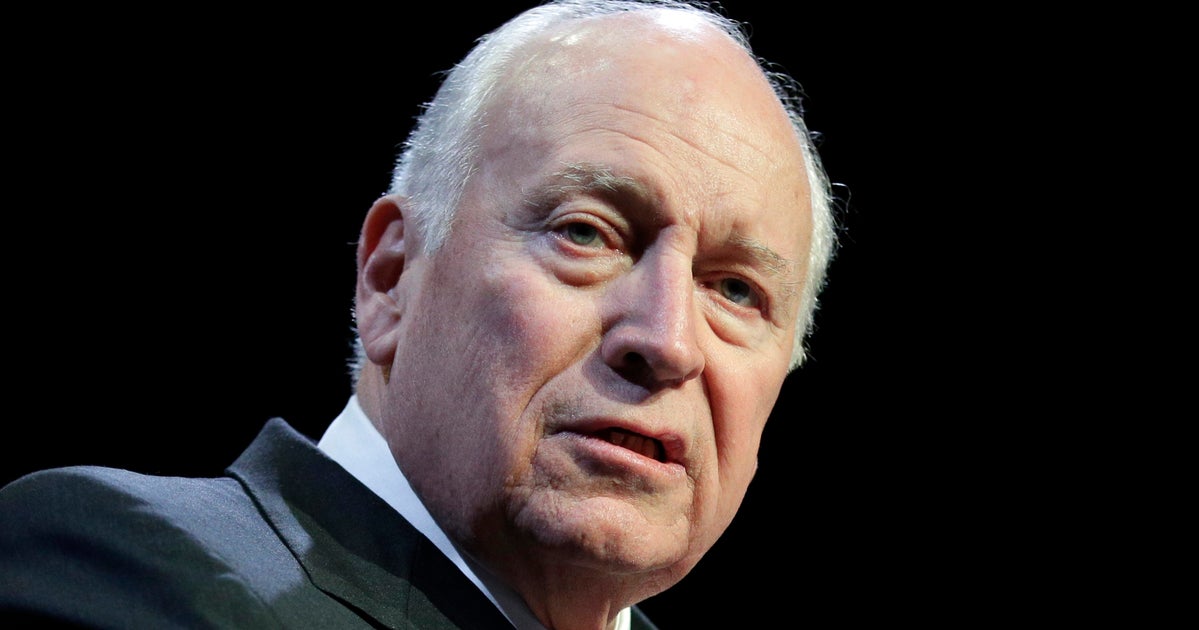

Former Vice President Richard B. “Dick” Cheney, the historically powerful vice president and architect of the U.S.’s endless “war on terror” during his time as the No. 2 in the George W. Bush administration, has died, his family announced in a statement Tuesday. He was 84.
“The former Vice President died due to complications of pneumonia and cardiac and vascular disease” on Monday evening, the statement reads.
“For decades, Dick Cheney served our nation, including as White House Chief of Staff, Wyoming’s Congressman, Secretary of Defense, and Vice President of the United States,” his family said. “Dick Cheney was a great and good man who taught his children and grandchildren to love our country, and to live lives of courage, honor, love, kindness, and fly fishing.”

Susan Walsh/File/AP Photo
During his tenure as Bush’s vice president from 2001 to 2009, Cheney was a crucial, manipulative proponent of the U.S. invasion of Iraq — which led to what has come to be viewed as a pointless war resulting in the deaths of an estimated hundreds of thousands of people, including about 4,500 Americans, while costing taxpayers over $2 trillion — and a notable advocate for torture of suspected terrorists. He became known for his neoconservative views on foreign policy and his advocacy of the use of executive power.
Cheney has been called “the most powerful vice president in history.” Bush said at one point, “When you’re talking to Dick Cheney, you’re talking to me. When Dick Cheney’s talking, it’s me talking.”

Despite his controversial record — which earned him an approval rating of just over 30% as he was leaving the VP post, according to the Pew Research Center — Bush called Cheney’s death “a loss to the nation and a sorrow to his friends.”
“Dick was a calm and steady presence in the White House amid great national challenges,” Bush said in a statement. “I counted on him for his honest, forthright counsel, and he never failed to give his best. He held to his convictions and prioritized the freedom and security of the American people.”

Charles Dharapak/File/AP Photo
Cheney was born in Lincoln, Nebraska, on Jan. 30, 1941, to parents who identified as Democrats. He grew up in Casper, Wyoming, where he met Lynne Vincent, who would become his wife in 1964. The couple had two daughters, Liz, the former congresswoman, and Mary.
Cheney was accepted to Yale University, but dropped out after three semesters when he lost his scholarship because of poor grades. He went on to attend the University of Wyoming, from which he received both a bachelor’s and master’s degree in political science. While living in Wyoming, he served as an intern in the state legislature. Later, Cheney worked toward a doctorate in political science at the University of Wisconsin, though he never completed the degree.
In 1968, after an internship with Wisconsin Gov. Warren Knowles (R), Cheney began his ascent through the ranks of Washington with a fellowship on Capitol Hill. He was later hired by Donald Rumsfeld, who had just been appointed by President Richard Nixon to lead the Office of Economic Opportunity. When Rumsfeld went on to become President Gerald Ford’s chief of staff, Cheney was tapped as his deputy. Later, Rumsfeld was named secretary of defense, and Cheney moved up to chief of staff, at the age of 34.
After Ford’s term ended, Cheney was elected to Congress as a representative from his home state of Wyoming, and eventually assumed the role of House minority whip. In 1989, he became secretary of defense under President George H.W. Bush, during which time he oversaw the Gulf War. The president awarded Cheney the Presidential Medal of Freedom in 1991 for his role in that conflict.
In 1996, he was named CEO of energy industry company Halliburton. Four years later, while living in Dallas, he agreed to lead the search for a vice-presidential candidate to run alongside Republican presidential candidate George W. Bush, who was at the time the governor of Texas. Cheney vetted a number of potential candidates, but Bush eventually decided Cheney himself would be the best running mate. “You know, you’re the solution to my problem,” Bush told the energy executive.


Even while the final results of the 2000 presidential election were delayed over disputed ballots in Florida, Cheney quietly began preparing for his White House job. In what may have been an indication of how he would approach the role, Cheney hired a large number of vice-presidential staff and was the first vice president to be given office space near the House of Representatives’ chamber.
Immediately following the Sept. 11, 2001, terrorist attacks, Cheney took charge of directing the emergency response from Washington, D.C., since the president was visiting a school in Florida at the time. After both World Trade Center towers and the Pentagon were hit by airplanes, Cheney received word that another airplane had gone off course. He gave authorization for the plane to be shot down, though the directive was not relayed to fighter pilots before the aircraft crashed in Pennsylvania. While Cheney, Bush and others later claimed the vice president gave the order after talking with Bush, 9/11 investigators found no record of the call.

After 9/11, Cheney pushed for the U.S. to invade Iraq, leading the faction of administration officials who argued that Iraqi leader Saddam Hussein possessed weapons of mass destruction and had ties to al Qaeda. He also sat in on GOP conference meetings to quell dissent against that stance.
The former vice president continued to defend the Iraq invasion, even while many others from the administration admitted errors in judgment. Bush himself said that using inaccurate intelligence to link Hussein with WMDs was his “biggest regret of all the presidency.” But in 2014, Cheney remained defiant, telling Politico of the invasion: “I believed in it then. I look back on it now, it was absolutely the right thing to do.”
Criticism of the increasingly unpopular Iraq war led to another problem for Cheney in 2007 when his chief of staff, I. Lewis “Scooter” Libby, was convicted of lying to federal officials about how he learned of the identity of CIA agent Valerie Plame, which had been leaked to the press. Plame’s husband, former ambassador Joseph Wilson, had criticized the administration’s move to invade Iraq, and the FBI suspected the White House had leaked Plame’s identity in retribution. (It was later learned that the leak came from Richard Armitage, deputy to then-Secretary of State Colin Powell.) Bush commuted Libby’s prison sentence at Cheney’s request, but did not offer a full pardon.

Richard Drew/File/AP Photo
During and after his time as vice president, Cheney staunchly advocated for the torture of suspected terrorists.
“We’ll have to work sort of the dark side, if you will,” he said shortly after 9/11, adding that “it’s going to be vital for us to use any means at our disposal basically, to achieve our objectives.”
More than a decade later, when the Senate Intelligence Committee released an incriminating report on the CIA’s use of torture after 9/11, Cheney continued to defend the controversial interrogation tactics. “I’d do it again in a minute,” he told NBC’s “Meet the Press” in December 2014.
“They are terrorists,” Cheney said, referring to the detainees who were tortured. “They are people who have committed unlawful acts of war against the American people. And we put them in places where we could proceed with the interrogation program and find out what they knew so we could protect the country against further attack. And it worked.”

AP Photo/Jae C. Hong, File
Most recently, Cheney made heads turn with his endorsement of then-Vice President Kamala Harris, the Democratic nominee in the 2024 presidential election.
“In our nation’s 248-year history, there has never been an individual who is a greater threat to our republic than Donald Trump,” Cheney said in a statement in September 2024. “He tried to steal the last election using lies and violence to keep himself in power after the voters had rejected him. He can never be trusted with power again.”
“As citizens, we each have a duty to put country above partisanship to defend our Constitution. That is why I will be casting my vote for Vice President Kamala Harris,” he continued.
Cheney had supported Trump in 2016 but turned on the GOP leader following the Jan. 6, 2021, insurrection.
Cheney had experienced heart problems for much of his adult life, suffering five heart attacks. He later got a heart transplant in 2012, about three years after retiring from his high-profile White House job.
“It’s the gift of life itself,” he told a podcast a few years after the procedure.