
Nineteen days after taking power as China’s leader, Xi Jinping convened the generals overseeing the country’s nuclear missiles and issued a blunt demand. China had to be ready for possible confrontation with a formidable adversary, he said, signaling that he wanted a more potent nuclear capability to counter the threat.
Their force, he told the generals, was a “pillar of our status as a great power.” They must, Mr. Xi said, advance “strategic plans for responding under the most complicated and difficult conditions to military intervention by a powerful enemy,” according to an official internal summary of his speech in December 2012 to China’s nuclear and conventional missile arm, then called the Second Artillery Corps, which was verified by The New York Times.
Publicly, Mr. Xi’s remarks on nuclear matters have been sparse and formulaic. But his comments behind closed doors, revealed in the speech, show that anxiety and ambition have driven his transformative buildup of China’s nuclear weapons arsenal in the past decade.
From those early days, Mr. Xi signaled that a robust nuclear force was needed to mark China’s ascent as a great power. He also reflected fears that China’s relatively modest nuclear weaponry could be vulnerable against the United States — the “powerful enemy” — with its ring of Asian allies.
Now, as China’s nuclear options have grown, its military strategists are looking to nuclear weapons as not only a defensive shield, but as a potential sword — to intimidate and subjugate adversaries. Even without firing a nuclear weapon, China could mobilize or brandish its missiles, bombers and submarines to warn other countries against the risks of escalating into brinkmanship.
“A powerful strategic deterrent capability can force the enemy to pull back from rash action, subduing them without going to war,” Chen Jiaqi, a researcher at China’s National Defense University, wrote in a paper in 2021. “Whoever masters more advanced technologies, and develops strategic deterrent weapons that can leave others behind it in the dust, will have a powerful voice in times of peace and hold the initiative in times of war.”
This article draws on Mr. Xi’s internal speeches and dozens of People’s Liberation Army reports and studies, many in technical journals, to trace the motivations of China’s nuclear buildup. Some have been cited in recent studies of China’s nuclear posture; many others have not been brought up before.
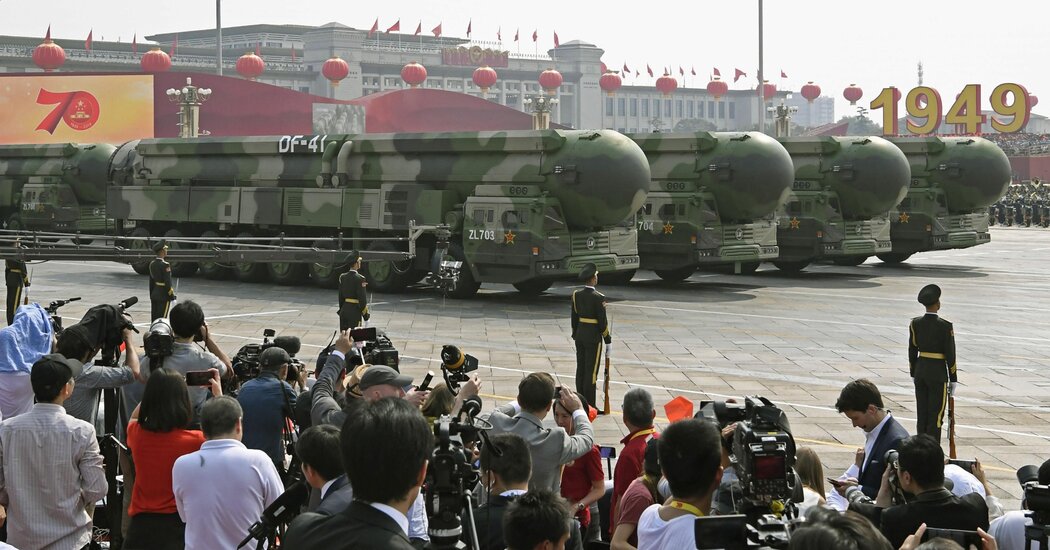
Mr. Xi has expanded the country’s atomic arsenal faster than any other Chinese leader, bringing his country closer to the big league of the United States and Russia. He has doubled the size of China’s arsenal to roughly 500 warheads, and at this rate, by 2035, it could have around 1,500 warheads — roughly as many as Washington and Moscow each now deploy, U.S. officials have said. (The United States and Russia each have thousands more warheads mothballed.)
China is also developing an increasingly sophisticated array of missiles, submarines, bombers and hypersonic vehicles that can deliver nuclear strikes. It has upgraded its nuclear test site in its far western Xinjiang region, clearing the way for possible new underground tests, perhaps if a superpower arms race breaks out.
A major shift in China’s nuclear power and doctrine could deeply complicate its competition with the United States. China’s expansion has already set off intense debate in Washington about how to respond, and it has cast greater doubt on the future of major arms control treaties. All while U.S.-Russian antagonism is also raising the prospect of a new era of nuclear rivalry.
Mr. Xi and President Biden have calmed rancor since last year, but finding nuclear stability may be elusive if Beijing stays outside of major arms control treaties while Washington squares off against both Beijing and Moscow.
Crucially, China’s growing nuclear options could shape the future of Taiwan — the island democracy that Beijing claims as its own territory and that relies on the United States for security backing. In the coming years, Beijing may gain confidence that it can limit the intervention of Washington and its allies in any conflict.
In deciding Taiwan’s fate, China’s “trump card” could be a “powerful strategic deterrence force” to warn that “any external intervention will not succeed and cannot possibly succeed,” Ge Tengfei, a professor at China’s National University of Defense Technology, wrote in a Communist Party journal in 2022.
Xi’s Nuclear Revolution
Since China first tested an atomic bomb in 1964, its leaders have said that they would never be “the first to use nuclear weapons” in a war. China, they reasoned, needed only a relatively modest set of nuclear weapons to credibly threaten potential adversaries that if their country was ever attacked with nuclear arms, it could wipe out enemy cities.

“In the long run, China’s nuclear weapons are just symbolic,” said Deng Xiaoping, China’s leader, in 1983, explaining Beijing’s stance to the visiting Canadian prime minister, Pierre Trudeau. “If China spent too much energy on them, we’d weaken ourselves.”
Even as China upgraded its conventional forces starting in the 1990s, its nuclear arsenal grew incrementally. When Mr. Xi took over as leader in 2012, China had about 60 intercontinental ballistic missiles capable of hitting the United States.
China was already increasingly challenging its neighbors in territorial disputes and saw danger in the Obama administration’s efforts to shore up U.S. power across the Asia-Pacific. In a speech in late 2012, Mr. Xi warned his commanders that the United States was “stepping up strategic containment and encirclement around us.”
Beijing worried, too, that its nuclear deterrent was weakening. Chinese military analysts warned that the People’s Liberation Army’s missiles were growing vulnerable to detection and destruction as the United States made advances in military technology and built alliances in Asia.
Official Chinese accounts of history reinforced that fear. People’s Liberation Army studies often dwell on the Korean War and crises over Taiwan in the 1950s, when American leaders hinted that they could drop atomic bombs on China. Such memories have entrenched views in Beijing that the United States is inclined to use “nuclear blackmail.”
“We must have sharp weapons to protect ourselves and killer maces that others will fear,” Mr. Xi told People’s Liberation Army armaments officers in late 2014.
Late in 2015, he took a big step in upgrading China’s nuclear force. In his green suit as chairman of China’s military, he presided over a ceremony in which the Second Artillery Corps, the custodian of China’s nuclear missiles, was reborn as the Rocket Force, elevated to a service alongside the army, navy and air force.
The Rocket Force’s mission, Mr. Xi told its commanders, included “enhancing a credible and reliable nuclear deterrent and nuclear counterstrike capability” — that is, an ability to survive an initial attack and hit back with devastating force.
From Tunnels to Silo Fields
China is not only on a quest for more warheads. It is also focused on concealing and shielding the warheads, and on being able to launch them more quickly and from land, sea or air. The newly elevated Rocket Force has added a powerful voice to that effort.
Researchers from the Rocket Force wrote in a study in 2017 that China should emulate the United States and seek “nuclear forces sufficient to balance the new global situation, and ensure that our country can win the initiative in future wars.”
China’s nuclear deterrent long relied heavily on units dug into tunnels deep in remote mountains. Soldiers are trained to go into hiding in tunnels for weeks or months, deprived of sunlight, regular sleep and fresh air while they try to stay undetected by enemies, according to medical studies of their grueling routine.
“If war comes,” said a Chinese state television report in 2018, “this nuclear arsenal that shuttles underground will break cover where the enemy least expects and fire off its missiles.”
The Rocket Force expanded quickly, adding at least 10 new brigades, an increase of about one-third, within a few years, according to a study published by the U.S. Air Force’s China Aerospace Studies Institute. China has also added more road- and rail-mobile missile launchers to try to outfox American satellites and other detection technology.
Chinese fears of American abilities have nonetheless remained. Even as China was rolling out road-mobile missiles, some experts from the People’s Liberation Army argued that they could be tracked by ever more sophisticated satellites.
A solution, some analysts from the Rocket Force argued in 2021, was to also build clusters of launch silos for missiles, forcing U.S. forces to try to detect which ones housed real missiles and which ones had dummies, making it “even harder to wipe them out in one blow.”
Other Chinese studies made similar arguments for silos, and Mr. Xi and his commanders seemed to heed them. The boldest move so far in his nuclear expansion has been three vast fields of 320 or so missile silos built in northern China. The silos, safely distant from U.S. conventional missiles, can hold missiles capable of hitting the United States.
The expansion, though, has hit turbulence. Last year, Mr. Xi abruptly replaced the Rocket Force’s two top commanders, an unexplained shake-up that suggests its growth has been troubled by corruption. This year, nine senior Chinese military officers were expelled from the legislature, indicating an widening investigation.
The upheaval could slow China’s nuclear weapons plans in the short term, but Mr. Xi’s long-term ambitions appear set. At a Communist Party congress in 2022, he declared that China must keep building its “strategic deterrence forces.”
And even with hundreds of new silos, Chinese military analysts find new sources of worry. Last year, Chinese rocket engineers proposed reinforcing silos to better shield missiles from precision attacks. “Only that can make sure that the our side is able to deliver a lethal counterstrike in the event of a nuclear attack,” they wrote.
Tough Decisions
Chinese leaders have said that they want peaceful unification with Taiwan, but may use force if they deem that other options are spent. If Beijing moved to seize Taiwan, the United States could intervene to defend the island, and China may calculate that its expanded nuclear arsenal could present a potent warning.
Chinese military officers have issued blustery warnings of nuclear retaliation over Taiwan before. Now, China’s threats could carry more weight.
Its expanding array of missiles, submarines and bombers could convey credible threats to not just cities in the continental United States, but to American military bases on, say, Japan or Guam. The risk of a conventional clash spiraling into nuclear confrontation could hang over decisions. Chinese military analysts have argued that Russian nuclear warnings constrained NATO countries in their response to the invasion of Ukraine.
“The ladder of escalation that they can apply now is much more nuanced,” said Bates Gill, the executive director of Asia Society Policy Institute’s Center for China Analysis. “The implicit message is not just: ‘We could nuke Los Angeles.’ Now it’s also: ‘We could wipe out Guam, and you don’t want to risk escalation if we do.’”
Beijing’s options include 200 or so DF-26 missile launchers, which can swap between conventional and nuclear warheads and hit targets across Asia. Chinese official media have described Rocket Force units practicing such swaps, and boasted during a military parade about the missile’s dual convention-nuclear role — the kind of disclosure meant to spook rivals.
In a real confrontation, Washington could face difficult decisions over whether potential targets for strikes in China may include nuclear-armed missile units, and in an extreme whether an incoming DF-26 missile may be nuclear.
“That’s going to be a really tough decision for any U.S. president — to trust that whatever advice he’s getting is not risking nuclear escalation for the sake of Taiwan,” said John K. Culver, a former C.I.A. senior analyst who studies the Chinese military. “As soon as the U.S. starts bombing mainland China, no one is going to be able to tell the U.S. president with conviction exactly where China’s line is.”