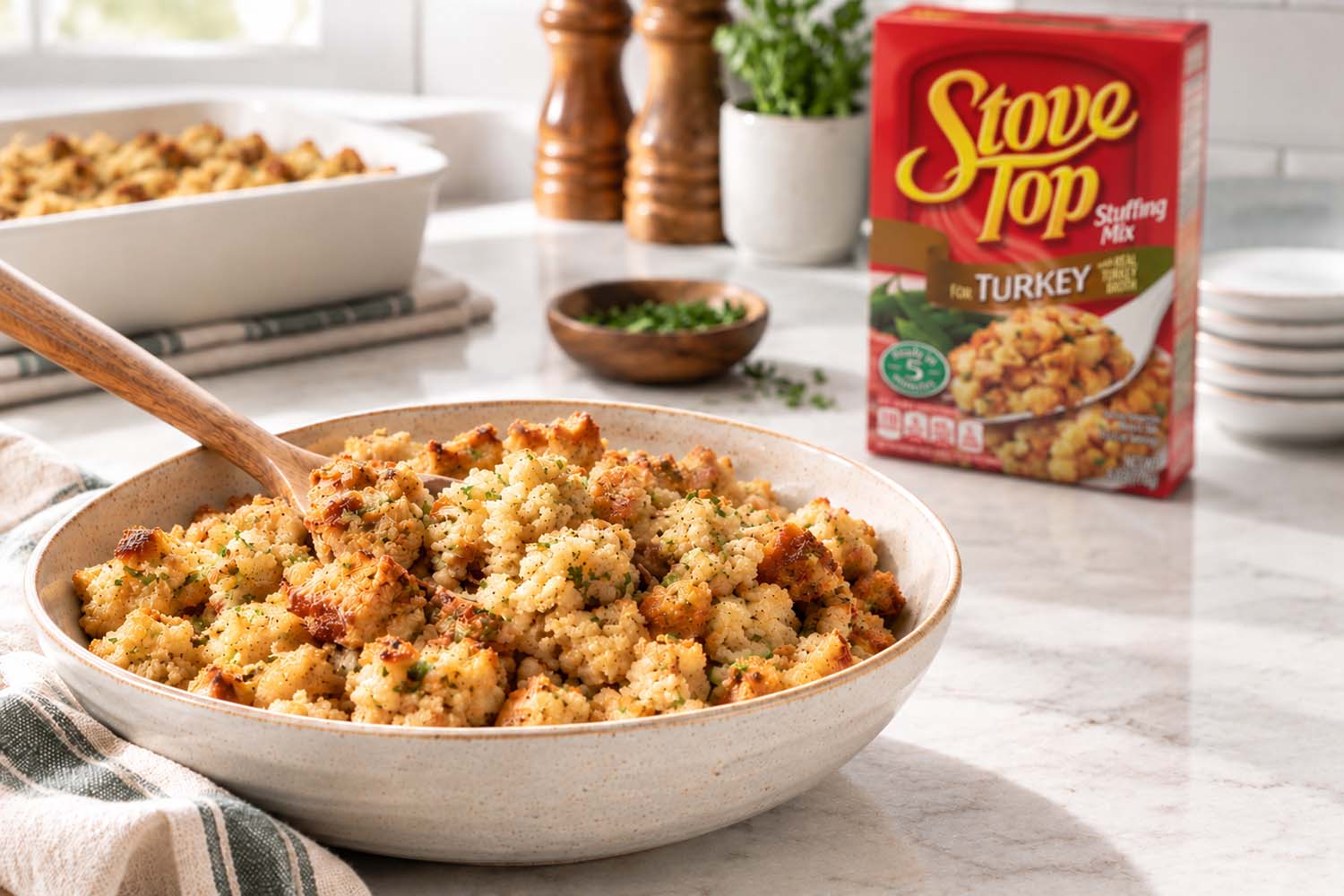

There is a box of stuffing mix in the back of the cupboard, and a dish of last night’s stuffing in the refrigerator. They aren’t the same kind of food, and they don’t follow the same rules. Here is what the agencies say, and where the Stove Top pages say nothing.
Does Stove Top stuffing go bad?
The short answer: Yes. The dry box is a pantry item, and USDA says its printed date is about quality, not safety. Once the stuffing is prepared, it is a cooked leftover: USDA says to refrigerate it within 2 hours (1 hour above 90°F) and use it within 3 to 4 days.
For a complete pantry storage reference, see our Food Storage Guide.
📋 Does Stove Top Stuffing Go Bad: At a Glance
| Unopened box | Pantry item. USDA says dating is for quality, not safety. NDSU lists bread mixes at 12 to 18 months unopened |
| Opened box | No maker or agency number we could find. Keep it in a tight-lidded container and check for pests |
| Prepared stuffing | Refrigerate within 2 hours of cooking (1 hour above 90°F). Use within 3 to 4 days, per USDA |
| Left out | 2 hours, or 1 hour above 90°F. Past that, throw it out |
| Made ahead, uncooked | Don’t refrigerate assembled, uncooked stuffing. Cook it right away or freeze it, per USDA |
| Frozen leftovers | USDA’s pages differ: 1 month, 3 to 4 months, or 4 to 6 months, all for quality. We aim for a month |
| Reheat to | 165°F, per USDA |
Key Takeaways
- Yes, Stove Top stuffing goes bad, but the dry box and the prepared stuffing run on very different clocks.
- The dry box is a pantry item, and USDA says dating is for quality, not safety. We found no storage or shelf-life text on the Kraft Heinz Stove Top pages we could load, so check your box.
- Once it’s prepared, stuffing is a cooked leftover. USDA says refrigerate it within 2 hours (1 hour above 90°F) and use it within 3 to 4 days.
- Some pages print 4 to 6 days for prepared stuffing. That is longer than USDA’s figure, and none we read cite a source.
- Don’t refrigerate assembled, uncooked stuffing. USDA says to cook it right away or freeze it, and to keep the wet and dry ingredients apart until just before cooking.
- A leftover that is moldy, left out too long, or past 4 days goes in the trash. A normal look and smell doesn’t prove it’s safe.
USDA’s Turkey Basics: Stuffing page says that for optimal safety and uniform doneness, you should cook stuffing separately. If you do stuff the bird, it says to stuff loosely, about 3/4 cup of stuffing per pound. The center of the stuffing has to reach a safe minimum internal temperature of 165°F. It also says to refrigerate the cooked turkey and stuffing within 2 hours after cooking, in shallow containers. Our section on making stuffing ahead covers where USDA and Kraft Heinz’s directions differ.
Which Stove Top Stuffing Do You Have?
Start with the state it’s in, because the dry box and the cooked dish have different clocks.
| Stuffing | How long it lasts | Source |
|---|---|---|
| Unopened box | Quality date, not a safety date. NDSU: 12 to 18 months for bread mixes | USDA, NDSU |
| Opened box | No number found. Reseal tightly and check for pests | UMD Extension, ours |
| Prepared, refrigerated | 3 to 4 days | USDA |
| Prepared, on the table | 2 hours, or 1 hour above 90°F | USDA |
| Assembled, uncooked | Don’t refrigerate. Cook it right away or freeze it | USDA |
| Frozen leftovers | 1 month, 3 to 4 months or 4 to 6 months, depending on the USDA page. All are for quality | USDA |
| Reheated leftovers | Heat to 165°F | USDA |
How Long Does an Unopened Box of Stove Top Last?
Kraft Heinz’s Stove Top page lists several Stove Top mixes, including chicken, turkey, pork, cornbread, savory herbs, traditional sage and low sodium. The pages we loaded show no shelf life or storage text for any of them, so we have no general shelf-life number to give you. Check the date and any storage directions on your own box. We treat the flavors alike, and that is our reading.
For a general range, NDSU Extension’s guide to storing canned and packaged food lists cakes, brownies and bread mixes at 12 to 18 months unopened. Stuffing mix isn’t named, so applying that range to Stove Top is our estimate, not a manufacturer recommendation. Many pages print a figure of their own, such as six months past the printed date, and none we read cite a source.
USDA’s shelf-stable food page says to store shelf-stable products in a cool, dry place. Our tip: pick a cupboard away from the stove and the sink, and use the oldest box first. NDSU suggests a “first in, first out” order for the same reason. Other boxed sides have their own guides, like instant mashed potatoes, rice and pasta. For the rest of the shelf, see our guide to expired pantry staples.
How Long Does an Opened Box of Stuffing Mix Last?
We found no maker or agency number for an opened box of stuffing mix. One page we read says to use it “within a few weeks,” and another says it “could last months.” Neither cites a source, so we don’t repeat either number.
What the extension sources do cover is pests. University of Maryland Extension’s kitchen and pantry pests page says pests may be brought into the home in packages contaminated with eggs. It says dry packaged foods such as flour, meal, pasta and breakfast cereals should be checked. It says to keep food in glass jars, plastic containers or metal canisters with tight fitting lids, because insects can chew through plastic bags and cardboard boxes. UC IPM’s pantry pests page says to carefully inspect all packages, especially those that have been opened or are exposed.
Both say to throw away infested food. Stuffing mix isn’t named, but it is a dry, bread-based product, and we treat it the same way. Our tip: tip the leftover mix into a lidded container and write the date on it. Making your own from stale bread? See whether sourdough bread goes bad. If you keep breadcrumbs too, our guide on whether breadcrumbs go bad covers a close cousin, and what to use instead of breadcrumbs helps when you run out.

Is Stove Top Stuffing Safe Past the Date on the Box?
USDA’s food product dating page says product dating isn’t required by federal regulations, except for infant formula. A “Best if Used By” date indicates when a product will be at its best flavor or quality, and it isn’t a safety date. NDSU Extension says the same about “Best if used by” dates.
So a past date does not automatically mean the mix is unsafe. Check the package and how it was stored, and discard the mix if it is damp, damaged, infested or smells off. We found no source that gives a specific extension past the printed date for Stove Top. NDSU says not to buy food with torn packaging, so tossing a torn or wet box at home is our call. UC IPM says webbing or tiny holes in a container are signs of infestation. Our tip: if the mix smells musty or off, or the crumbs are clumped from damp, don’t use it. We don’t suggest tasting it to test.
How Long Does Prepared Stove Top Stuffing Last?
USDA’s leftovers guidance says leftovers can be kept in the refrigerator for 3 to 4 days. USDA gives the same figure for leftover stuffing, and says cooked stuffing should be cooled in shallow containers and refrigerated within 2 hours. USDA’s clock runs from the end of cooking, or from when the food comes out of an appliance keeping it warm, not from when you put it away. Keep the refrigerator at 40°F or below, per USDA’s Food Safety Basics page.
That applies to Stove Top the same as homemade. Some pages print 4 to 6 days for prepared stuffing, and none we read cite a source. USDA’s 3 to 4 days is the figure we use. Our tip: label the container with the day you cooked it.
If you stir in sausage, eggs or broth, our practical rule is to follow the 3 to 4 day window for the finished dish. Follow any shorter instructions on the ingredients you added too. Adding them doesn’t extend the window. For the rest of the meal, see how long leftovers last, and for the turkey and sides, our guides on deli turkey, ham and potatoes. Making a ham for the same meal? Try our wine-glazed ham or bourbon baked ham.
Can You Make Stove Top Stuffing Ahead of Time?
USDA’s Stuffing and Food Safety page (last updated August 2013) says stuffing should not be prepared ahead. It says the dry and wet ingredients can be prepared ahead of time and chilled, but not mixed until just before the stuffing goes into the poultry cavity. It says not to refrigerate uncooked stuffing, and that if stuffing is prepared ahead, it must be either frozen or cooked immediately.
Cooked stuffing is different. USDA says to cool it in shallow containers and refrigerate it within 2 hours, then use it within 3 to 4 days. It also says it is safe to freeze uncooked stuffing. Combine the ingredients, put them in a shallow container and freeze immediately. Don’t thaw it before cooking. Cook it from frozen until it reaches 165°F.
Kraft Heinz’s Stove Top in-the-bird directions have you place any remaining prepared stuffing in a baking dish. You refrigerate it until it goes in the oven for the last 30 minutes of the turkey’s baking time. That differs from USDA’s advice not to refrigerate uncooked stuffing, and the Kraft Heinz page doesn’t address the difference. We follow USDA’s more specific stuffing guidance. Our tip: if you want a head start, measure the dry mix and prep the add-ins ahead, and add the hot water on the day you cook.
How Long Can Stuffing Sit Out?
USDA says to always refrigerate perishable food within 2 hours, or 1 hour when the temperature is above 90°F. USDA’s leftovers guidance says leftovers must be refrigerated within 2 hours of cooking, or of being removed from an appliance keeping them warm. After that, USDA’s rule is to throw it away.
The clock isn’t about the turkey cavity. It is about time outside the refrigerator or a warming appliance. USDA says to refrigerate the cooked turkey and stuffing within 2 hours after cooking, so stuffing left in a bird at room temperature runs on the same clock. A stuffed turkey that went into the refrigerator promptly is a different situation from one left on the counter.
Our tip: pull the stuffing out of the bird and into shallow containers as soon as you carve. For a table that runs long, set out a small dish and refill it from the kitchen. To round out the menu, try our fresh cranberry sauce with orange and cinnamon, low-carb cranberry sauce or maple pumpkin pie. If you’re hosting, our Thanksgiving home cleaning checklist can take some of the prep off your list.
Does Stove Top Stuffing Need to Be Refrigerated?
Not the dry box. Kraft Heinz’s pages we loaded give no storage text, and USDA says to store shelf-stable products in a cool, dry place. A dry boxed mix fits that description, so the pantry is the place for it. That is our reading, and the box wins if it says otherwise.
Prepared stuffing is the opposite. Once cooked, it is a leftover, so it goes in the refrigerator within 2 hours (1 hour above 90°F), in shallow containers, per USDA. Uncooked, assembled stuffing is the exception. USDA says not to refrigerate it. The box isn’t the thing that spoils. The cooked food is.
Can You Freeze Stove Top Stuffing?
USDA’s pages give three different freezer times for stuffing, and all are for quality. USDA lists stuffing at 1 month in the freezer. USDA’s leftovers guidance says leftovers can be frozen for 3 to 4 months. USDA’s Turkey Basics: Handling Cooked Dinners page lists cooked poultry dishes, stuffing and gravy at 4 to 6 months. It says freezer storage times are for quality only and that frozen foods remain safe indefinitely.
The leftovers page adds that frozen leftovers are safe indefinitely but can lose moisture and flavor when stored for longer times in the freezer. FoodSafety.gov’s cold food storage chart says food held continuously at 0°F can be kept indefinitely, and its chart doesn’t list stuffing.
So you can freeze prepared stuffing, and the trade-off is texture. We found no maker guidance on freezing Stove Top. Our rule: aim to use it within a month for best quality, and treat the longer USDA ranges as the outer limit. Our tip: cool it first, pack it flat in a freezer container, and label the date. Don’t leave it sitting in the dish for hours to cool.
How Do You Reheat Leftover Stuffing?
USDA’s leftovers guidance says to reheat leftovers to 165°F, measured with a food thermometer. For the microwave, it says to cover and rotate the food for even heating. USDA says the same 165°F for leftover stuffing.
Our tip: check the center of the stuffing with the thermometer, and more than one spot if you’re using the microwave, since heating can be uneven. Stir a splash of broth or water in before reheating if it has dried out. Reheating makes leftovers hot again, but it doesn’t rescue stuffing that sat out too long or has passed its window, because USDA’s rule for that is to throw it away.
Signs Something Is Actually Wrong
- Webbing, tiny holes, bugs or larvae in the box or the mix.
- Mold on prepared stuffing, even a small spot.
- A musty or off smell from the dry mix or the leftovers.
- Clumped, damp mix in an opened box.
- Prepared stuffing left out more than 2 hours (1 hour above 90°F), or kept past 4 days in the refrigerator.
- Assembled, uncooked stuffing that was refrigerated. USDA says to cook it right away or freeze it.
The pest signs come from the extension sources. The smell and clumping items are our checklist. USDA’s page on mold on food says to discard moldy bread and baked goods, and cooked casseroles, because porous or high-moisture foods can be contaminated below the surface. It says if food is covered with mold, discard it. Stuffing isn’t named, but it is a cooked, bread-based dish, so we treat it the same way. Don’t taste it to test.
Normal Things That Aren’t a Problem
- A box that is a little past its printed date but is sealed, dry and undamaged.
- Leftover stuffing firming up in the refrigerator.
- Frozen stuffing that comes out a little drier than fresh, which USDA describes.
The first and second items are our observations. The third is described by USDA.
Quick Storage Reference
- Unopened box: Cool, dry cupboard. The printed date is about quality.
- Opened mix: Tight-lidded container, checked for pests (ours).
- Prepared stuffing: Shallow containers, refrigerated within 2 hours (1 hour above 90°F), used in 3 to 4 days.
- Uncooked, assembled: Cook right away or freeze. Don’t refrigerate it.
- Frozen leftovers: USDA’s pages say 1 month, 3 to 4 months or 4 to 6 months, all for quality. We aim for a month.
- Reheat to: 165°F, covered and rotated in the microwave.
| Situation | What to Do |
|---|---|
| Stuffing prepared 2 days ago, kept in the refrigerator | Within USDA’s 3 to 4 days. Reheat it to 165°F. |
| Stuffing prepared 4 days ago, kept in the refrigerator | Within the last day of USDA’s 3 to 4 days. Reheat it to 165°F and finish it today. |
| Stuffing prepared 6 days ago | Past USDA’s 3 to 4 days. Discard it. |
| Dish on the table for 3 hours | Over the 2 hour limit. Discard it. |
| Dish on a patio table for 90 minutes at 95°F | Over the 1 hour limit above 90°F. Discard it. |
| Cooked stuffed turkey left at room temperature overnight | Discard the turkey and the stuffing. USDA’s limit is 2 hours, or 1 hour above 90°F. |
| Cooked stuffed turkey refrigerated within 2 hours, stuffing removed and stored separately | Within the rules. Use the leftovers in 3 to 4 days and reheat them to 165°F. |
| Assembled, uncooked stuffing sitting in the refrigerator overnight | USDA says not to refrigerate uncooked stuffing. Cook it right away next time, or freeze it. |
| Unopened box a year past its printed date, box intact | A past date does not automatically mean the mix is unsafe. USDA says dates indicate quality, not safety. Check the package and storage history, and discard it if it is damp, damaged, infested or smells off. |
| Box with webbing or tiny holes | Discard it and check nearby dry goods. |
| Torn or water-damaged box | NDSU says not to buy food with torn packaging. Discarding one already at home is our call, and we would. |
| Fuzzy spot on leftover stuffing | Discard all of it. USDA says mold can go below the surface of bread and casseroles. |
| Frozen leftover stuffing, 5 months old | USDA’s freezer times range from 1 to 6 months, all for quality, and it says frozen food remains safe indefinitely. Expect a drier texture, and reheat it to 165°F. |
How We Checked This
In October 2026 we read USDA’s pages on turkey stuffing, stuffing and food safety, and cooked turkey dinners. We also read its pages on leftovers, food safety basics, shelf-stable food, product dating and mold, plus FoodSafety.gov’s cold food storage chart. We also read NDSU Extension’s packaged food guide, the University of Maryland Extension and UC IPM pantry pest pages, and two Kraft Heinz Stove Top pages. The Stove Top product pages we could load carry no shelf-life or storage text, so we say so instead of guessing. Other pages print storage numbers that vary and don’t cite a source. We have not tested any stuffing ourselves. Suggestions marked as ours are practical tips and not source guidance.
Does Stove Top Stuffing Go Bad FAQ
How long does prepared Stove Top stuffing last in the refrigerator?
USDA says 3 to 4 days for leftover stuffing, refrigerated within 2 hours of cooking (1 hour above 90°F) in shallow containers, with the refrigerator at 40°F or below. Some pages print 4 to 6 days, but none we read cite a source.
How long does an unopened box of Stove Top last?
The Stove Top pages we loaded give no shelf life, so check the box. NDSU lists bread mixes at 12 to 18 months unopened, and USDA says dating is for quality, not safety. Applying NDSU’s range to stuffing mix is our reading.
See also

Does Stove Top stuffing expire?
A printed date is a quality date. USDA says product dating isn’t required by federal regulations, except for infant formula, and that a “Best if Used By” date isn’t a safety date. Check that the box is sealed, dry and free of pests.
Is Stove Top stuffing good after the expiration date?
A date in the past does not automatically mean the mix is unsafe, because USDA says “Best if Used By” dates indicate quality, not safety. Check the package and storage history, and discard the mix if it is damp, damaged, infested or smells off. We found no source that gives a specific extension for Stove Top.
How long does an opened box of stuffing mix last?
We found no maker or agency number. Reseal it in a tight-lidded container and check it for pests. Some pages say “a few weeks” and others say “months,” with no source.
Does Stove Top stuffing need to be refrigerated?
Not the dry box. Store it in a cool, dry place, per USDA’s guidance for shelf-stable products. Prepared stuffing goes in the refrigerator within 2 hours of cooking, or 1 hour above 90°F.
Can you eat leftover stuffing after 5 days?
USDA’s limit is 3 to 4 days. We’d discard it. Reheating makes it hot, but it doesn’t change the rule.
Can stuffing sit out overnight?
No. USDA says to refrigerate perishable food within 2 hours, or 1 hour when the temperature is above 90°F. Overnight at room temperature is far past that, and USDA’s rule is to throw it away.
Can stuffing stay in the turkey overnight?
Not at room temperature. USDA says to refrigerate the cooked turkey and stuffing within 2 hours after cooking. A bird that was refrigerated promptly is a different situation, but we’d still pull the stuffing out and store it separately. Cook it separately when you can, which USDA says is better for optimal safety and uniform doneness.
Can you freeze Stove Top stuffing?
Yes. USDA’s pages give three quality times: 1 month, 3 to 4 months, and 4 to 6 months for cooked poultry dishes, stuffing and gravy. Frozen food remains safe indefinitely, per USDA, but quality drops. We found no maker guidance on freezing Stove Top, so we aim for a month, cool it first and pack it flat.
How do you reheat leftover stuffing?
Heat it to 165°F, measured with a food thermometer. In the microwave, cover it and rotate it for even heating, per USDA. Our tip: check the center of the stuffing, and more than one spot.
Can you make Stove Top stuffing ahead of time?
Partly. USDA says the wet and dry ingredients can be prepared ahead and chilled, but not mixed until just before cooking, and not to refrigerate assembled, uncooked stuffing. Cook it right away or freeze it. Once cooked, refrigerate it in shallow containers and use it within 3 to 4 days.
Can you refrigerate uncooked stuffing?
No. USDA says not to refrigerate uncooked stuffing, and that if stuffing is prepared ahead it must be either frozen or cooked immediately. Kraft Heinz’s in-the-bird directions have you refrigerate extra prepared stuffing until baking, which differs from USDA’s advice. We follow USDA.
How can you tell if Stove Top mix is bad?
Look for webbing, tiny holes, bugs, mold, clumping from damp or a musty smell. The extension sources cover the pest signs, and the rest is our checklist. We don’t suggest tasting it.
Can stuffing mix get bugs?
Yes. The University of Maryland Extension says pests may be brought into the home in packages contaminated with eggs. It says to keep dry food in containers with tight fitting lids and to throw away infested food.
Can you scrape mold off leftover stuffing?
No. USDA says to discard moldy bread and baked goods and cooked casseroles, because they can be contaminated below the surface. Stuffing isn’t named, but we treat it the same way.
Does homemade stuffing last longer than Stove Top?
No. Once cooked, USDA gives stuffing 3 to 4 days in the refrigerator, whatever the source.
Can old stuffing make you sick?
It can. USDA says mold can go below the surface of bread and casseroles, and leftovers kept too long or left out should be thrown away. A normal look and smell doesn’t prove it’s safe.
Can you use leftover stuffing in other dishes?
Yes, within the same 3 to 4 days. Kraft Heinz’s Stove Top product page says, “Have Thanksgiving leftovers? Turn them into mouthwatering sandwiches, wraps or casseroles.” Keep the clock on the oldest ingredient, and see how long leftovers last for the rest of the table.
Does the butter in stuffing change how long it lasts?
Kraft Heinz’s in-the-bird directions call for water and margarine. Once the stuffing is cooked, USDA’s 3 to 4 days applies to the whole dish. The fat follows its own rules before you use it, so see our guide on whether butter goes bad.
Further Reading

Better Living may earn commissions through affiliate links and may occasionally feature sponsored or partner content. If you make a purchase through our links, we may receive a small commission at no cost to you.