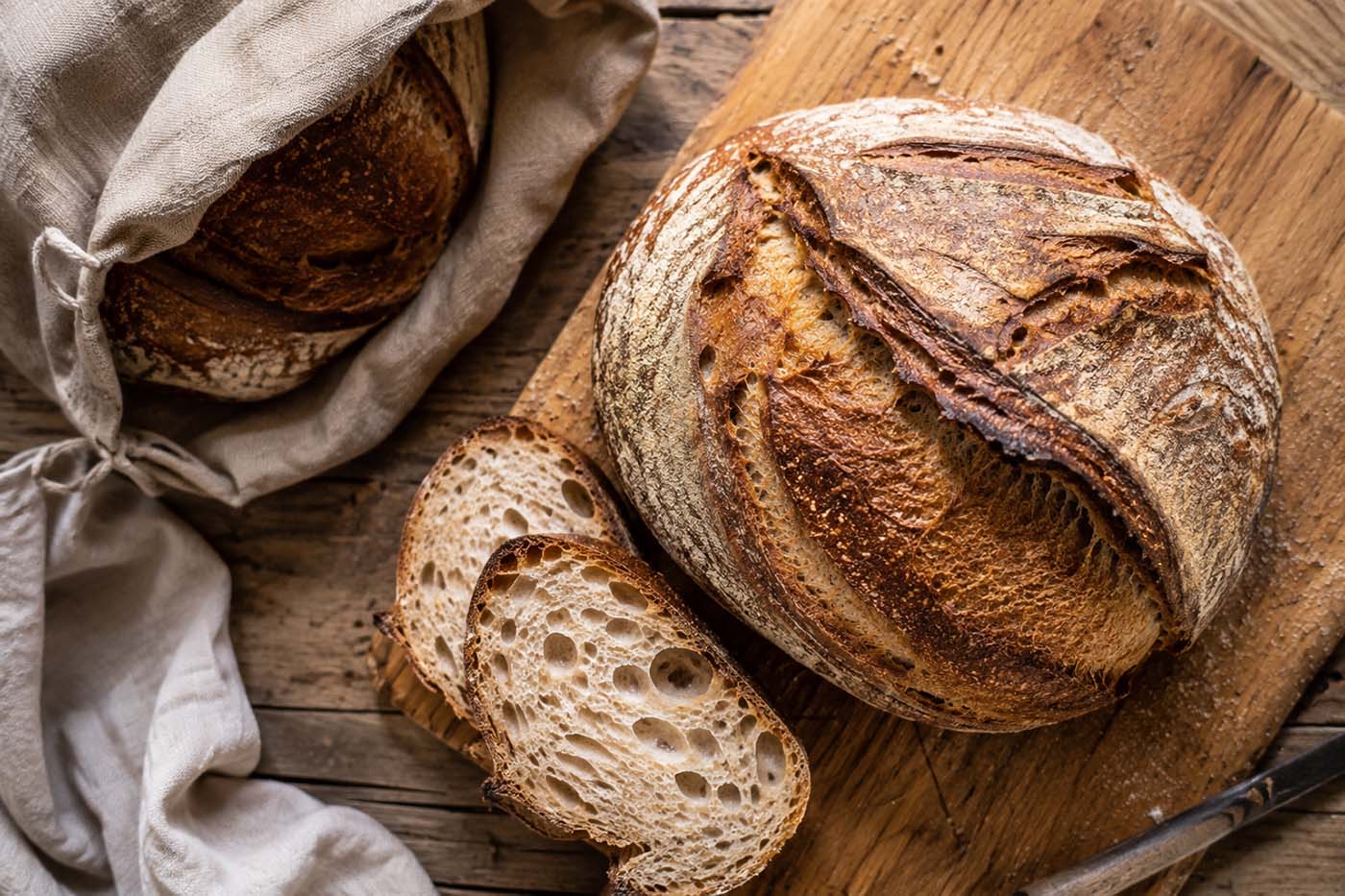

I buy sourdough from both my local farm stand and Costco, and I learned the hard way that they do not behave the same way once they get home. Left on the counter, both eventually grew mold, usually within about a week. So I started freezing whatever I would not finish in the next few days and thawing only 3 to 5 days worth of bread at a time. It made a real difference: the frozen-and-thawed loaf held its texture far better than anything I had tried keeping in the fridge, which always seemed to go dense and dry way faster than I expected, even with no mold in sight.
Does sourdough bread go bad?
The short answer: Yes, eventually. A real sourdough loaf, made with a live starter and no added preservatives, typically stays mold-free at room temperature for about 3 to 7 days, depending on the loaf, the starter’s acidity, and how humid your kitchen is, and generally longer than most preservative-free yeasted bread, thanks to the lactic and acetic acid its bacteria produce during fermentation. Staling is a separate issue from spoilage: the crumb firms up well before mold ever appears, and refrigerating the loaf actually speeds up that staling process even though it can buy you a little extra time before mold shows up. Freezing is the only storage method that pauses both processes at once.
This guide is part of our food storage guide. If you keep other baking staples on hand, our guides on whether yeast goes bad and whether flour goes bad cover the rest of what typically sits next to a loaf of sourdough in the kitchen.
📋 Does Sourdough Bread Go Bad: At a Glance
| Room temperature, mold-free window | About 3 to 7 days, depending on the loaf and how humid the kitchen is |
| Why it lasts longer | Lactic and acetic acid from fermentation inhibit mold growth |
| Refrigerator effect | Can reduce mold risk but speeds up staling of the crumb |
| Best long-term storage | Freezer, sliced, in an airtight bag |
| Can you cut mold off and keep the rest | No. USDA guidance says discard the whole loaf |
| Frozen shelf life | Safe indefinitely, best quality within 3 months |
🔑 Key Takeaways
- Sourdough’s natural acidity gives it a real, measurable edge over standard bread. University research has found the organic acids produced by sourdough’s lactic acid bacteria actively inhibit common bread molds.
- Staling and spoiling are two different things. Firm, dry crumb is a quality issue, not a safety one, while visible mold, sliminess, or a sour off-smell beyond the bread’s normal tang means it is done.
- Counterintuitively, the refrigerator is one of the worst places to store bread for texture. Peer-reviewed food science research has measured starch recrystallization, the process behind staling, as fastest at refrigerator temperatures.
- USDA guidance is clear that mold on bread should not be cut away and the rest eaten, because bread’s soft, porous structure lets mold’s root-like hyphae spread invisibly through the loaf.
- Freezing is the one storage method that pauses staling and mold growth at the same time, which makes it the best option if you will not finish a loaf within about a week.
Why Sourdough Behaves Differently Than Other Bread
🔬 The Mechanism: Acid as a Built-In Preservative
Sourdough is fermented by a mix of wild yeast and lactic acid bacteria rather than commercial yeast alone. As those bacteria work, they produce lactic acid, acetic acid, and other compounds that lower the dough’s pH and actively suppress the mold species most likely to spoil bread. A University of Nebraska-Lincoln undergraduate research study tested four American sourdough cultures against common spoilage molds, including Aspergillus and Penicillium species, and found real antifungal activity tied to those organic acids. A 2024 peer-reviewed bread safety study measured a wheat and rye sourdough whole loaf at a pH of about 4.4, noticeably more acidic than the standard yeasted sandwich bread it tested alongside it, though the same study also found that not every commercial loaf labeled “sourdough” reached that level of acidity. How sour and mold-resistant a given loaf actually is depends heavily on fermentation time and the specific culture used, not just the word on the label.
Signs Sourdough Has Actually Gone Bad
Mold
Fuzzy spots in white, green, black, or blue-grey are the clearest sign. Sourdough’s crust can also develop a naturally dusty, floury look from the bake itself, so check any suspicious patch closely: true mold has texture and often a distinct color core, not just a pale dusting.
Staling, Not Spoilage
A sourdough loaf that has gone firm, dry, or chewy on day 3 or 4 is stale, not spoiled. This is a texture and quality issue driven by starch changes in the crumb, and it happens well before the bread becomes unsafe. Stale sourdough is still perfectly fine to eat, and it is genuinely better for some uses, like croutons or bread pudding, than fresh bread would be.
Off Smells and Sliminess
Sourdough has a natural tang, but a smell that turns sharply sour, yeasty in an unpleasant way, or alcohol-like, especially combined with a slimy or sticky crumb, points to bacterial spoilage rather than normal fermentation character. When in doubt, do not taste it to check.
⚠️ Do Not Cut the Mold Off and Eat the Rest
USDA’s Food Safety and Inspection Service classifies bread and baked goods as a discard-the-whole-item category when mold appears, unlike firm produce or hard cheese, because bread’s soft, porous structure lets mold’s thread-like roots spread through the loaf invisibly. A 2024 peer-reviewed study that intentionally inoculated several bread types, including sourdough toast, with common molds found that most of the toxic byproducts stayed concentrated near the visible spot, but one compound, citrinin, spread much more broadly and unpredictably through the loaf. The researchers’ own conclusion: it is not advisable to eat partially moldy bread. When you see mold, the whole loaf goes.

Storage: Counter, Fridge, or Freezer
🔬 Why the Fridge Backfires on Texture
See also
Bread staling is driven by starch retrogradation, the process by which starch molecules that were loosened during baking slowly recrystallize as the loaf cools and sits. A peer-reviewed study in the journal Starch/Staerke measured this process at three storage temperatures and found the rate of retrogradation was highest at refrigerator temperature (about 39°F), faster than either room temperature or freezer storage. In other words, the fridge sits in exactly the temperature range that speeds staling up rather than slowing it down. NC State Extension notes refrigeration can still meaningfully cut mold risk for baked goods in general, so it is a reasonable tradeoff in a hot, humid kitchen, but it is trading texture for a longer mold-free window, not getting both.
💡 Best Practice for Each Storage Spot
Counter: cut side down on a board, or in a paper bag, which keeps the crust from going soft while still letting the loaf breathe. A fully sealed plastic bag traps moisture against the crust and can encourage mold faster than a paper bag would. Fridge: only worth it in a hot or humid kitchen where mold is the bigger risk, and expect the crumb to firm up noticeably faster. Freezer: slice before freezing so you can pull out only what you need, and toast slices straight from frozen rather than thawing them on the counter first.
| Storage Method | Shelf Life |
|---|---|
| Whole loaf, room temperature, paper bag or cut side down | 3 to 7 days before mold risk rises meaningfully, depending on the loaf and kitchen humidity |
| Whole loaf, sealed plastic at room temperature | 2 to 4 days before crust softens and mold risk climbs |
| Refrigerated, wrapped | 1 to 2 weeks for mold, but noticeably stale within a couple of days |
| Frozen, whole or sliced, airtight | Safe indefinitely, best quality within 3 months |
| Commercial sourdough with preservatives | Follow the package date, typically longer than a bakery loaf |
If you end up with more stale sourdough than you can eat fresh, it is the base for some of the best uses of old bread: bread pudding, croutons, or a bread bowl alongside clam corn chowder, seafood gumbo, or red lentil soup.
Frequently Asked Questions
Does sourdough last longer than regular bread?
Yes, typically. Its lower pH and the organic acids produced during fermentation give it real, research-backed antifungal properties that most preservative-free yeasted bread does not have. It is not a guarantee against mold forever, just a longer runway.
Can I cut mold off sourdough and eat the rest?
No. USDA guidance treats bread and baked goods as a discard-the-whole-item category, unlike hard cheese or firm produce, because mold’s roots can spread invisibly through bread’s soft, porous crumb.
Does sourdough need to be refrigerated?
Not for safety in most home kitchens. Refrigeration can reduce mold risk, which matters more in hot or humid conditions, but it also measurably speeds up staling. For most people, room temperature for a few days followed by the freezer works better than the fridge.
How long does sourdough last in the freezer?
It is safe indefinitely once frozen, but quality holds up best within about 3 months. Slice before freezing so you can thaw only what you need.
Why does my homemade sourdough go moldy faster than bakery sourdough?
Usually it comes down to acidity and fermentation time, not preservatives. A milder starter, or a shorter rise, produces less of the organic acid that suppresses mold, so a home loaf can lag behind a bakery’s long-fermented one. There is a separate wrinkle worth knowing: a lot of bread labeled “sourdough” at the grocery store is not made with a true starter at all. It is commercial yeast with added acid or flavoring to fake the tang, and that version can contain real preservatives. If a store loaf outlasts your homemade one by a wide margin, check the ingredient list. Flour, water, salt, and starter is real sourdough; anything with added yeast, vinegar, or preservatives on the label is not, and it is not a fair comparison to your own baking.
Is stale sourdough safe to eat?
Yes. Staling is a texture change, not a safety issue, and it happens well before mold or spoilage would. Stale sourdough is a good candidate for toasting, croutons, or bread pudding rather than the trash.
Does sourdough starter go bad the same way as the bread?
No, a starter is a different situation. An active starter that develops a layer of dark liquid (“hooch”) or separates is usually still fine once stirred back in or poured off, since that is a normal sign of hunger, not spoilage. A starter is generally only lost if it grows visible mold or develops a smell that turns foul rather than just sour.
Why did the crust go soft and chewy overnight?
That usually means the loaf was sealed in plastic while still warm or stored somewhere too humid. A fully sealed bag traps moisture against the crust. A paper bag, or the loaf resting cut side down on a board, keeps the crust crisper for longer.
Can you toast moldy sourdough to make it safe?
No. Heat does not reliably destroy the mycotoxins some molds produce, and toasting will not undo the risk of hyphae that have already spread through the crumb. Discard moldy bread rather than trying to cook around it.
Does gluten-free or rye sourdough spoil faster?
Often, yes. Gluten-free and rye doughs tend to hold more moisture, and higher moisture generally means a more favorable environment for mold. Keep a closer eye on gluten-free or rye sourdough than on a standard wheat loaf, and consider freezing sooner.
Is it safe to eat sourdough past a “best by” date?
Usually, yes, as long as it shows no mold, sliminess, or off smell. Best-by dates on packaged bread are about peak quality, not a safety cutoff. Judge the loaf itself, not the date on the bag.
What is the best way to store a crusty artisan sourdough loaf specifically?
Crusty, open-crumb loaves do best in a paper bag or bread box at room temperature, since a sealed container traps steam and softens the crust you worked to get crisp. Save the fridge for humid climates only, and move to the freezer, sliced, once you are past the first few days.
Further Reading
Good things to spread on toast or serve alongside a fresh loaf: check whether butter goes bad, whether cream cheese goes bad, whether jelly goes bad, or whether mozzarella goes bad for a quick bruschetta. Using up a stale loaf works well in bread pudding, or alongside soups like clam corn chowder, seafood gumbo, red lentil soup, and tortilla soup. If breakfast is the goal, our banana bread recipe and perfect boiled egg guide round out the bread basket, and check whether milk or eggs are still good if French toast is on the menu. For dips and spreads to pair with a fresh loaf, see fresh basil pesto and spinach artichoke dip.
Better Living may earn commissions through affiliate links and may occasionally feature sponsored or partner content. If you make a purchase through our links, we may receive a small commission at no cost to you.