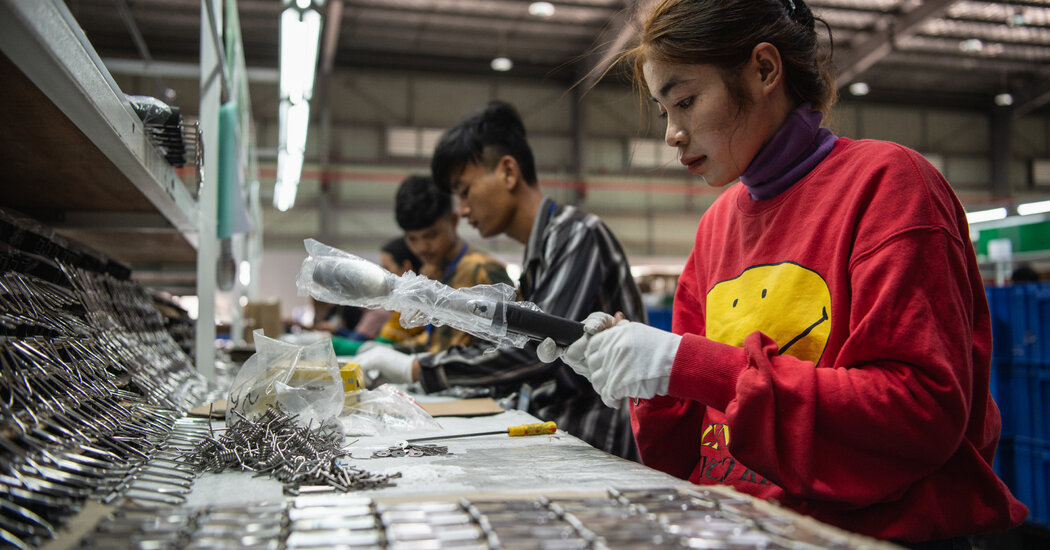

In a world besieged by turmoil, Jacob Rothman thought he had secured a refuge.
Mr. Rothman, 52, grew up in California but has spent more than two decades in China, overseeing factories that make grilling accessories and other kitchen items for Walmart and retailers around the globe. Well before the rest of the business world, he grasped the pressures bearing on the relationship between his native country and the one where he runs his business.
President Trump used his first term to impose tariffs on imports from China. President Joseph R. Biden Jr. advanced that policy. The pandemic exposed the pitfalls of American reliance on Chinese factories for an array of goods, from parts for ventilators to basic medicines.
Mr. Rothman and his company, Velong Enterprises, had correctly anticipated demand for alternatives to Chinese industry. He had forged a joint venture in Vietnam, and two more in India. He had set up a wholly owned factory in Cambodia. Come what may, he figured, he could shift production to limit his exposure to tariffs, conflicts and natural disasters.
“I thought I was really ahead of the game,” Mr. Rothman said last week, still absorbing the shock of the one thing he had not seen coming — a veritable tsunami of tariffs that hit dozens of countries at once. “It’s apocalyptic,” he said. “People don’t know what to do next.”
Even after the White House last week paused most tariffs on every country except China, Mr. Rothman remained shaken. “What does ‘safe’ even mean anymore?” he said. “With a chaos-first foreign policy, even Southeast Asia may no longer be immune.”
He assumed that tariffs could eventually be imposed on the region as the Trump administration treated Southeast Asia as an extension of Chinese business interests.
Among the enduring impacts of Mr. Trump’s sharply escalated trade war was the effective foreclosing of safe harbors. In recent years, as global supply chains have confronted a series of crises — from tariffs, to pandemic disruptions, to obstructions to shipping in the Panama and Suez Canals — multinational companies that sell their goods to the United States have sought to limit their vulnerability to trouble in any single place by spreading around their factory production.
The Trump administration’s broad salvo this week appeared to decimate that strategy. American imports from China face duties reaching 125 percent. Duties on imports from Vietnam were set to increase to 46 percent, and Cambodian goods confronted tariffs of 49 percent. India faced 27 percent levies.
For the moment, the pausing of many tariffs has left China uniquely vulnerable. But importers are cognizant that levies on the rest of the world — and especially Southeast Asia — could be revived. The result is chaos, bewilderment and delay that presages rising consumer prices.
“Supply chains require long-term planning that is nearly impossible in the current environment,” said Ryan Petersen, chief executive of Flexport, a global logistics company based in San Francisco. “So many businesses are paralyzed and craving stability.”
That described the state of play for Mr. Rothman, and the kitchen items his factories make. A college religion major who considered training to be a rabbi, he now finds himself serving as the “Spatula Rabbi,” fielding calls from anxious customers around the world. As recently as last month, he was attending a major housewares trade show in Chicago, manning a booth with his Indian partners behind a banner heralding the benefits of their geographic diversity: “Building the safest supply chain on the planet.”
“I thought we were going to be the solution,” Mr. Rothman said.

Then Mr. Trump unveiled the series of enormous new taxes on American imports.
Mr. Rothman was especially shocked by the tariffs on Cambodia, given its history with the United States — the American carpet-bombing of the country during the Vietnam War, laying ground for the genocidal Khmer Rouge, followed by decades of isolation and poverty.
As the news of the tariffs reverberated last week, a major retailer delayed a $5 million order, Mr. Rothman said. Other customers may retain finished goods in his warehouses, hoping for an easing of the tariffs. He anticipates that orders will slow as much as 30 percent over the next six months.
Mr. Rothman struggles to square the upheaval with the supposed policy aims — limiting American reliance on China, while bringing factory production home to the United States.
He is mulling invitations to consider building factories in the United States, in Mississippi, Utah or Pennsylvania, for example. Walmart has a program that helps factories set up in its home state, Arkansas. But building a factory anywhere in the United States seems risky.
How can he outfit an American factory given the hefty tariffs that now hit imports of equipment and machinery from around the world? How can he hire enough people in an era of mass deportation of immigrants?
Constructing a factory is an expensive and long-term proposition. Should a future American government change the policy, Mr. Rothman’s competitors could use lower-wage countries to make their goods, while he would be stuck with a more expensive setup — a recipe for failure.
“We elect presidents every four years,” Mr. Rothman said. “Factories take at least that long to recover the costs of building. And if the world changes, and we can no longer manufacture in the U.S. in a cost-effective way, what am I doing with a factory in the U.S.?”