
Emily Moen, a coffee shop manager in Omaha, was scrolling through TikTok earlier this week when she came across a video informing her that President Trump’s tariffs could lead to higher prices for essential baby products.
Ms. Moen, who is 15 weeks pregnant, said that she had not planned to buy a car seat soon. But after watching the video, she researched the one made by Graco that she had been eyeing, and learned that it was manufactured in China. Worried that the $200 seat could get even more expensive, she bought the item on Amazon the same day.
“It was like an awakening to get this done now,” said Ms. Moen, 29.
As the Trump administration’s trade war with China escalates, many consumers have raced to purchase foreign-made products out of fear that companies could start to raise prices soon. Some have rushed to buy big-ticket items like iPhones and refrigerators. Others have hurriedly placed orders for cheap goods from Chinese e-commerce platforms.
The White House this week imposed a minimum tariff rate of 145 percent on all Chinese imports to the United States, on top of other previously announced levies, including a 25 percent tariff on steel, aluminum, cars and car parts.
And last week, Mr. Trump ordered the end of a loophole that had allowed goods from China worth less than $800 to enter the United States without tariffs.
Some early data show that consumers flocked to stores and stocked up on goods after the administration announced sweeping tariffs on nearly all trading partners. Mr. Trump backed down on some of those threats this week and instituted a 90-day pause on more punishing levies. But he said that the halt would not apply to China, and he instead raised tariffs again on all Chinese goods.
China is the second largest source of U.S. imports, and makes the bulk of the world’s cellphones, computers and toys. Late Friday, the Trump administration issued a memo that appeared to exempt smartphones, computers and other electronics from most of its punishing tariffs on China.
According to Earnest Analytics, a firm that analyzes data on millions of debit and credit card payments, consumer spending at Apple was up 20 percent between April 2 and April 7 compared with average spending there in recent months. Spending was also up 10 percent at Home Depot and 18 percent at the department store chain Belk, according to the analysis.
Consumers have also raced to grocery stores, large discount chains and car dealerships in recent days. Purchases of shelf-stable goods surged in the five days following Mr. Trump’s tariff announcement on April 2, with sales of canned and jarred vegetables up 23 percent, sales of instant coffee up 20 percent and ketchup sales up 16 percent compared with the same period the week before, according to data from Consumer Edge, a company that tracks consumer behavior.
Although some consumers have been more strategic with their purchases, others might be stockpiling because of uncertainty about which products will be affected by tariffs, and whether companies will raise prices, analysts said.
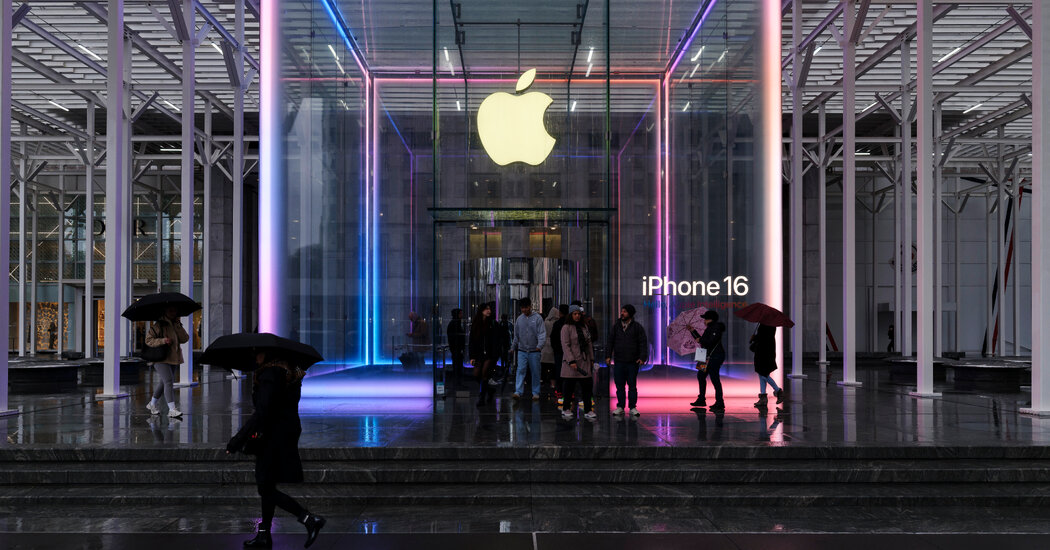
The threat of higher prices has also prompted many consumers to buy electronics, particularly iPhones. For more than a decade, American shoppers have purchased iPhones each year beginning in September, when Apple releases its newest models. But Mr. Trump’s tariffs have turned April into this year’s iPhone-buying season.
Apple makes roughly 80 percent of its iPhones in China, according to Counterpoint Research, a technology research firm. The exemptions for reciprocal tariffs that the Trump administration issued on Friday for certain electronics did not appear to apply to an earlier round of levies it had imposed on China. The administration had applied a tariff of 20 percent on Chinese goods for its role in supplying fentanyl to the United States.
“There’s panic buying going on and panic selling by investors, too,” said Gene Munster, managing partner at Deepwater Asset Management. “It’s more turmoil than I’ve seen in 20 years following the company. The speed of it has been crazy.”

Tom Barnard, 49, a university marketing director in Waco, Texas, said that he helped his mother buy a new iPhone 16 on Friday. Mr. Barnard said that his mother would have waited for the newest model to come out, but that he thought that it was wiser to make the purchase now, in case Apple increased prices later this year.
“I think we’re going to be in a trade war with China until at least through the end of the year,” he said.
Mr. Barnard said that he and his wife also spent around $650 at Walmart last weekend, in large part because they were concerned that tariffs could raise grocery costs.
Some parents have even debated buying Christmas gifts eight months early, to stave off higher prices. In Facebook groups and on message boards dedicated to families, parents debated what to buy, given the attention span of toddlers. Parents asked each other if their children would still be interested in narwhal or unicorn toys at the end of the year, or if it was better to go for a more standard gift, such as Lego sets.
In one Facebook group for families in the Los Angeles area, parents shared notes about Apple products, video game consoles they had purchased and where they had seen the lowest prices.
“We were talking about getting our son an iPhone when he turns 14 at the end of the year, but we are going to buy it now,” wrote one parent, in a Facebook group for families in the San Francisco area. “We just have to hide it from him until his birthday.”
Other consumers have been preparing for the possibility of higher prices for months. Bree Chaudoin, 47, a lending support specialist in Normal, Ill., said she upgraded her iPhone shortly after Mr. Trump was elected in November, out of concern that prices could rise if he imposed new tariffs. Ms. Chaudoin said that she also started saving up for new camping gear late last year.
About a month ago, Ms. Chaudoin purchased a $1,500 rooftop tent for her car that appeared to have been manufactured in China. She also ordered a new water tank, camping lanterns and fire tongs from Temu and AliExpress, popular e-commerce platforms with Chinese owners.
Ms. Chaudoin said that she typically tries to buy as many American products as she can. But a similar water tank produced domestically, she added, would have cost at least $120 more.
“I have a very tight budget,” she said. “When they sell these products that are such high quality and for a less amount of money, it just didn’t make sense to me to buy them anywhere else.”
Even though the recent surge in sales has provided a boon for some companies, retail analysts said that firms appeared to be more concerned about consumers pulling back on spending. Wall Street economists have lowered their forecasts for growth and warned about a potential recession amid a global trade war. Consumer sentiment has also tumbled as households grow more anxious about inflation.
“When I talk to companies, they’re more worried that people are not going to buy,” said Simeon Siegel, a retail analyst at the investment bank BMO Capital Markets.
Tripp Mickle and Sheera Frenkel contributed reporting.