
The next big fight over offshoring is playing out in Washington, and this time it involves artificial intelligence.
The Biden administration, in its final weeks in office, is rushing to issue new regulations to try to ensure that the United States and its close allies have control over how artificial intelligence develops in the years to come.
The rules have touched off an intense fight between tech companies and the government, as well as among administration officials.
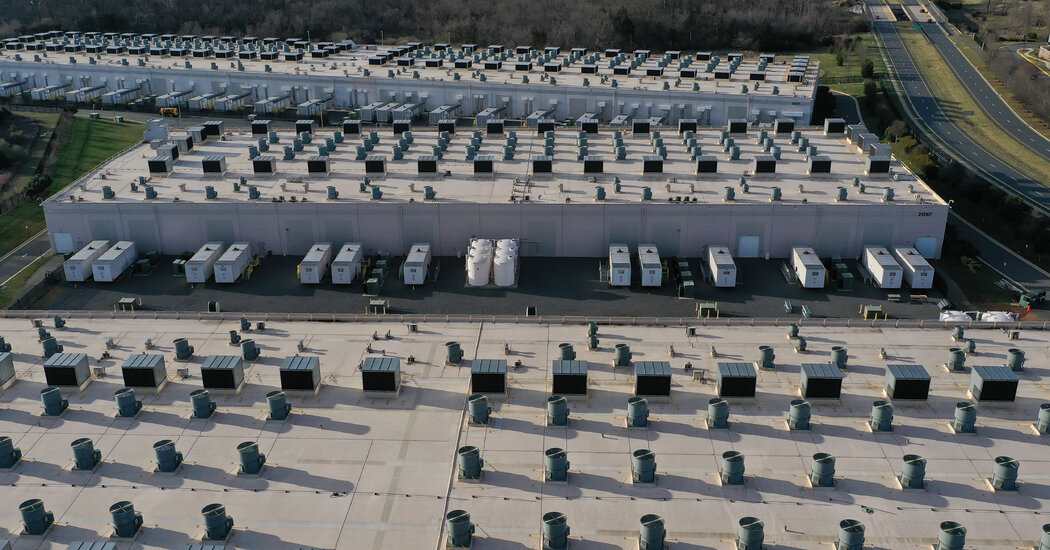
The regulations, which could be issued as early as Friday, would dictate where American-made chips that are critical for A.I. could be shipped. Those rules would then help determine where the data centers that create A.I. would be built, with a preference for the United States and its allies.
The rules would allow most European countries, Japan and other close U.S. allies to make unfettered purchases of A.I. chips, while blocking two dozen adversaries, like China and Russia, from buying them. More than 100 other countries would face different quotas on the amount of A.I. chips they could receive from U.S. companies.
The regulations would also make it easier for A.I. chips to be sent to trusted American companies that run data centers, like Google and Microsoft, than to their foreign competitors. The rules would establish security procedures that data centers would have to follow to keep A.I. systems safe from cybertheft.
The Biden administration’s plan has prompted swift pushback from American tech companies, which say global regulations could slow their businesses and create costly compliance requirements. Those firms also question whether President Biden should be setting rules with such far-reaching economic consequences in his final days in office.
While some of the details remain unclear, the new rules may force tech companies that are pouring tens of billions of dollars into building data centers around the world to rethink some of those locations.
Artificial intelligence, which can answer questions, write code and create images, is expected to revolutionize the way countries fight wars, develop medicines and make scientific breakthroughs. Because of its potential power, U.S. officials want A.I. systems to be built in the United States or in allied countries — where they will have more say over what the systems do — rather than in countries that could share that technology with China or act in other ways contrary to U.S. national security.
Peter Harrell, a former White House economic official and a fellow at the Carnegie Endowment for International Peace, said the United States currently had a substantial edge in A.I. and the leverage to decide which countries could benefit from it.
“It’s important to think about how we want those transformational developments to be rolled out around the world,” he said.
The rules are largely about national security: Given the way that A.I. might transform military conflict, the regulations are designed to keep the most powerful technology in the hands of allies and prevent China from getting access to A.I. chips through international data centers.
But U.S. officials say data centers are also important sources of new economic activity for American communities. They want to encourage companies to build as many data centers as possible in the United States rather than in regions like the Middle East, which is offering money to attract tech firms.
Some labor unions have come out in support of the Biden administration’s plan. That’s because data centers are huge consumers of electricity and steel. Each one creates work for construction companies, electricians and HVAC technicians, as well as workers involved in energy production.

“Labor has a huge interest in the future of A.I. and technology, not only in terms of its application but in terms of the infrastructure that supports it,” said Michael R. Wessel, an adviser to the United Steelworkers union.
But U.S. tech companies and their supporters argue that the rules could hold back technological developments, strain international alliances and motivate countries to buy alternative technologies from China, which is racing to develop its own A.I. chips.
“The risk is that over the long term, countries are going to say, ‘We cannot rely on the United States, we cannot be importing our advanced technology from the United States, because there is always this threat that the U.S. government is going to take it away from us,’” said Geoffrey Gertz, a senior fellow at the Center for a New American Security.
California-based Nvidia, which controls 90 percent of the A.I. chip market, has lobbied against the rules in meetings with Congress and the White House, as have Microsoft, Oracle and other companies. They worry that the rules could hurt international sales.
Ned Finkle, Nvidia’s vice president of global affairs, said in a statement that the policy would hurt data centers around the world without improving national security and would “push the world to alternative technologies.”
“We would encourage President Biden to not pre-empt incoming President Trump by enacting a policy that will only harm the U.S. economy, set America back and play into the hands of U.S. adversaries,” Mr. Finkle added.
Tech companies have also tried to blunt the impact by appealing to President-elect Donald J. Trump’s incoming administration, which can decide whether to keep or enforce the rules, tech executives and other people familiar with the exchanges said.
Microsoft and Oracle declined to comment.
Biden officials have also clashed over the regulations. Commerce Secretary Gina M. Raimondo, who is more sympathetic to industry complaints and had concerns about how the Trump administration would carry out the rules, has been at odds with the White House and other agencies, according to three officials and others familiar with the discussions, who declined to be named to discuss private deliberations.
Some U.S. allies expressed concerns about the rules, officials said. And in a Dec. 19 letter to the Biden administration, bipartisan lawmakers on the Senate Commerce Committee criticized the restrictions as “draconian” and said they would “severely hinder the sale of U.S. technology abroad.”
After the White House decided to move forward, the Commerce Department pushed for additional changes to the rule, including increasing the number of chips that can be sold without a license, and delaying the rule’s implementation for 120 days to allow the Trump administration to potentially make changes, two officials said.
It is unclear what Mr. Trump would do about the issue, although he has recently expressed support for having data centers built in the United States. His advisers include some China skeptics who are likely to favor tougher restrictions. Others, including the president’s son-in-law Jared Kushner, have business ties to countries in the Middle East that are likely to oppose any restrictions.
The new rules build on export controls that the Biden administration has put in place in recent years to ban shipments of advanced A.I. chips to China and other adversarial countries and to require special licenses to send A.I. chips to countries, including in the Middle East and Southeast Asia.
Those controls have allowed the United States to exert some global influence. To gain access to Nvidia chips last year, G42, a leading A.I. firm in the United Arab Emirates, promised to relinquish its use of technology made by Huawei, a Chinese telecommunications firm under U.S. sanctions.
But U.S. concerns have grown that Chinese companies are getting critical technology by smuggling in chips or through remote access to data centers in other countries.
Companies have also faced long waits to obtain licenses for even small numbers of chips, and foreign officials have appealed directly to the Biden administration to try to obtain them. So officials began working last year on a more transparent distribution system.
Tech companies say the requirements could make data centers too expensive for some nations, preventing some from using A.I. to benefit their health care, transportation and hospitality industries. Among the countries that would face caps and other restrictions are traditional American allies like Israel, Mexico and Poland, a NATO member.
“We can all agree that none of these workloads or uses of A.I. technology and the GPUs they rely on constitute national security concerns,” said Ken Glueck, Oracle’s executive vice president, in a company blog post referring to graphic processing units, or A.I. chips.
Nvidia and other tech companies have also argued that the rules could backfire by driving buyers in the Middle East, Southeast Asia and elsewhere to Chinese companies like Huawei.
Some U.S. officials disagree. One analysis that U.S. officials put together, including for consultations with private industry, argued that Chinese chipmakers faced significant hurdles and would not be able to export enough chips to train cutting-edge A.I. models. The analysis was viewed by The New York Times.
“Huawei is struggling to make enough advanced chips to train A.I. models within China, much less export chips,” said Matt Pottinger, a former deputy national security adviser to Mr. Trump and the chief executive of Garnaut Global, a China-focused research firm.