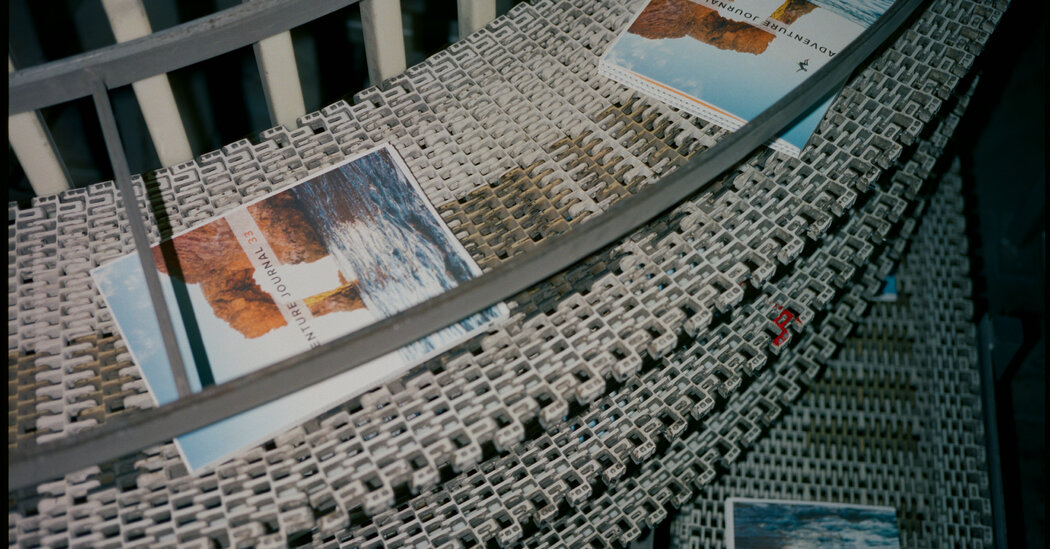

In an ordinary industrial building off a busy Orange County street, a Seussian contraption, nearly 100 feet long, clattered to life. The room filled with the hum and squeaks of belts and machinery. There was the smell of hot glue.
Like passengers on a dark amusement ride, bundles of colorful magazine pages, printed a week earlier, began a wild, circuitous journey, through tunnels and up ramps, that lasted a few minutes. The bundles were somehow cut and collated. The long edge of each new 130-page sheaf was dipped into a pool of melting glue, then dropped into a U-shaped cover. After drying during a series of slow corkscrews, the new magazine’s edges were chopped smooth by guillotines and emerged through an opening. Unimpressed men stacked them into boxes.
Nearby, Stephen Casimiro held one of the 7,200 copies in his hand.
Casimiro, a former editor of Powder and National Geographic Adventure, is the founder and publisher of Adventure Journal, an unapologetically analog magazine at the heart of an old-school trend.
He sifted through the pages. He smiled.
“People will have this in their hands, on their coffee table,” Casimiro said. “That was the idea. We’re all exhausted from our screens. We want something to savor.”
There are sprouts of life, even profitability, on the landscape of print media and magazines, cratered by the pixilated bombardment of the digital age. High-end niche periodicals are popping up, but the trend might be most evident in a burst of small-batch, independent outdoors magazines like Adventure Journal, Mountain Gazette, Summit Journal and Ori. They are crowding into quiet spaces of narrow lanes — climbing, surfing, skiing, running and the like — where quality is key, advertising is minimal and subscribers are faithful. Most do not put their content online; this is journalism meant to be thumbed through, not swiped past.
The magazines are sometimes oversized and increasingly matte finished, filled with edge-to-edge photographs and literary heaves. They can cost $25 or more per issue. They are meant as much for the coffee table as the shoulder bag — designed to be collectible, not disposable.
Like vinyl records and micro beers, they’re aimed at a small audience with appreciation for the craft. Most are at-home operations where the editors are owners, managing a web of freelancers and overseeing every bit of the production cycle. Like Casimiro, many are expats from the wreckage of iconic glossy magazines that lost luster in an era of consolidation, venture capitalism and attention spans deemed too short to consume anything but algorithmic candy.
“The screen experience is so reductionist,” Casimiro said. “It just flattens the world, so that a Pulitzer Prize-winning story feels the same as spam. Some things deserve better.”
In Seattle, Ori founder Kade Krichko called it the “slow-read movement.” Near Lake Tahoe, Mountain Gazette owner Mike Rogge believes “we went too far in the digital realm — and now we’re pulling it back.” In New York, writer and climber Michael Levy has resurrected Summit (calling it Summit Journal), seeing a desire for curation.
“There’s a lot of really good stuff in the outside ecosystem, but it gets drowned out by the noise,” Levy said. “I have no interest in just trying to churn out content.”
Back in California, where he began publishing the quarterly Adventure Journal in 2016, Casimiro, 62, considered the wave of titles that have followed his lead, mostly since 2020. “Outdoor boutique magazines are having a moment,” he said. “Absolutely, unquestionably.”
Then he deflected credit, a few miles away and several decades back.

A Feeling of Timelessness
An office park in San Clemente holds the headquarters of The Surfer’s Journal. If the new breed of outdoor magazines had a family tree, The Surfer’s Journal might be the parents, maybe the godparents.
It was first published in 1992, before the digital age, by the husband-wife team of Steve and Debbee Pezman. Exiles from Surfer magazine, where he was the longtime editor and publisher and she was the marketing director, the couple saw mostly read-and-toss surf magazines aimed at teenagers. They felt a void for something meatier, for adults like them.
The vibe they wanted was a surf-centric cross between National Geographic and Architectural Digest. A minimalist cover. A flat binding meant to stack or shelve. Deep stories, beautiful photography. An aura of timelessness.
The Surfer’s Journal persists as envisioned, now with about 28,000 subscribers (six issues a year for $84, or $25 for one) and eight “sponsors” (each paying $70,000 per year). Thousands of other copies are sold in surf shops and bookstores. The company has expanded into books, a popular podcast and The Golfer’s Journal, with manicured green grass taking the place of swelling blue oceans. It has about two dozen employees, including those who handle circulation from company headquarters.
Debbee Pezman, now 69 and The Surfer Journal’s publisher (Steve retired in 2015), thought about the secret ingredients to success, then typed them into a one-page memo. Among them:
“Never underestimate the intelligence of the reader.”
“Be commercially quiet. Have sponsors, not advertisers.”
“Pay attention to the details. Stay alert to the fact that erosion occurs subtly.”
“Quality. Quality. Quality.”
She does not call it a magazine, but a journal, even a bimonthly book. She noted high-end flourishes, like an embossed title. She picked up an upcoming issue, printed on thicker paper — 18 percent thicker. Why do that?
“That’s a really good question, because it’s going to cost, like, $22,000 in postage,” Pezman said. But she sees other magazines entering the market, ratcheting up the standards that she helped set. “It’s just a dial-up of our quality, to differentiate,” she said.
Pezman had just emerged from a staff meeting where results from the latest reader survey were discussed. The study found that one third of subscribers are under 45 — a generation that doesn’t remember the days before digital content engaging with an expensive print magazine.
What readers want, she believes, is not rooted in nostalgia for print. It is based on things like posture and pulse rate.
“There’s a difference between ‘lean in’ and ‘lean back,’” Pezman said. Digital content forces you to lean in, she said. “It’s harder on my eyes, my body. My muscles are a little tighter. A printed coffee-table book, including a National Geographic, is a lean back — I lean back on my sofa, open it and relax.”
‘It’s Not Nice Scrolling Through Instagram’
High-end magazines are not new, and their re-emergence is not exclusive to outdoor pursuits. A visit to an independent bookstore or a sprawling newsstand like Casa Magazines in New York or The Kosher News in Los Angeles unveils a universe of artful niche publications, from The Bitter Southerner to Catnip, Mildew to Whalebone.
“I equate my business model or my product to what you’ve seen happen with vinyl records,” said Liz Lapp, owner of Hi-Desert Times, a magazine shop in Twentynine Palms, Calif. “It’s kind of the same audience, people coming back to magazines, people new to magazines, people who just don’t want to be on their phones anymore.”
The surge is acute in American outdoor magazines, where esteemed mass-market titles like Outside, National Geographic, even Sports Illustrated — along with a bevy of once-loved, deep-niche outdoor titles covering everything from climbing to skiing, running to biking, snowboarding to skateboarding — have struggled to paddle through the fire hose of online content.
“The brokenness of the media landscape is allowing these smaller publications to to spring up and test the market,” Casimiro said. “They can find an audience.”
In 2020, Mike Rogge, a former managing editor of Powder, bought the rights to the defunct Mountain Gazette and soon began publishing a twice-yearly, 11-by-17-inch magazine. He sold prints of old covers to raise seed money, and hustles on social media to gain a following and entice subscribers. (These new magazine owners aren’t Luddites; they use digital savvy to sell paper and ink.) Rogge, 38, said he has turned a profit since his third month of operation. His marketing mantra: Print ain’t dead.
Among the early contributors to the new Mountain Gazette was Levy, a veteran of the outdoors freelancing web, who wondered how Rogge was pulling it off.
“It’s absolutely viable,” Rogge told him.
Last winter, Levy unveiled a revived, once-revered title of his own. Summit Journal is aimed at climbers and was “in the black from day one,” said Levy, 34, adding that he has turned away would-be advertisers. The first issue had 132 oversized pages of feature stories and full-bleed photo essays.
“It’s the kind of thing you’ll think twice about before tossing in the trash can,” Levy said.
Thembi Hanify and Mariah Ernst, 30-something veterans of surf media and marketing, also saw a fertile crack in the hardpan environment. They started Emocean after seeing, firsthand, a surf world dominated by white men.
“There’s this interesting cycle — big print outlets dying, but in conjunction with that, outdoor sports are diversifying,” Hanify said. “There is a gap for different stories to be told.”
Emocean has printed seven issues, about twice a year. The latest, 148 full-color, matte pages on 7-by-9-inch paper, is a mix of profiles, Q-and-As, photo essays, even poetry, skewing toward women and people of color and the L.G.B.T.Q. communities.
“There’s a thirst for being able to just be present with something in front of you,” Ernst said. “It’s not nice scrolling through Instagram. I’ve never heard a single person say ‘I really liked scrolling’ or ‘I really love reading things on my phone.’”
With Ori, Krichko — a writer and a former Powder intern, hired by Rogge — has launched a new kind of travel magazine. Instead of dispatching reporters around the world, he solicits contributions from local writers, photographers and artists. Inside the first issue last fall were features from Mexico (street-food art), Nigeria (music), Colombia (bullfighting), Spain (rowing) and Hawaii (regenerative farming), among others.
“Ori has been built as the antidote to the algorithm,” Krichko, 35, said. “‘Read slow, scroll less’ is something we say.”
Like others, he sees Casimiro as inspiration. After National Geographic Adventure shuttered its print magazine in 2009, Casimiro turned a personal blog (remember those?) into a commercial online magazine called Adventure Journal.
“It was exhausting, because the stories I cared the most about were not getting traffic,” Casimiro said. He was publishing stories from well-known writers like David Roberts and Greg Child, “and they’d get 500 views.”
Casimiro was happy with the content, unsatisfied with the digital business model and its unseemly pursuit of clicks and ad revenue. Unwilling to be bounced from the business (journalism) or subjects he loved (the outdoors), he made a counterintuitive move: He took Adventure Journal to print.
“I decided I’d have a small audience served really well,” he said.
He has a home office, a website, a newsletter, a podcast and an active presence on social media. He has a 90 percent retention rate among subscribers. He has nine advertisers that he calls “patrons” who pay enough to cover production costs. His wife, Joni, another exile from Surfer, serves as art director.
“Nobody’s doing it for the money,” Casimiro said. “I mean, we’re doing it because we need to make a living, but we’re doing it because we’re so passionate about it.”
Persistent worries include the cost of print production, which spiked during the pandemic and have not receded, and the relatively small group of outdoor-industry advertisers. Another 4,000 subscribers would allow Adventure Journal to eliminate advertising, making it completely financed by readers, Casimiro said.
“That feels like the purist representation of a publication,” he said. “It’s really rare.”
Four times a year, from a computer screen, Casimiro sends the pages of his latest issue — not instantly to readers, who have to wait a few weeks by their mailboxes, but to an old-fashioned printing company in Orange County.
Once the pages are printed, they are trucked to a nearby bindery and fed into a whirring machine of conveyors, choppers and hot glue. They emerge at the other end, like a wonder from another time, but also a future response to today.
Even after decades in the magazine business, Casimiro finds delight in it all.
“The difference is I own it,” he said, holding Adventure Journal in his hands. “My values are woven into it.”