
How soon is soon? Or exactly how much later is later?
As the year started, there was a widespread view among economists and on Wall Street that the Federal Reserve would lower interest rates in the first half of the year. Maybe in March, maybe in May, but sooner rather than later.
That long-awaited moment, two years after the Fed began ratcheting up rates to their highest level in decades, held the prospect of brightening consumer sentiment, increasing company valuations and improving corporate financing opportunities. It was called “the pivot party,” and everyone was invited.
But three months of hotter-than-expected inflation data followed. Financial markets then projected that the Fed would lower rates once, near the end of the year, or not at all — based on a view that the central bank will see little merit in such a move as long as inflation remains a bit elevated and employment is growing.
Interest rates for home and car loans tilted up again. And it seems the pivot party has been canceled. But some experts argue that it has only been postponed, leaving forecasters divided about what the rest of the year will bring.
Camp 1: Inflation Is Coming Under Control
Some market analysts and bank economists are making the case that rate cuts are still on the table. The April jobs report, which implied a cooling labor market and softer wage growth, gave them some fodder.
These analysts generally contend that current measures of inflation are overstated because of lagging indicators, reflecting cost pressures from over a year ago, that will ebb in summer. And they believe that while the diffuse process of stabilizing prices, formally called disinflation, may face setbacks (especially any oil shock), it is on track.
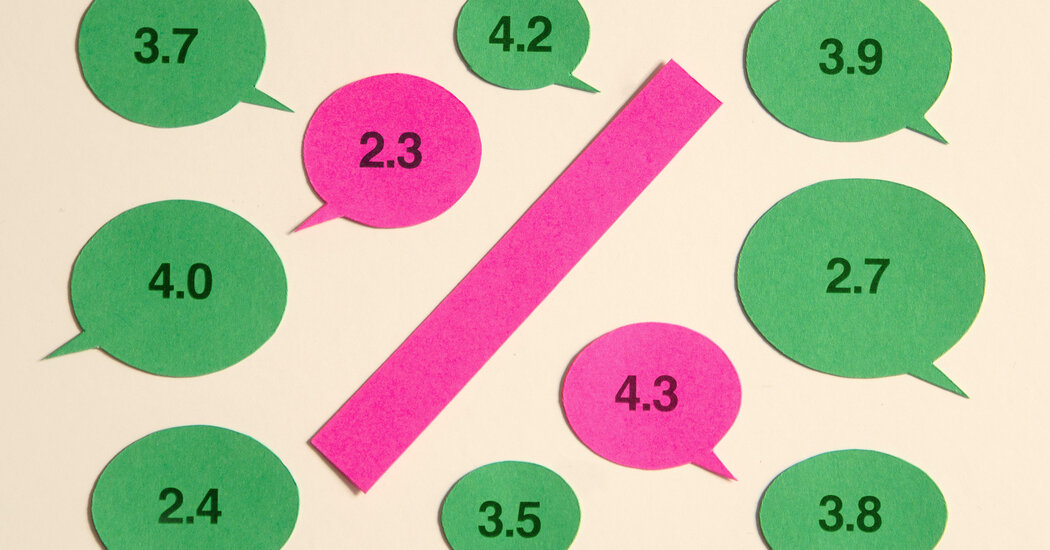
The Fed’s preferred inflation measure, the Personal Consumption Expenditures index, increased 2.7 percent on an annual basis in March, far below its 7.1 percent peak in June 2022. Yet slower progress this year in that measure and the higher-profile Consumer Price Index has been notable, frustrating efforts to reach the Fed’s official target of 2 percent.
Skanda Amarnath, the executive director of Employ America, a labor-focused group that tracks inflation data and Fed policy, was originally among those expecting a spring rate cut. In a recent newsletter, he said the first quarter “was filled with a series of upside inflation surprises” — from well-known potential trouble spots like auto insurance and obscure ones like financial adviser management fees — but “it does not mean that the disinflationary process has come to an end.”
“We are still optimistic,” Mr. Amarnath said, adding that recent inflation “deviations are ultimately marginal” and that “the first interest-rate reduction is most likely to transpire in September.”
Research teams at a couple of Wall Street’s most influential firms are also keeping faith in the gradual cooling of inflation and a set of rate cuts to come.
On the question of cuts this year, “we remain bullish on our call for three,” the U.S. research team at Morgan Stanley, led by Ellen Zentner, said last week in a note to clients — “but are pushing out the start to September.”
Goldman Sachs expects two rate cuts this year — one in July, another in November.
These calls are premised on the idea that while the pivot party in winter may have been overly exuberant, the pessimistic commentary of late has been overdone.

Camp 2: The Labor Market Is Still Too Hot
Corporate earnings calls in the last month showed that a variety of businesses are losing sales from inflation-weary customers who have become more picky. But others, flush with raises or investment income, are ponying up for costlier services and goods.
Supply chains and energy markets have stabilized after being scrambled by the pandemic and war in Europe, easing some of the price pressure. But the Fed has not “done enough to really kill the consumer in order to result in that slower demand-side inflation,” Lindsey Piegza, the chief economist for Stifel Financial, said in a recent interview with CNBC.
The uncomfortable truth, according to a common view among those in finance, is that this period of unusually low layoffs may have to end for wage growth and ultimately inflation to be fully tamed.
“Labor conditions remaining strong — there’s no reason to believe that inflation will slow materially into year-end,” argued José Torres, senior economist at Interactive Brokers.
The hot economy, he said, is “leading to structurally higher wage bills” for employers, who are still choosing to respond to that cost by raising prices when they can. That, Mr. Torres concludes, makes the journey to the Fed’s inflation target “almost impossible at this juncture absent a rise in unemployment.”
He thinks the Fed will begin easing rates no sooner than next year.
Most economists picking apart the data agree that a continued willingness to pay for more expensive stuff (or “price insensitivity”) accounts in part for inflation’s persistence.
Torsten Slok, the chief economist at Apollo Global Management, has asserted that the upper middle class and the most affluent are fueling price increases for services specifically and inflation in general, even as several companies report that their lower-earning customers are cutting back, seeking deals and trading down to save.
He is projecting that there will be little progress in coming inflation readings and that there will be no rate cuts from the Fed this year.
“Because of the significant rise in the stock market and significant cash flows” from high-yield savings accounts and bonds, Mr. Slok said in a research note, “U.S. households have more money to travel on airplanes, stay at hotels, eat at restaurants, go to sporting events, amusement parks and concerts.”
The Wild Card: Housing Costs
Morningstar, a financial services firm, is “still expecting inflation to return essentially to normal in 2024” and interest-rate cuts by early fall, said Preston Caldwell, the firm’s chief U.S. economist.
That call, he said, is mostly based on an expectation that government measures of rent inflation — lately responsible for a vast majority of above-target inflation — will soon align with recent private-sector readings, which have been milder.
“Leading-edge data is still pointing strongly to an inevitable fall in housing inflation,” Mr. Caldwell contended, “even as the exact timing remains somewhat uncertain.”
Assessing the direction of a large item in the Consumer Price Index known as owners’ equivalent rent — an estimate of what homeowners, who make up two-thirds of households, would pay if they rented their homes — has bedeviled forecasters. Since early last year, a variety of experts have been incorrectly guessing when it will fade as an inflation driver.
The Harvard economist Jason Furman characterizes owners’ equivalent rent as “the implicit rent that you owe yourself every month as a homeowner.” That tends to confuse owners, particularly those with a fixed mortgage payment, who think of their housing as an asset, not a service they are providing to themselves. It has become a point of controversy among experts.
In the latest reading, the Consumer Price Index put inflation at 3.5 percent over the past year. An alternative measure — one that is used in other major developed nations and does not include owners’ equivalent rent — indicates that the U.S. economy has been hovering just below or above the Fed’s inflation target since June. But virtually no one expects officials to switch their chosen inflation measures this cycle.
So a wait-and-see approach rules, with high rates persisting in the meantime. And the timing of sooner or later remains as ambiguous as ever.