
In the Red Sea, attacks by Iranian-backed Houthi militants on commercial ships continue to disrupt a crucial trade route and raise shipping costs. The threat of escalation there and around flash points in Lebanon, Iraq, Syria, Yemen and now Iran and Pakistan ratchets up every day.
Despite the staggering death toll and wrenching misery of the violence in the Middle East, the broader economic impact so far has been mostly contained. Oil production and prices, a critical driver of worldwide economic activity and inflation, have returned to pre-crisis levels. International tourists are still flying into other countries in the Middle East like Saudi Arabia, the United Arab Emirates and Qatar.
Yet for Israel’s next-door neighbors — Egypt, Lebanon and Jordan — the economic damage is already severe.
An assessment by the United Nations Development Program estimated that in just three months, the Israel-Gaza war has cost the three countries $10.3 billion, or 2.3 percent of their combined gross domestic product. An additional 230,000 people in these countries are also expected to fall into poverty.
“Human development could regress by at least two to three years in Egypt, Jordan, and Lebanon,” the analysis warned, citing refugee flows, soaring public debt and declines in trade and tourism — a vital source of revenue, foreign currency and employment.
That conclusion echoed an update last month by the International Monetary Fund, which said that it was certain to lower its forecast for the most exposed countries when it publishes its World Economic Outlook at the end of this month.
The latest economic gut punches could not come at a worse time for these countries, said Joshua Landis, director of the Center for Middle East Studies at the University of Oklahoma.
Economic activity across the Middle East and North Africa was already on a down slide, slipping to 2 percent growth in 2023 from 5.6 percent the previous year. Lebanon has been enmeshed in what the World Bank calls one of the world’s worst economic and financial crises in more than a century and half. And Egypt has been on the brink of insolvency.
Since Hamas fighters attacked Israel from Gaza on Oct. 7, about 25,000 Palestinians have been killed by Israel, according to the Gazan health ministry. The strip has suffered widespread destruction and devastation. In Israel, where the Hamas attacks killed about 1,200 people, according to officials, and resulted in 240 being taken hostage, life has been upended, with hundreds of thousands of citizens called into military service and 200,000 displaced from border areas.
In Jordan, Lebanon and Egypt, uncertainty about the war’s course is eating away at consumer and business confidence, which is likely to drive down spending and investment, I.M.F. analysts wrote.
Egypt, the Arab world’s most populous country, has still not recovered from the rise in the cost of essential imports like wheat and fuel, a plunge in tourist revenue, and a drop in foreign investment caused by the coronavirus pandemic and the war in Ukraine.
Lavish government spending on showy megaprojects and weapons caused Egypt’s debt to soar. When central banks around the world raised interest rates to curb inflation, those debt payments ballooned. Rising prices within Egypt continue to gnaw away households’ buying power and business’s plans for expansion.
“No one wants to invest, but Egypt is too big to fail,” Mr. Landis said, explaining that the United States and I.M.F. are unlikely to let the country default on its $165 billion of foreign loans given its strategic and political importance.
The drop in shipping traffic crossing into the Red Sea from the Suez Canal is the latest blow. Between January and August, Egypt brought in an average of $862 million per month in revenue from the canal, which carries 11 percent of global maritime trade.

James Swanston, an emerging-markets economist at Capital Economics, said that according to the head of the Suez Canal Authority, traffic is down 30 percent this month from December and revenues are 40 percent weaker compared to 2023 levels.
“That’s the biggest spillover effect,” he said.
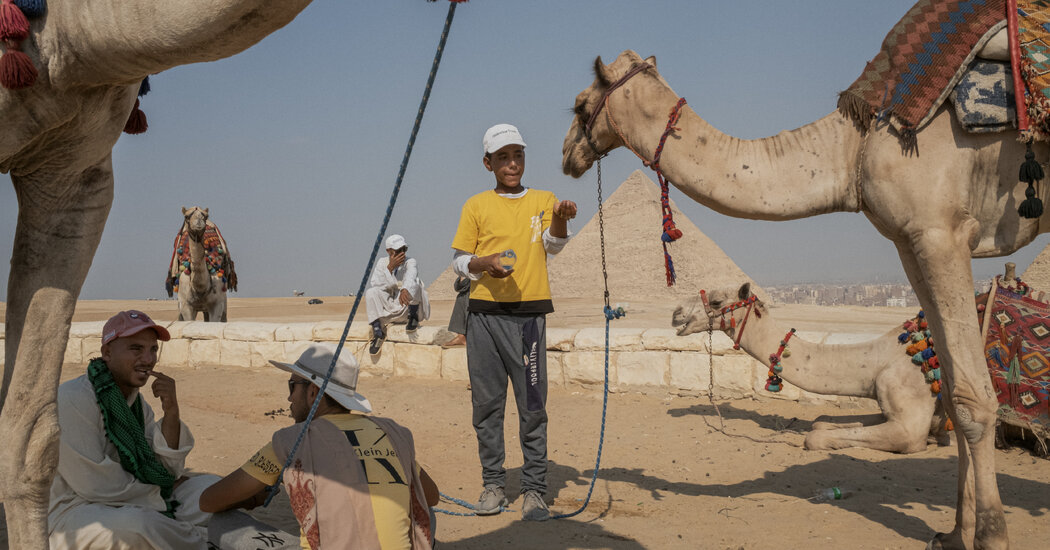
For these three struggling economies, the drop in tourism is particularly alarming. In 2019 tourism in Egypt, Lebanon and Jordan accounted for 35 percent to nearly 50 percent of their combined goods and services exports, according to the I.M.F.
In early January, confirmed tickets for international arrivals to the wider Middle East region for the first half of this year were 20 percent higher than they were last year, according to ForwardKeys, a data-analysis firm that tracks global air travel reservations.
But the closer the fighting, the bigger the decline in travelers. Tourism to Israel has mostly evaporated, further hammering an economy upended by full-scale war.
In Jordan, airline bookings were down 18 percent. In Lebanon, where Israeli troops are fighting Hezbollah militants along the border, bookings were down 25 percent.
“Fears of further regional escalation are casting a shadow over travel prospects in the region,” Olivier Ponti, vice president of insights at ForwardKeys.
In Lebanon, travel and tourism has previously contributed a fifth of the country’s yearly gross domestic product.
“The number one site in Lebanon is Baalbek,” said Hussein Abdallah, general manager of Lebanon Tours and Travels in Beirut. The sprawling 2,000-year-old Roman ruins are so spectacular that visitors have suggested that djinns built a palace there for the Queen of Sheba or that aliens constructed it as an intergalactic landing pad.
Now, Mr. Abdallah said, “it is totally empty.”
Mr. Abdallah said that since Oct. 7, his bookings have dropped 90 percent from last year. “If the situation continues like that,” he said, “many tour operators in Beirut will go out of business.”
Travel to Egypt also dropped in October, November and December. Mr. Landis at the Middle East Center in Oklahoma mentioned that even his brother canceled a planned trip down the Nile, choosing to vacation in India instead.
Khaled Ibrahim, a consultant for Amisol Travel Egypt and a member of the Middle East Travel Alliance, said cancellations started to pour in after the attacks began. Like other tour operators he offered discounts to popular destinations like Sharm el-Sheik at the southern tip of the Sinai Peninsula, and occupancy hit about 80 percent of normal.
He is less sanguine about salvaging the rest of what is considered the prime tourist season. “I can say this winter, January to April, will be quite challenging,” Mr. Ibrahim said from Medina in Saudi Arabia, where he was leading a tour. “Maybe business drops down to 50 percent.”
Jim Tankersley contributed reporting from Davos, Switzerland.