
For more than a year, U.S. Steel pursued an ambitious solution to its mounting challenges. Once a symbol of American industrial might, it had agreed to a takeover by Nippon Steel, a Japanese rival, in a bid to ward off obsolescence.
Citing the need to finance a costly modernization of its mills, U.S. Steel warned that if the deal was foiled, it would need to shut down plants and lay off workers.
Now, with the $14 billion acquisition blocked by President Biden on national security grounds — and President-elect Donald J. Trump outspoken in opposing it — the company has few easy alternatives.
Without a merger partner, the company may be forced to shutter its traditional steel plants, threatening the livelihoods of the workers and regions that rely on them. An effort to combine with a different competitor could encounter antitrust concerns. And it lags behind in the technological transition from blast furnaces to electric furnaces.
U.S. Steel is not conceding defeat on a takeover by Nippon Steel. The two companies are suing the federal government, contending that politics corrupted its review process.
“Nippon Steel and U.S. Steel remain confident that the transaction is the best path forward to secure the future of U.S. Steel, and we will vigorously defend our rights to achieve this objective,” Amanda Malkowski, a spokeswoman for U.S. Steel, said in a statement.
U.S. Steel primarily makes flat-rolled sheet steel, which goes into cars, trucks and appliances. For decades, booming foreign competition has weakened the company, as well as the entire domestic steel industry, particularly as Chinese steel came to dominate the international market.
In its heyday, U.S. Steel was the world’s largest steel producer. By 2023, however, it ranked 24th globally, far behind powerhouses like Baowu of China and Nippon Steel, according to the World Steel Association.
The company enjoyed a recent resurgence, in part because of efforts to protect it from competition. Tariffs imposed in the first Trump administration and a surge in steel demand — driven in part by a construction boom early in this decade — led to record-high steel prices, bolstering U.S. Steel’s bottom line.
But that has not quelled concerns about U.S. Steel’s long-term viability. Compared with their foreign rivals, domestic steel companies have been slower to adopt “minimills” that are more energy-efficient and cost-effective than traditional mills. The smaller mills melt steel scrap in electric furnaces, a faster and cheaper process, while the larger mills make steel from iron ore and coke, derived from coal.
U.S. Steel has “done a poor job in modernizing,” said Alden Abbott, a senior research fellow at the Mercatus Center at George Mason University and a general counsel for the Federal Trade Commission in the first Trump administration. “Were it not for tariffs, it would have gone under years ago.”
Some American companies have made a more concerted effort to update their production methods, including Nucor, which has become the top domestic producer. Ms. Malkowski, the U.S. Steel spokeswoman, said the company would continue to move away from blast furnaces regardless of the outcome of the Nippon deal. In 2023, U.S. Steel opened a plant in Arkansas that runs on electric furnaces.
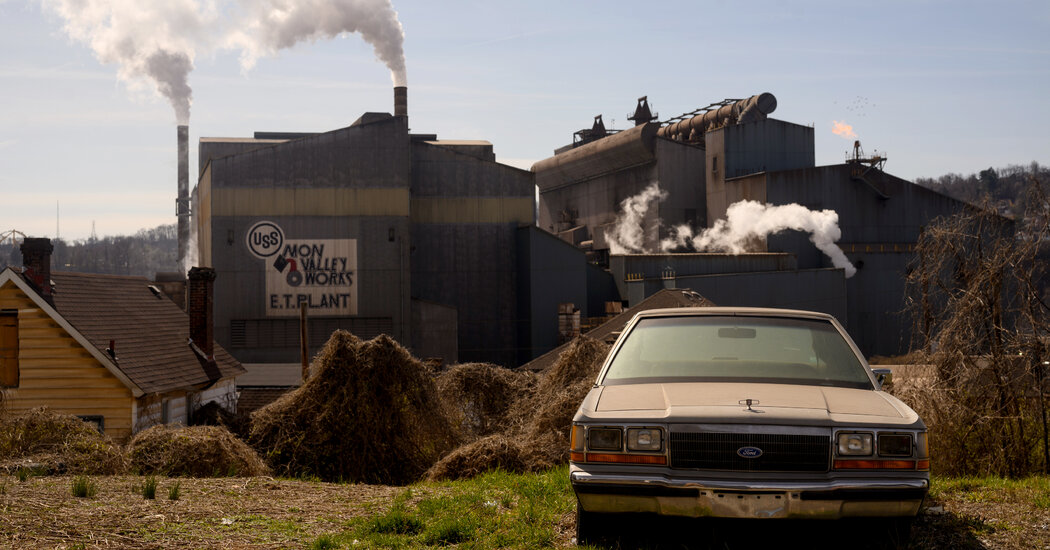
U.S. Steel has maintained that Nippon is the only buyer willing and able to make large investments in multiple steel mills and protect jobs. That includes at least $1 billion toward building a new mill at the Mon Valley Works plant outside Pittsburgh and $300 million for relining a blast furnace at the Gary Works facility in Gary, Ind.
“Blocking this transaction means denying billions of committed investment to extend the life of U.S. Steel’s aging facilities and putting thousands of good-paying, family-sustaining union jobs at risk,” the two companies said last week.

Bill Peterson, a stock analyst at JPMorgan Chase, wrote in a research note that if U.S. Steel operated as a stand-alone company, it would focus on its newer plant in Arkansas and possibly cut back its blast furnace assets.
But the United Steelworkers, the powerful union representing 11,000 U.S. Steel employees, has forcefully opposed the Nippon merger. It has accused the Japanese company of illegal trade practices and of bad faith in its dealings with the union.
The union previously lobbied for a merger with Cleveland-Cliffs, an American company that made a bid for U.S. Steel in 2023 but lost to Nippon in a bidding war. Unlike Nippon, it is unionized. (On Monday, U.S. Steel and Nippon sued Cleveland-Cliffs, accusing the company of colluding with David McCall, the head of the steelworkers union, to undermine the Nippon Steel deal.)
“We have no doubt that it’s the right move for our members and our national security,” the union said in a statement after Mr. Biden blocked the deal.
If U.S. Steel was sold to a competitor like Cleveland-Cliffs, the combined entity would be formidable but could draw federal antitrust scrutiny. It’s not clear, however, whether the Trump administration would take as aggressive an approach to enforcement as the Biden administration.
John Newman, a professor at the University of Miami School of Law and a former deputy director of the Federal Trade Commission’s Bureau of Competition, said a merger with Cleveland-Cliffs would be challenged in court, in large part because domestic steel production is already dominated by a few players. Nucor, Cleveland-Cliffs and U.S. Steel accounted for half of American steel production in 2023, according to the Commerce Department.
Regardless of political administration, “everyone agrees that type of merger is problematic,” Mr. Newman said. In contrast, “if you have a supercompetitive market, a couple of players shouldn’t be that concerning.”
But Mr. Abbott of George Mason said a domestic merger was more likely for U.S. Steel than its continuing as a stand-alone entity. He said federal regulators under Mr. Trump might argue that a combined domestic steel company would be more competitive internationally.
“There’s also a political concern,” Mr. Abbott added, “that ‘we can’t let U.S. Steel go down.’”
Cleveland-Cliffs did not respond to a request for comment.
Sarah Bauerle Danzman, a senior fellow at the Atlantic Council and an associate professor at Indiana University, said having one company control more domestic steel production would make steel — including steel produced for defense purposes — more expensive.
“You want to diversify across where steel is made,” Ms. Bauerle Danzman said.
In a social media post on Monday, Mr. Trump, who vowed to block Nippon’s acquisition, wrote that U.S. Steel “should lead the charge to greatness” and should not be sold to anyone.
“Why would they want to sell U.S. Steel now when Tariffs will make it a much more profitable and valuable company?” Mr. Trump wrote on Truth Social.
Inexpensive imported steel has been a target for decades. Presidents George W. Bush and Barack Obama imposed tariffs on Chinese steel. Mr. Trump went further, placing tariffs of 25 percent on steel from most countries in 2018. Mr. Biden has used quotas to limit steel imports, in addition to expanding tariffs on some steel melted outside the United States.
Frank Giarratani, a professor emeritus of economics at the University of Pittsburgh who has studied the steel industry for decades, said steel tariffs had primarily helped protect jobs. But they haven’t made domestic steel companies more productive or competitive internationally, he said, while investing in new technology would do that.
“It’s been about protecting jobs, and that only has a temporary benefit,” Mr. Giarratani said. “In terms of making the industry competitive, the tariffs don’t seem to have done that.”
Bill Farrier, a leader of Local 1557 of the United Steelworkers in Clairton, Pa., said he was happy that Mr. Biden had rejected the Nippon deal and was heartened by Mr. Trump’s opposition to the merger. Mr. Farrier, a mechanic at the Mon Valley Works plant, said that he wanted Cleveland-Cliffs to be the eventual buyer but that any suitor needed to commit to a wholesale improvement of the steel mills.
“I’d like to see some modernization, new equipment,” Mr. Farrier said. “Then we can compete with anyone.”