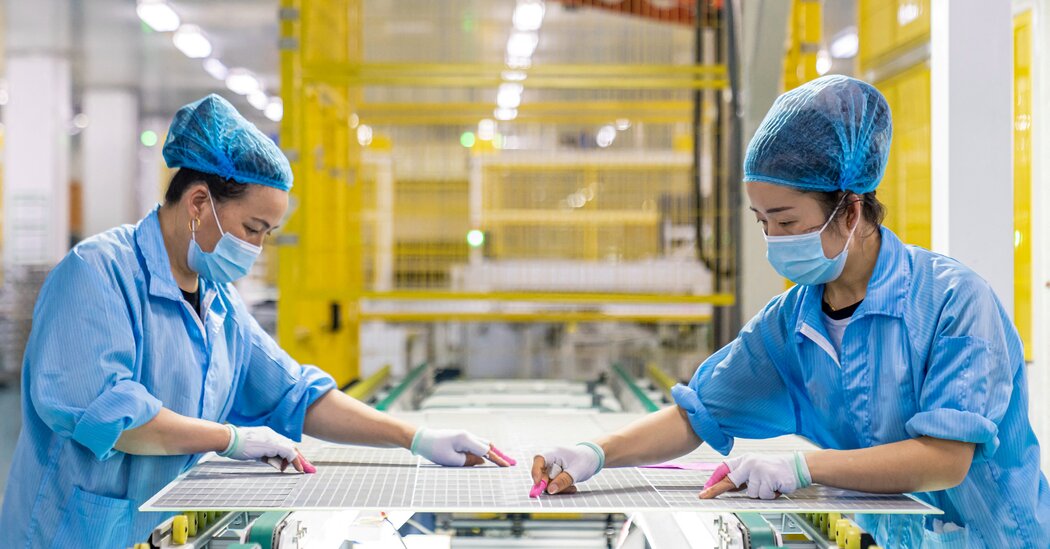

Tariffs aimed at protecting America’s solar industry from foreign competition snapped back into place on Thursday, ending a two-year pause that President Biden approved as part of his effort to jump-start solar adoption in the U.S.
The tariffs, which will apply to certain solar products made by Chinese companies in Southeast Asia, kicked in at a moment of growing global concern about a surge of cheap Chinese solar products that are undercutting U.S. and European manufacturers.
The Biden administration has been trying to build up America’s solar industry by offering tax credits, and companies have announced more than 30 new U.S. manufacturing investments in the past year. But U.S. solar companies say they are still struggling to survive as competitors in China and Southeast Asia flood the global market with solar panels that are being sold at prices far below what American firms need to charge to stay in business.
That has forced President Biden to make an uncomfortable choice: Continue welcoming inexpensive imports that are helping the United States transition away from fossil fuels, or block them to protect new U.S. solar factories that are benefiting from taxpayer money.
The tariffs that take effect Thursday encapsulated that dilemma. The levies, which apply to certain solar products coming to the United States from Cambodia, Thailand, Malaysia and Vietnam, were approved two years ago, after U.S. officials ruled that some Chinese firms were trying to dodge preexisting American tariffs on China by routing solar panels through other countries. The exact tariff rate depends on the company but could be more than 250 percent.
The Chinese firms had set up factories in Southeast Asia, but Commerce Department officials said that some were not doing substantial manufacturing there. Rather, they were using sites in those countries to make minor changes to Chinese-made solar products, and then shipping them to the United States tariff-free, the ruling decided.
Those products should have been subject to additional tariffs, but the Biden administration made an unusual decision in June 2022 to temporarily pause them for two years, to ensure that the United States would still have access to plenty of solar panels. Congress passed a resolution last year to reinstate the tariffs, but Mr. Biden vetoed it.
The administration described the decision to suspend the tariffs as a compromise. Groups like the American Clean Power Association, which represents utility solar and energy storage companies, had argued that imposing the tariffs would harm U.S. efforts to combat climate change. But the decision angered many of the domestic solar manufacturers that the Biden administration also wanted to help.
In the two years since the Biden administration made the decision to pause the tariffs, solar prices have cratered, and solar panel imports have surged.
Danny O’Brien, the president of corporate affairs for Qcells, which makes solar panels in Georgia, said there were nearly two year’s worth of subsidized, imported solar panels sitting in U.S. warehouses. “We welcome President Biden’s significant steps to level the playing field,” he said. “But if we want to build a durable domestic supply chain that meets our climate goals, continues to create jobs and adds to our energy security, the Biden administration’s industrial policies will need to evolve further and be forceful.”
Over the last year, Biden administration officials have grown increasingly vocal about the risk that imports pose, and the need to protect nascent factories, some of them in key electoral states.
In March, Treasury Secretary Janet L. Yellen delivered a speech in Norcross, Ga., at Suniva, a struggling solar manufacturer that has received subsidies through the 2022 Inflation Reduction Act. Ms. Yellen noted that the company, which filed for bankruptcy in 2017, is now restarting production of solar cells this year.
However, she also suggested that such investments could be threatened by China’s excess industrial capacity of green energy technology. “China’s overcapacity distorts global prices and production patterns and hurts American firms and workers, as well as firms and workers around the world,” she said.
The Treasury secretary raised the case of Suniva again in April at a news conference in Beijing, where she was meeting with senior Chinese officials. She recalled that Suniva’s financial troubles started more than a decade ago when China started ramping up its production of cheap solar panels.

While the firm now had more support from the U.S. government, she said, “the continued investment in capacity in these areas in China, that outstrips growing global demand, really could begin to threaten a company like this.”
It’s not yet clear how many of the Chinese companies routing products through Southeast Asia will still face tariffs, if any. In the last two years, many have built up factories in Southeast Asia that may allow them to argue that they are doing substantial manufacturing there, not simply circumventing tariffs by routing goods through those countries, industry executives said.
In the meantime, U.S. solar makers have begun pressing for broader protections. In April, a group of American solar manufacturers filed another set of cases with the Commerce Department and the U.S. International Trade Commission, asking them to investigate unfair subsidies and pricing practices from factories in Cambodia, Malaysia, Thailand and Vietnam.
The commission is set to make an initial determination Friday about whether U.S. business have suffered injury from those practices. If it decides that they have, additional levies could be imposed on imports from Southeast Asia, the source of a majority of U.S. solar panels.
“We don’t expect that the lifting of the tariff holiday will have much of an impact because the Chinese-owned and Chinese-headquartered companies have already adjusted their manufacturing to avoid the circumvention case,” said Timothy Brightbill, a lawyer at Wiley Rein who is representing the U.S.-based solar manufacturers in the newer case. “Our case is extremely important because it sort of picks up where the circumvention case left off.”
The back-and-forth over the tariffs highlights a dilemma the United States faces as it tries sever some links to China. Cutting ties has been particularly difficult in green industries where China dominates global production, like solar panels, critical minerals and electric vehicle batteries.
China accounts for more than 80 percent of global solar supply at every stage of the production chain, from the raw material of polysilicon to the final panels.
Substantial support from the Chinese government — as well as the massive economies of scale that the Chinese industry has achieved — has allowed Chinese makers to offer their products at extremely low prices. According to data from Wood Mackenzie, solar modules cost just 9 to 11 cents per watt in China, compared with 27 to 33 cents a watt for those made in the United States. Many U.S. factories are currently selling modules either at cost or for negative profit margins in order to compete with imports, Wood Mackenzie said.
Those low prices triggered a surge in imports. According to data from S&P Global, the United States imported a record 54 gigawatts of solar panels in 2023, up 82 percent from 2022.
Some argue that the United States should simply take advantage of these cheap prices to build out its solar power supply. But the glut is also putting Mr. Biden’s plans to revive green energy manufacturing in the United States at risk. Some new manufacturers have been discouraged from opening facilities in the United States. In February, a Massachusetts company called CubicPV Inc. canceled plans to build a factory for solar wafers, citing collapsing prices.
Under the rules, companies must technically install all of the solar panels that they brought into the United States tariff-free before December, or end up paying tariffs retroactively,
“The scramble is on now for companies to use up their stock over the next six months,” said Mona Dajani, global co-chair of energy infrastructure and hydrogen at Baker Botts. “Many in the industry are sure to be keeping their eyes on how this impacts installation and pricing numbers in the coming weeks.”