
WASHINGTON — President Donald Trump’s trade war against the planet and his real war against Iran have stoked higher inflation over the past year and have now increased borrowing costs for Americans, too.
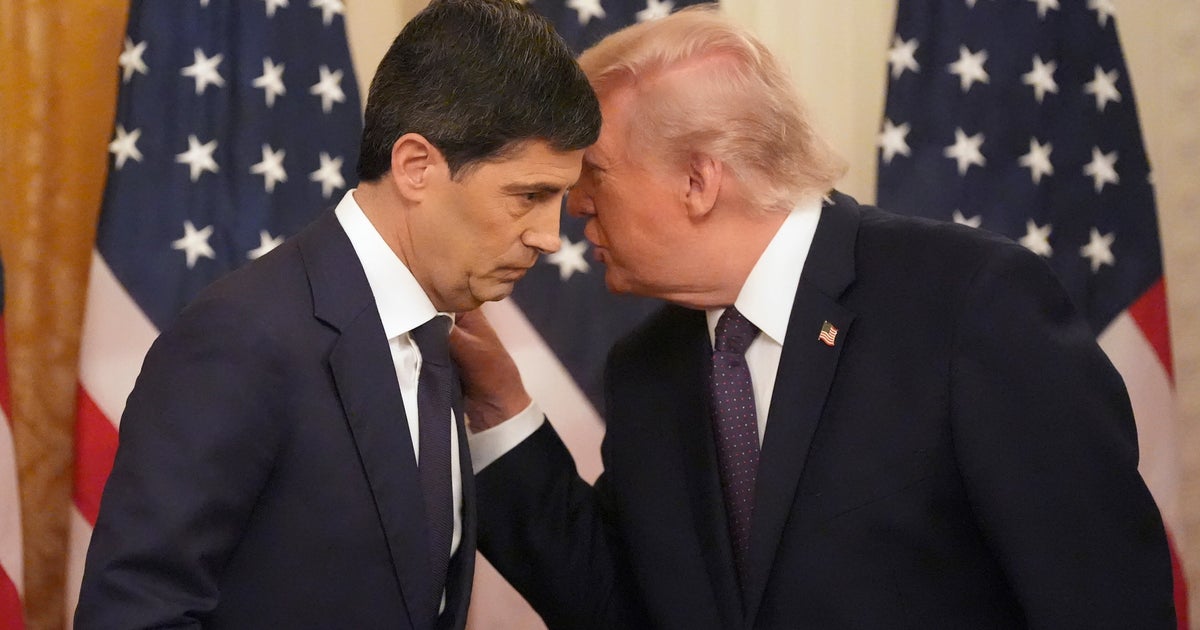
Kevin Warsh, Trump’s handpicked Federal Reserve chair, cited “geopolitical” factors multiple times in his explanation for the central bank’s decision to raise interest rates by a quarter point, the first rate hike since 2023.
“The plain fact is that inflation is too high, and has been for too long. This summer’s inflation readings do not tell me that underlying trends have meaningfully improved,” Warsh said at a press conference Wednesday.
Warsh would not, when asked, comment on either Trump’s Iran war or his various import taxes on Canada and other nations.
“Part of the independence of the Federal Reserve is we stay in our lane. Independence is a two-way street. We let people that do trade policy and fiscal policy stay in their lane, too. That’s how we can stand up here and call them the way we see them,” he said, seeming to nod at likely criticism from Trump.
Trump, though, does not respect the independence of other institutions, particularly the Federal Reserve. He even threatened recently to cut off trade with some other countries entirely if the Fed did not do as he wanted and lower rates.
By late Wednesday afternoon, Trump had only posted a demand that the interest rate be lowered to 1% or less — the Fed’s new target is 3.75% to 4% — but did not attack the board or Warsh personally. “LOWER THE INTEREST RATES FOR THE UNITED STATES OF AMERICA, AND FAST!” Trump wrote two hours after the Fed’s announcement.
And two hours after that, he told reporters traveling with him to a campaign rally in North Carolina that he does not blame Warsh for the rate hike, but the others on the board.
“He’s got a hostile board,” he said. “They’re raising that only for political reasons, and that’s a raise against Trump.”
Trump also suggested he had collaborated with Warsh beforehand and gave him permission to vote with the others.
“I told Kevin, I said, ‘You might as well vote with the board because it’s just not going to matter,’” he said.
The president, however, is a habitual liar, and it cannot be determined if he ever had any such discussion with Warsh.
Warsh had previously declined to comment on his previous conversations with Trump. “I don’t have anything for you on discussions with the president,” he said.

Al Drago/Bloomberg via Getty Images

Economists broadly have attributed rising inflation since Trump retook power to his global trade war, which increased prices on a broad range of goods, and to his decision to attack Iran, which spiked prices for crude oil, gasoline, diesel and jet fuel.
The new rate hike of a quarter point will increase rates on consumer loans and credit cards, making Americans pay more in a new way. Trump’s foreign policy and his dramatic increase of the federal deficit and debt have already made mortgage rates higher by increasing the rates paid by government bonds.
On a nearly daily basis, Trump lies that he inherited high inflation from his predecessor Joe Biden, but, in fact, high post-pandemic inflation rates had fallen to 3% by the time Trump retook office in January 2025.
The inflation rate continued to decrease for the first few months of Trump’s term but then reversed course and began rising again after Trump announced his tariffs against the rest of the world that April. A year later, inflation — led primarily by higher prices for both crude oil and refined fuels — increased some more after Trump unilaterally began a war against Iran on Feb. 28.
If Trump does start attacking Warsh, it will not be the first time he has gone after a Fed chair he himself elevated.
In November 2017, Trump chose Jerome Powell as the new chair of the Federal Reserve, praising him as perfect for the job. “He’s strong, he’s committed, he’s smart,” he said as he announced his nomination in the White House Rose Garden. “I am confident that Jay has the wisdom and leadership to guide our economy through any challenges that our great economy may face.”
Powell was confirmed by the Senate three months later, and not long after that, Trump was already angry at him for raising interest rates. “I think the Fed is making a mistake. They are so tight. I think the Fed has gone crazy,” he told reporters, unprompted, after getting off Air Force One in Erie, Pennsylvania, en route to a campaign rally.
Trump began going after Powell in personal terms after retaking office last year for not lowering rates quickly enough. He and his allies even ginned up investigations against him in an attempt to remove him as chair before his second term as chair expired.
In response, Powell decided to remain as a governor on the Fed board through the end of his term next January, rather than leave at the end of his chairmanship in May, as departing chairs have traditionally done.