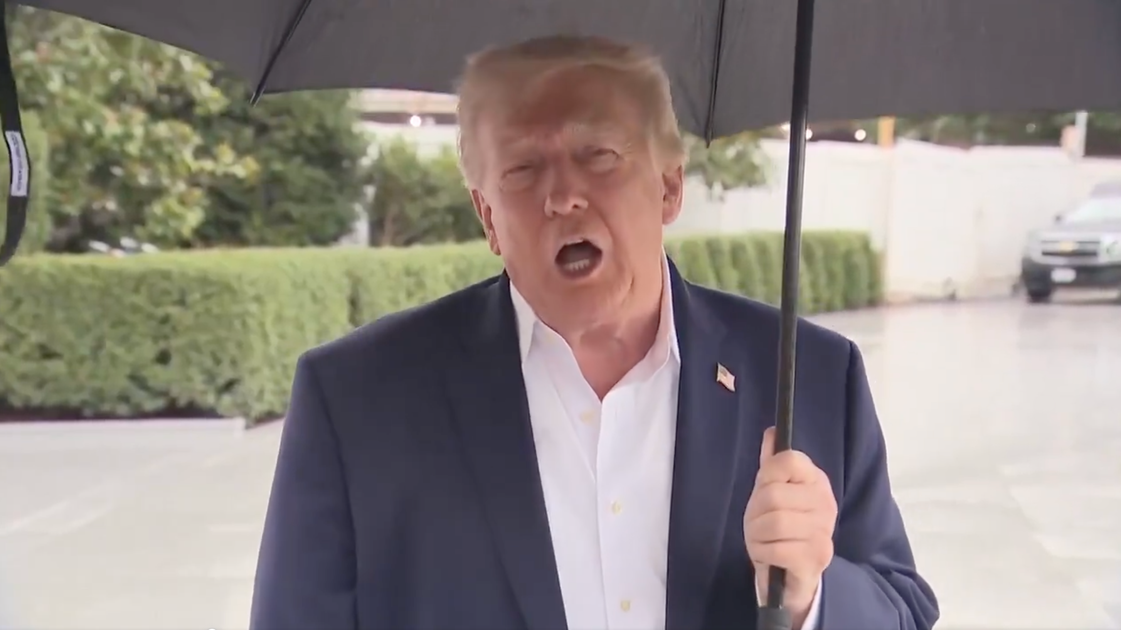

President Donald Trump told reporters outside the White House on Sunday that the U.S. has the “best poverty numbers,” referring to the U.S. Census report released earlier this month.
“We have the best, I guess you could say poverty, they talk poverty,” Trump said. “We have the best poverty numbers ever in the history of our country.”
The White House confirmed with HuffPost that Trump was referring to the U.S. Census report from Sept. 15, which said that poverty levels had dropped to a historic low in 2025, with just 10.2% of the population — 34.5 million people — reporting their income fell below the federal poverty line. The official federal poverty line threshold for 2025 was $32,642 in pre-tax cash income for a family of four.
But economists told HuffPost the statistic does not accurately reflect how hard federal policy changes — particularly the One Big Beautiful Bill Act — are hitting households this year.
Steven Durlauf, an economist and social scientist, and inaugural director for research on wealth inequality and mobility at the University of Chicago, told HuffPost that the “historic low” claim only applies to “the official (and inferior) measure,” referring to the Official Poverty Measure (OPM).
Durlauf emphasized that experts rely on the Supplemental Poverty Measure (SPM), which includes both cash and non-cash benefits, and subtracts any necessary expenses, such as taxes or medical care. (The Official Poverty Measure only looks at pre-tax cash.)
The SPM was at 13.1% in 2025, not statistically different from 2024, according to the U.S. Census Bureau, but up significantly from 7.8% in 2021, Durlauf said.

The increase between 2021 and 2025 isn’t a mystery, according to Durlauf — 2021 was the one year the temporary Advance Child Tax Credit was in effect. When it lapsed in 2022, child poverty — measured under the SPM — jumped to 12.4%.
“The ability of the [Child Tax Credit] to dramatically reduce the poverty rate shows that the rate is a policy choice,” Durlauf told HuffPost. “The Trump tax cuts will reduce revenue by about $400 billion per year. The CTC cost about $110 billion.”
Jason Furman, who former President Barack Obama named as the chair of the Council of Economic Advisers in 2013, agreed with Durlauf that Trump’s claims only rely on the Official Poverty Measure.
“Unlike some of his other wild statements, he is making a factually defensible claim,” Furman told HuffPost. “Two big issues, however. First, most experts prefer the Supplemental Poverty Measure, also published by the Census, which incorporates the effects of government programs and a more accurate measure of poverty in general.”
“By that more accurate measure, the poverty is the highest [it] has been since 2017,” Furman said. “More importantly, President Trump’s policies have exacerbated poverty, not reduced it.”

The Census Bureau has used OPM since the 1960s, while the SPM was introduced in 2010, and had its cutoffs adjusted in 2016 and 2020, according to the Census. Bruce Meyer, a professor at the University of Chicago’s Harris School of Public Policy, told HuffPost that the history could be part of why the administration leans on the older measure.
“[The best measure would] rely on people’s actual ability to buy food, clothing, and other goods (consumption), and those that include in-kind transfers like SNAP and housing assistance, but don’t keep moving the goalposts,” Meyer said.
SPM poverty in 2017 was at 13.9%, according to the Census data. No year between 2017 and 2024 has been as high — though still below 2017 itself.
Trump’s One Big Beautiful Bill Act slashed Medicaid, cut the Supplemental Nutrition Assistance Program (food stamps) and other public benefits that help the millions of people teetering on the poverty line in the U.S.
“Those cuts are reflected in the more accurate Supplemental Poverty Measure, and omitting them is one of the flaws in the official measure and why experts generally don’t rely on it to gauge either poverty or the impact of policy,” Furman said.
The number of children who received SNAP benefits fell by 1.2 million from July 2025 to July 2026, according to the Center on Budget and Policy Priorities’ August report. Overall, 13% or more than 5 million people no longer have SNAP benefits.
“The declines started before the harmful 2025 Republican reconciliation law’s enactment, suggesting factors at play in addition to that law,” the report said. “But in almost all states, declines in SNAP participation accelerated after the 2025 Republican reconciliation law, and we expect that trend to continue.”
“I expect poverty rates to increase as the effects of the [One Big Beautiful Bill] work their way through,” Durlauf said. “Large reductions in Medicaid and SNAP access have occurred and will grow. … Reduction of federal college aid will mean less education and will fall on the children of the less advantaged. So the longer-run prognosis is grim.”