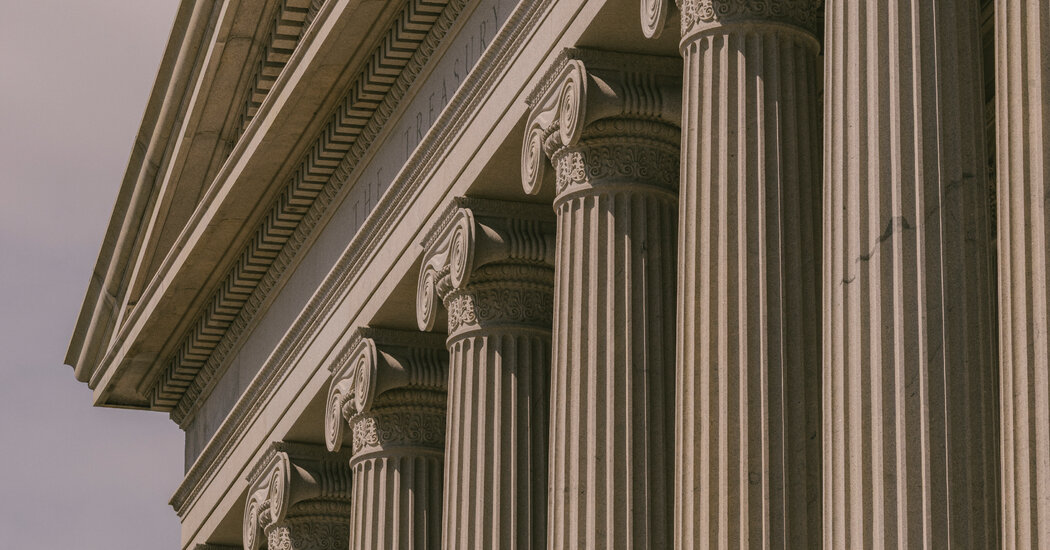

There are not many certainties in the world of money, but this traditionally has been one of them: When life turns scary, people take refuge in American government bonds.
Investors buy U.S. Treasuries on the assumption that, come what may — financial panic, war, natural disaster — the federal government will endure and stand by its debts, making its bonds the closest thing to a covenant with the heavens.
Yet turmoil in bond markets last week revealed the extent to which President Trump has shaken faith in that basic proposition, challenging the previously unimpeachable solidity of U.S. government debt. His trade war — now focused intently on China — has raised the prospect of a worldwide economic downturn while damaging American credibility as a responsible steward of peace and prosperity.
“The whole world has decided that the U.S. government has no idea what it’s doing,” said Mark Blyth, a political economist at Brown University and co-author of the forthcoming book “Inflation: A Guide for Users and Losers.”
An erosion of faith in the governance of the world’s largest economy appears at least in part responsible for the sharp sell-off in the bond market in recent days. When large numbers of investors sell bonds at once, that forces the government to offer higher interest rates to entice others to buy its debt. And that tends to push up interest rates throughout the economy, increasing payments for mortgages, car loans and credit card balances.
Last week, the yield on the closely watched 10-year Treasury bond soared to roughly 4.5 percent from just below 4 percent — the most pronounced spike in nearly a quarter century. At the same time, the value of the American dollar has been falling, even as tariffs would normally be expected to push it up.
Other elements also go into the explanation for the bond sell-off. Hedge funds and other financial players have sold holdings as they exit a complex trade that seeks to profit from the gap between existing prices for bonds and bets on their future values. Speculators have been unloading bonds in response to losses from plunging stock markets, seeking to amass cash to stave off insolvency.
Some fear that China’s central bank, which commands $3 trillion in foreign exchange reserves, including $761 billion in U.S. Treasury debt, could be selling as a form of retaliation for American tariffs.
Given the many factors playing out at once, the sharp increase in yields for government bonds registers as something similar to when medical patients learn that their red blood cell count is down: There may be many reasons for the drop, but none of them are good.
One reason appears to be an effective downgrading of the American place in global finance, from a safe haven to a source of volatility and danger.
As Mr. Blyth put it, Treasury bills have devolved from so-called information invariant assets — rock-solid investments regardless of the news — to “risk assets” that are vulnerable to getting sold when fear seizes the market.
The Trump administration has championed tariffs in the name of bringing manufacturing jobs back to the United States, asserting that a short-term period of turbulence will be followed by long-term gains. But as most economists describe it, global trade is being sabotaged without a coherent strategy. And the chaotic way in which tariffs have been administered — frequently announced and then suspended — has undercut confidence in the American system.
For years, economists have worried about an abrupt drop in the willingness of foreigners to buy and hold United States government debt, yielding a sharp and destabilizing increase in American interest rates. By many indications, that moment may be unfolding.
“People feel nervous about lending us money,” said Justin Wolfers, an economist at the University of Michigan. “They are saying, ‘We’ve lost our faith in America and the American economy.’”

For Americans, that reassessment threatens to revoke a unique form of privilege. Because the United States has long served as the global economy’s safe harbor, the government has reliably found takers for its debt at lower rates of interest. That has pulled down the cost of mortgages, credit card balances and auto loans. And that has allowed American consumers to spend with relative abandon.
At the same time, foreigners buying dollar-denominated assets pushed up the value of the American currency, making products imported to the United States cheaper in dollar terms.
Critics have long argued that this model is both unsustainable and destructive. The flow of foreign money into dollar assets has permitted Americans to gorge on imports — a boon to consumers, retailers and financiers — while sacrificing domestic manufacturing jobs. Chinese companies have gained dominance in key industries, making Americans dependent on a faraway adversary for vital goods like basic medicines.
“The U.S. dollar’s role as the primary safe currency has made America the chief enabler of global economic distortions,” the economist Michael Pettis wrote last week in an opinion piece in The Financial Times.
But economists inclined to that view generally prescribe a gradual process of adjustment, with the government embracing so-called industrial policy to encourage the development of new industries. This thinking animated the Biden administration’s economic policy, which included some tariffs against Chinese industry to protect American companies while they gained time to achieve momentum in industries like clean energy technology.
Encouraging American industry requires investment, which itself demands predictability. Mr. Trump has warned companies that the only way to avoid his tariffs is to set up factories in the United States, while lifting trade protectionism to levels not seen in more than a century.
Even an abrupt decision from the White House to pause most tariffs on all trading partners except China failed to dislodge the sense that a new era is underway — one in which the United States must be viewed as a potential rogue actor.
That Mr. Trump does not bow to diplomatic decorum is hardly new. His Make America Great Again credo is centered on the notion that, as the world’s largest economy, the United States has the power to impose its will.
Yet the pullback in the bond market attests to shock at how far this principle has been extended. Mr. Trump has broken with eight decades of faith in the benefits of global trade: economic growth, lower-priced consumer goods and a reduced risk of war.
That the gains of trade have been spread unequally now amounts to a truism among economists. Anger over joblessness in industrial communities helped bring Mr. Trump to power, while altering the politics of trade. But many economists say the trade war is likely to further damage American industrial fortunes.
The tariffs threaten existing jobs at factories that depend on imported parts to make their products. The levies have been set at rates seemingly plucked at random, economists said.
“What the market really didn’t like was the random crazy math of the tariffs,” said Simon Johnson, a Nobel laureate economist at the Massachusetts Institute of Technology. “It seemed like they didn’t know what they were doing and didn’t care. It’s a whole new level of madness.”
The immediate consequence of higher interest rates on United States bonds is an increase in what the federal government must pay creditors to keep current on its debts. That cuts into funds available for other purposes, from building schools to maintaining bridges.
The broader effects are harder to predict, yet could metastasize into a recession. If households are forced to pay more for mortgages and credit card bills, they will presumably limit spending, threatening businesses large and small. Companies would then forgo hiring and expanding.
The chaos in the bond market is at once an indicator that investors see signs of this negative scenario already unfolding, and is itself a cause of future distress via higher borrowing rates.
For years, foreign holders of American bonds have sought to diversify into other storehouses for savings. Still, the dollar and U.S. government bonds have maintained their status as the ultimate repository.
Europe and its common currency, the euro, now seem enhanced as a part of the global financial realm. But Germany’s staunch reluctance to issue debt has limited the availability of bonds for investors seeking another place to entrust savings.
That may now change, suggested Mr. Blyth, the Brown economist. “If the Europeans decide to issue a ‘sanity bond,’ the world might jump at it,” he said.
The Chinese government has long sought to elevate the place of its currency, the renminbi. But foreign investors hardly view China as a paragon of transparency or rule of law, limiting its utility as an alternative to the United States.
All of which leaves the world in a bewildering place. The old sanctuary no longer seems so safe. Yet no other place looks immediately capable of standing in.