
President Trump is brandishing the U.S. economy like a weapon, putting more than a trillion dollars of trade on the line as he opens economic wars on multiple fronts.
He has threatened tariffs on the United States’ closest trading partners, which are together responsible for more than 40 percent of American imports, to try to force them to accede to his demands. Mr. Trump is pushing Canada, Mexico and China to stop flows of migrants at the border — one of his major domestic policy issues — as well as to stem shipments of deadly drugs, and offer the United States better terms when it comes to trade relationships.
On Monday, Mexico earned a slight reprieve after Mr. Trump agreed to delay tariffs of 25 percent — which were supposed to go into effect on Tuesday — for a month. That decision came after President Claudia Sheinbaum of Mexico promised to reinforce the U.S.-Mexico border with 10,000 members of its National Guard.
But Mr. Trump made clear on Monday that he would use tariffs liberally to get other governments to give him what he wants, essentially saying he would leverage America’s economic strength to bully other nations.
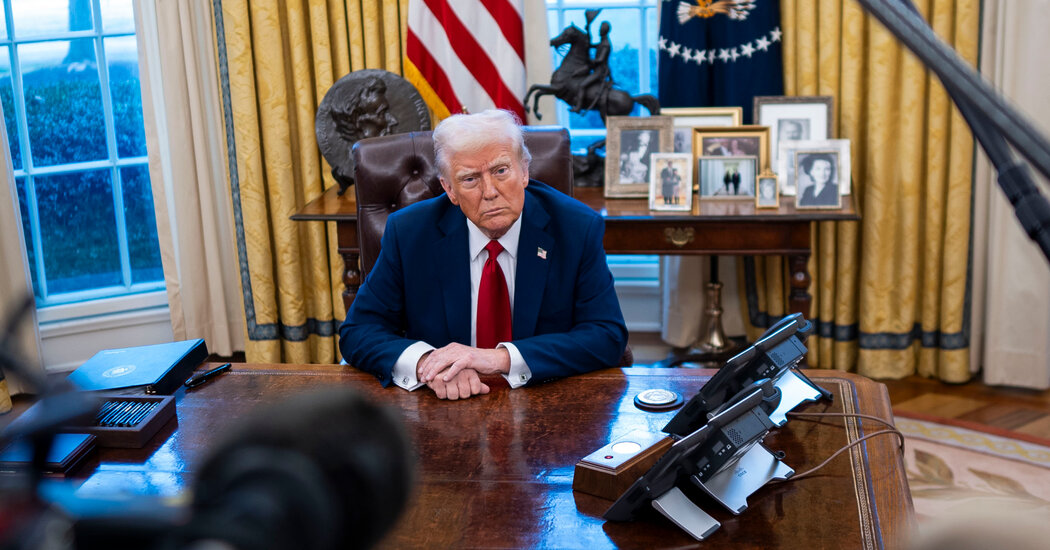
“I don’t want to use names, but tariffs are very powerful, both economically and in getting everything else you want,” Mr. Trump said during remarks in the Oval Office. “When you’re the pot of gold, the tariffs are very good, they’re very powerful and they’re going to make our country very rich again.”
The president is right that the American economy is a powerful weapon, and that a trade war would hit other countries harder. Canada and Mexico in particular are deeply dependent on trade with the United States. They send more than 80 percent of their exports to the United States, and could be crippled by a prolonged fight.
But many economists say the strategy will cost the United States, too. They estimate that as strong as the American economy is, trade wars will weaken it by raising prices, stalling investment, slowing growth and dragging down exports. Many farmers and businesses who would see their costs go up and export markets evaporate have protested the risk.
Even if the president ultimately does not follow through on tariffs, the uncertainty his policies are creating could discourage businesses from investing in new factories and hiring workers until they have a clearer picture of how trade will unfold.
Emily Blanchard, an economics professor at Dartmouth’s Tuck School of Business, argued that the tariff threats would eat away at U.S. economic leverage. She said that Mr. Trump was “undermining the trust that provides the foundation of U.S. strength” by throwing around the country’s weight in global markets.
If companies and investors expect the United States to deploy tariffs regularly, they will hedge against future disruptions by reducing their reliance on American markets, she said. “Trade policy is an economic weapon that becomes less powerful every time it is used,” she said.
The president has briefly acknowledged that trade wars could hurt Americans, but he has argued that they will hurt other countries more.
“WILL THERE BE SOME PAIN?” he wrote on social media on Sunday. “YES, MAYBE (AND MAYBE NOT!). BUT WE WILL MAKE AMERICA GREAT AGAIN, AND IT WILL ALL BE WORTH THE PRICE THAT MUST BE PAID.”
A news release accompanying Mr. Trump’s trade executive orders over the weekend stated that access to the American market was a “privilege” for foreign governments. The White House noted that trade accounted for 73 percent of Mexico’s economic activity, 67 percent of Canada’s and 37 percent of China’s. But trade is only 24 percent of U.S. gross domestic product, it said.
Wendy Cutler, a former U.S. trade negotiator and vice president at the Asia Society, said Mr. Trump was correct that trade wars would be more painful for Canada and Mexico. “There is no doubt that our partners will be more severely impacted than the United States, with over three-fourths of their exports destined for our market,” she said.

“Still, U.S. consumers, companies and economy will also feel the pain, particularly when subject to retaliatory actions by our partners.”
Researchers at the Peterson Institute for International Economics in Washington have estimated that a 25 percent tariff on Canada and Mexico and a 10 percent tariff on China would hit other countries the hardest, but would also slow the U.S. economy.
Canadian and Mexican gross domestic product would both shrink by a full percentage point by 2027, they estimate. G.D.P. in the United States would fall by only about a third of that. While that may not seem like much, there are few actions that American presidents have willingly taken that cut economic growth by so much.
Tariffs on Canada and Mexico would be particularly painful because, after 30 years under a common trade agreement, many companies have set up supply chains that cross North American borders. Companies making petroleum, cars, consumer care products, tequila, steel and other products have expressed concern over the tariffs.
Ontario, the province that is home to Canada’s auto industry, estimates that 450,000 jobs are at risk because of the tariffs. Officials there announced that they would offer tax deferrals and other measures to help businesses affected by the tariffs.
Beyond the effects on companies, trade experts said there could be longer-term damage to U.S. interests. That is because the tariff threats would eat away at international confidence that the United States will abide by trade rules and norms that govern when governments deploy tariffs and why.
Edward Alden, a trade expert at the Council on Foreign Relations, said that the United States had nurtured a system of international rules and predictability for decades. With Trump’s decision to move ahead with tariffs over the weekend in a “random, incomprehensible fashion,” he said, “that era has come to an end.”
“The United States is now signaling that tariffs are an all-purpose club to be used for whatever policy goal the president wishes,” he said. “That formula will create enormous, in many ways unprecedented, uncertainty not just in North America but in the entire global economy.”
Canada and Mexico have been poised to retaliate if the tariffs go into effect, despite a U.S. threat to escalate tariffs further if they do. Canada announced on Sunday that it would target American-made honey, tomatoes, whiskey and refrigerators. Before the one-month reprieve, Mexico’s president had also said her country would respond.
Foreign officials have been frustrated that Mr. Trump’s metrics for having tariffs removed are subjective and vague. He has expanded his goals in recent days, saying that countries also need to reduce their trade surpluses with the United States, in addition to action on drugs and migrants.
Asked on Monday what Mr. Trudeau could offer the United States in order to forestall tariffs, Mr. Trump answered: “I don’t know. We have big deficits with Canada, like we do with all countries.”
Some have implied that Mr. Trump’s real goal is to shift the blame for domestic problems to foreign countries.
Ms. Sheinbaum said in a social media post on Saturday that if the United States really wanted to address drug issues, it should look to internal measures. It could combat fentanyl sales on its streets, address money laundering or start a campaign to prevent drug consumption, she wrote.
Others have contended that Mr. Trump’s motives may be more about sending political signals to his supporters, rather than really affecting drugs, migrants or trade.
Heather Hurlburt, a former Biden administration trade official, said at an event at the Council on Foreign Relations in January that “signaling in politics” was the “single most important purpose of tariffs.”
“This is a signaling game,” she said.
Economic research published last year found that Mr. Trump’s tariffs in his first term had not accomplished his stated aims of increasing manufacturing jobs, but that they had still benefited the president politically, by winning over voters for the Republican Party.
Ms. Hurlburt said that after Mr. Trump’s first term, it was “duly noted across the political spectrum” that tariffs had been incredibly effective in getting people to pay attention.
“If you want to signal to the public that you are taking on issue X, Y or Z, tariffs are now an irresistible way to do it,” she said.