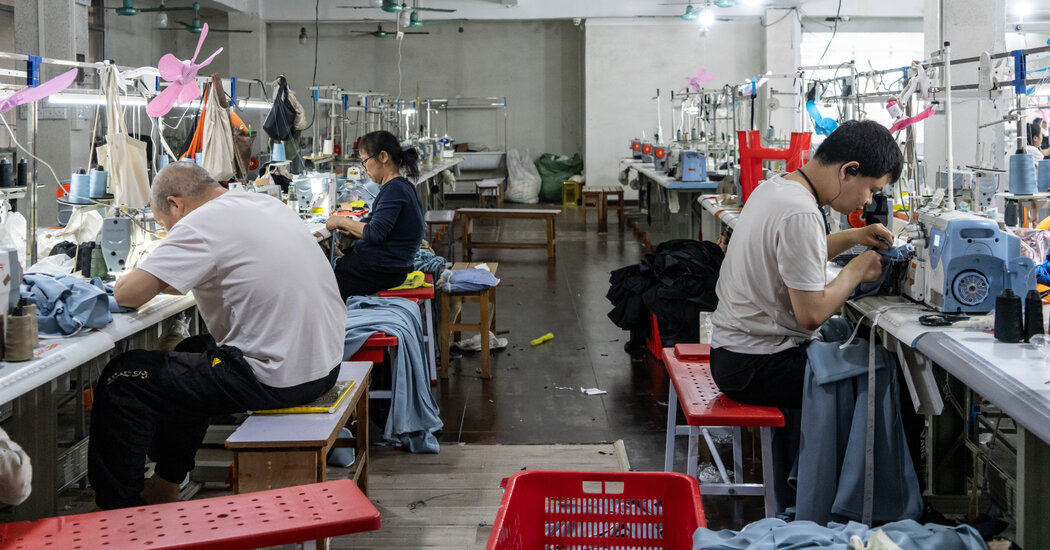

The Trump administration on Friday officially eliminated a loophole that had allowed American shoppers to buy cheap goods from China without paying tariffs. The move will help U.S. manufacturers that have struggled to compete with a wave of low-cost Chinese products, but it has already resulted in higher prices for Americans who shop online.
The loophole, called the de minimis rule, allowed products up to $800 to avoid tariffs and other red tape as long as they were shipped directly to U.S. consumers or small businesses. It resulted in a surge of individually addressed packages to the United States, many shipped by air and ordered from rapidly growing e-commerce platforms like Shein and Temu.
A growing number of companies used the loophole in recent years to get their products into the United States without facing tariffs. After President Trump imposed duties on Chinese goods during his first term, companies started using the exemption to bypass those tariffs and continue to sell their products more cheaply to the United States. Use of the loophole ramped up in Mr. Trump’s second term as he hit Chinese goods with a minimum 145 percent tariff.
U.S. Customs and Border Protection processed a billion such packages in 2023, the average value of which was $54.
In a cabinet meeting at the White House on Wednesday, Mr. Trump referred to the loophole as “a scam.”
“It’s a big scam going on against our country, against really small businesses,” he said. “And we’ve ended, we put an end to it.”
Mr. Trump’s decision was related partly to concerns about the loophole’s use as a conduit for fentanyl into the United States.
The exemption allowed companies shipping inexpensive goods to submit less information to customs officers than other standard shipments. The administration said drug traffickers were “exploiting” the loophole by sending precursor chemicals and other materials used to manufacture fentanyl into the United States without having to provide shipping details.
Growing use of the loophole also threatened U.S. jobs in warehousing and logistics. It encouraged major American retailers to ship more products directly from China to consumers’ doorsteps, avoiding larger shipments that were subject to tariffs and then distributed through U.S. warehouses and delivery networks.
Kim Glas, the president of the National Council of Textile Organizations, which represents American textile makers and fought to eliminate the loophole, said it had “devastated the U.S. textile industry.” Ms. Glas said it had allowed unsafe and illegal products to flood the U.S. market duty-free for years. More than half of all de minimis shipments by value contained textile and apparel products, she said.
“This tariff loophole has granted China almost unilateral, privileged access to the U.S. market at the expense of American manufacturers and U.S. jobs,” she said.
But opponents of ending the exemption complained that the move would significantly raise prices for American consumers, hurt small companies that had built their businesses around the loophole and slow the flow of trade between the countries. The change is expected to weigh on airlines and private carriers like FedEx and UPS, which have had a steady business flying small-dollar goods across the world to the United States.
The changes, which apply to shipments from mainland China and Hong Kong, went into effect at 12:01 a.m. Friday. They are likely to sow pain and confusion for consumers as well as small retailers.
Temu recently started listing “import charges” on its site, while Shein’s website tells shoppers that tariffs are “included in the price you pay.”

Gabriel Wildau, a China analyst at Teneo, an advisory firm, said the change would “take a bite out of Chinese exports” and “force online retailers whose main selling point is dirt cheap prices to raise their prices dramatically.”
“It’s a price shock for price sensitive U.S. consumers who really enjoyed access to cheap goods,” he said.
The Trump administration has also promised to eliminate the loophole for shipments from other countries, but said it was waiting until the government figured out how to deal with collecting fees from such packages. U.S. customs officials are already burdened by the Trump administration’s increased enforcement of immigration rules and vast expansion of global tariffs.
The administration briefly turned off the de minimis exception for China in early February, before realizing that the sudden change was overwhelming shipment channels, including the Postal Service. Mr. Trump then reversed that order to give his advisers more time to establish systems that could accommodate the change.
The de minimis exception was created in the 1930s to ease the work of customs officials who were required to collect tariffs in cases where the revenue would be less than the cost of collecting the duties. Congress raised the threshold for de minimis packages to $5 in 1978 and $200 in 1993, and then to $800 in 2016.
In recent years, pressure to eliminate the loophole has grown. Lawmakers have been considering legislation to reform the de minimis rule, and the Biden administration proposed changes last year that would narrow the exception when it came to China.
One potential issue with the current rules is that they appear to create a discrepancy that allows goods moved through the Post Office to be subject to lower tariffs than goods moved using private carriers.
Goods that come into the United States from China via private carriers like DHL or FedEx will be subject to tariffs of at least 145 percent — for example, adding $14.50 of duties to a $10 T-shirt. But shipments that come in through the Postal Service face either a tariff of 120 percent of the value of the goods or a fee of $100 per package, which increases to $200 in June.
Shipments that come in through private carriers also appear to be subject to other duties, like the tariffs Mr. Trump imposed on China in his first term, and most-favored-nation duties set by the World Trade Organization. But shipments that travel through the Postal Service are not.
In addition, the Postal Service appears to face less scrutiny for collecting tariffs on goods shipped from China to other countries and then into the United States through foreign postal services.
The United States, for now, still offers the de minimis exception for countries other than China. But starting Friday, goods made in China are not supposed to qualify for de minimis, even if they are routed through another country before coming to the United States. Private carriers like UPS and FedEx are required to collect information on the origin of products, so that tariffs still must be paid for a Chinese-made good that is shipped into the United States via Canada, for example.
But the Postal Service has not been legally required to collect information on where products originate, and neither are foreign postal services. That could lead to an increase in schemes that try to bypass China tariffs by using the post office.
Peter Eavis and Julie Creswell contributed reporting.