
After 24 hours of travel, I was done. At baggage claim, a businessman spotted the small gap between me and the carousel and stepped into it. I moved back to avoid him and tripped over my own carry-on. He didn’t notice. He only had eyes for a belt that was stationary.
He wasn’t being malicious; he was doing what plenty of travelers do, getting as close as possible to a conveyor that had not started moving. The logic, presumably, is readiness. But the result is that everyone gets crammed in and nobody can reach their bag. When you spot your suitcase, you have to weave between people and bags, apologizing through a wall of strangers to reach it. It’s been dubbed carousel grinding, and it’s my No. 1 airport annoyance.
I am not alone. It is one of a long list of airport habits that feel productive, or go unnoticed by the person doing them, and accomplish nothing but slowing everyone down. And they start long before the carousel ― it’s the moment you reach security.
At a London airport, Sean Purdy, traveling with his two young kids, watched one traveler hold up the whole line. His belt was still on, coins in every pocket, the laptop buried in “a backpack that looked like it had been packed during a house fire.”
What made it memorable for Purdy wasn’t the delay. “It was watching the ripple effect. Families trying to keep toddlers occupied, people checking departure times, one woman visibly power-walking in place with that ‘I might miss my flight’ energy.”
Bea Meitiner, a tour leader, knows exactly how these bottlenecks happen, because she has been one. At London Luton, a forgotten tube of toothpaste was flagged at security, then her liquids bag split open. Instead of accepting the loss, she argued.
“What followed was a lengthy and rather embarrassing argument at security while a queue formed behind me,” Meitiner said. It ended when the passenger behind her held out a spare bag and, in effect, asked her to take it and move on. “It was a humbling reminder that airports can turn otherwise reasonable people into the exact passengers everyone else complains about.”

ozgurcankaya via Getty Images
Past security, the crush does not let up. Nick Kembel, who has flown through Asia’s busiest airports for decades, sees it constantly.
“I hate when you stop completely as soon as you get off the escalator or moving sidewalk,” he said. The belt keeps moving. The people behind keep coming. He has watched two passengers nearly collide, both carried forward with nowhere to go. His rule is to step clear before you check your phone. “Airport flow,” he said, “is similar to a synchronized dance.”
By the gate, the cluster builds early. Frequent flyers call them gate lice, the people who pack around the boarding door 30 minutes before their group is called, shuffling forward whenever someone moves and creating a barricade of bags and elbows between the gate agent and everyone else. A poll of 9,000 travelers by the booking site Opodo found that the most common irritation, cited by nearly half, was people cutting in line at security or boarding.
Travel writer Eryn Gordon saw it recently before a packed Lisbon, Portugal, flight, where “the gate agent had hardly even raised the mic to start announcing boarding groups when a mass of people began forming by the boarding line.” Wheelchair users and families with strollers were swallowed by the swarm. The agent had to stop announcements repeatedly just to clear space around the gate. “By the time we finally boarded,” Gordon said, “most of the passengers were visibly agitated.”
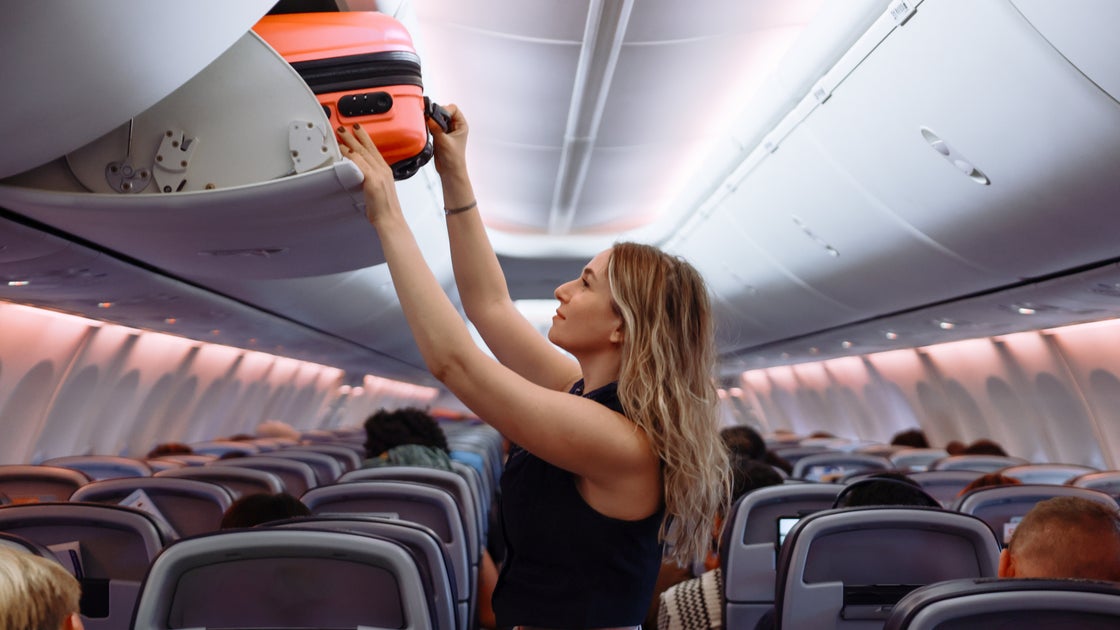
Some of the rush is bin anxiety, the fear that if you don’t board first, someone will fill your overhead space. Photographer Julia-Carolin Zeng runs into it often, and it’s a big pet peeve.
“When it bothers me the most is when I can’t find a space for my suitcase in the overhead lockers in between all the jackets and small bags,” she said. “The consequence is that airlines force passengers to put carry-on suitcases in the hold.”

On a flight from Mexico City to Miami, a gate agent made Zeng check her suitcase, so she emptied her camera gear into a tote bag and sent the empty suitcase to the hold. The irony is that the bin space people rush the gate to protect is often filled with bags that would have fit under a seat.
Then the wheels touch down and I become the problem. I always do the deplane dash. The second the seat belt sign switches off, I am unbuckled and on my feet, crowding the aisle as if 15 minutes hunched under a bin will get me off sooner. It never does. I take over 50 flights a year, and I still do it.
And this behavior is contagious. Saugat Adhikari, who runs trekking tours out of Nepal and flies constantly for work, watches it spread. “Almost the whole cabin imitates that same move within seconds, even though they all fully understand that no one is going to get out faster.”
There is a name for it. Mel Plourde, a licensed social worker who works as a psychiatric technician, calls it progress anxiety. We stand the moment we land, she said, because the brain “generally prefers to take some type of action rather than waiting,” even when the action changes nothing.
So why can’t we stop? Lauren Mahoney, a licensed psychologist and board-certified behavior analyst, pointed to reward. “These successes are infrequent, but they are powerful,” she said. “Behavior does not persist because it is rational. Behavior persists because it has been reinforced.”
As Mahoney put it, “Travelers cannot control delays, gate changes, boarding times, weather or when their luggage appears. Research consistently shows that when people experience uncertainty and reduced control, they often engage in behaviors that restore a sense of agency, even if that control is largely symbolic.”
Back at the carousel, the businessman had his bag the second it reached him and was gone. Crowding the belt saved him maybe two seconds. Yet it sent me tripping over my own carry-on and left a dozen people unable to reach theirs. I would like to say I have learned something. But the moment the seat belt sign goes off on my next flight, I’ll be on my feet. So will half the cabin.