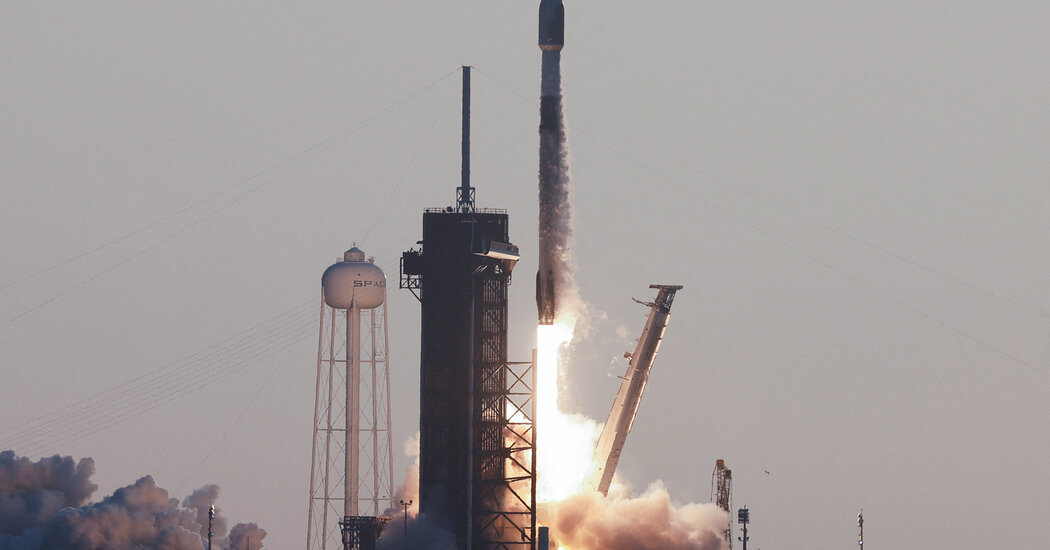

Just before the Russian-Ukrainian war reached its two-year milestone today, U.S. intelligence agencies warned that Russia might aim a nuclear weapon at an unusual target: not any place on Earth, but satellites orbiting in space.
Putting a weapon into orbit is not just a military threat. It’s also a risk to the space economy — and the one on the ground. There is a little-known but fast-growing industry that insures satellites, but it doesn’t provide insurance against nuclear arms.
What’s at stake: hundreds of billions (and probably trillions) of dollars when including the services that rely on satellites, according to David Wade, an underwriter at the Atrium Space Insurance Consortium, which insures satellites for Lloyd’s.
Of more than 8,000 satellites in orbit, thousands belong to private companies, according to Orbiting Now, a site that compiles real-time satellite tracking data from NASA and other sources. The Russian weapon is said to be designed to target satellites in low Earth orbit, where most commercial satellites operate.
SpaceX’s Starlink dominates the space-based internet services industry, and Amazon also has big aspirations in space. But the sharp drop in launch costs in recent years — driven largely by SpaceX — has made entry possible for many smaller players, leading to a satellite-business frenzy that prompted the Federal Communications Commission to open a Space Bureau last year.
Wade estimated the total value of all insured satellites in orbit at $25 billion. That doesn’t include the revenue they generate. The Satellite Industry Association estimated revenues for nongovernmental satellite services at $113 billion in 2022.
Investment in the space economy is increasing quickly. Space activity could total $620 billion this year, according to the most recently available estimate. That’s up from $545 billion in 2022, according to an estimate from the Space Foundation, a nonprofit that promotes space education and enterprise.
Aspirations for the space economy include mining for rare minerals and water, tourism, communications, and data transfer infrastructure. On Thursday, a lunar lander from Intuitive Machines, traveling on a SpaceX rocket, became the first private craft to land on the moon, which some are hopeful leads to mining for water that could be used to make fuel for more distant industrial missions.
A space weapon would cast a pall across other businesses, too. Industries from agriculture to tech depend on satellites, and sectors like shipping, transport, banking and supply chain management rely on GPS, which uses satellites. The threat would also have “a depressive effect” on space company valuations broadly, said Donald Moore, C.E.O. of the Space Finance Corporation and a space policy lecturer at the University of Michigan Law School.
The new threat could also put a dent in the U.S. government’s plans to rely on private players just as the Department of Defense is expected to release details of a new strategy to integrate commercial satellites in national security, noted Brian Weeden, the chief program officer for the Secure World Foundation, a nonprofit that works on space policy.
Some are skeptical of the risk. The precise effects would depend on unknowns about the weapon, company contingency planning and other factors. “We could still communicate,” said Henry Hertzfeld, a space policy professor at George Washington University and former chief economist at NASA. “We still have some landlines,” he added, speaking from his office phone. And he doubts that Russia will introduce this menace, as it would also endanger its space activities. Notably, it would also violate an international space treaty.
But the risk is not covered by insurance. “Exclusions for acts of war, antisatellite devices and nuclear reaction, nuclear radiation or radioactive contamination (except for radiation naturally occurring in the space environment) are typically listed in a space insurance policy,” Wade said in an email.
The U.S. space model depends heavily on commercialization, noted Russell Sawyer, a space insurance broker at Lockton in London. The government has pushed risk out onto private companies, he said, and this trend could shift if this nuclear threat really is serious: “The government would be needed.” — Ephrat Livni
IN CASE YOU MISSED IT
Reddit files to go public. The company is seeking a valuation of at least $5 billion, and it sees artificial intelligence as helping to turbocharge its ad-sales business and generate new licensing revenue. This week it confirmed it had signed a deal with Google that’s reportedly worth $60 million a year to help the search giant train its A.I. models.

The Securities and Exchange Commission will reportedly drop some of its proposed climate disclosures. The agency will no longer pursue a requirement for major public companies to reveal “Scope 3” emissions created indirectly along its value chain, sources told Reuters. By walking back the proposal, which it introduced in a climate disclosure rule in 2022, the agency may be hoping to thwart litigation forcing it to defend its power to demand any climate disclosures at all.
Nvidia’s share price surge sets a record. The chipmaker added $277 billion in market value on Thursday, the biggest one-day gain ever for a U.S.-listed company, after its blowout earnings report. The results helped power rallies in both the S&P 500 and the Nasdaq composite index.
Bill Ackman steps up his campaign against Business Insider. The billionaire investor has been embroiled in a dispute with the publication since it published an article saying his wife, Neri Oxman, a prominent academic and architect, had plagiarized in her dissertation. On Friday, his lawyer sent a 77-page letter to the publication’s parent company, asking it to correct the article and issue an apology.
Why Russia still has plenty of money
Even as Vladimir Putin faces new U.S. sanctions after Aleksei Navalny’s death, the Russian president emerged this week with two big corporate concessions that could strengthen his hand. Danone, the French food conglomerate, agreed to sell its Russian assets to a Putin crony, at a steep discount, while the snack maker Mondelez said it would remain in Russia.
Putin is on something of a winning streak at the two-year anniversary of the Kremlin’s invasion of Ukraine. Despite a price cap on Russian oil exports, the International Monetary Fund predicts solid growth in Russia’s gross domestic product this year. What is more, Putin can afford to play for time as he waits to see if Donald Trump wins in November, perhaps bringing warmer relations and sanctions relief.
“I have very bad news,” Alexandra Prokopenko, a Russian economist who spent years at the Central Bank in Moscow before leaving Russia in 2022, told DealBook. “For the next 12 to 18 months, Putin definitely has the money to maintain the current level of war.”
Vivienne Walt reports for DealBook on the cards that Putin holds:
He has important friends, and is making new ones. After Europe’s ban on Russian oil, Putin found eager buyers in India and China. The supply of discounted fuel is just one way that ties between Moscow and Beijing have deepened. The Chinese have also supplied Russia with key equipment to drill for natural gas in the Arctic after Western companies cut off its access to the technology. Elsewhere, Russia is relying on a shadow fleet of tankers from friendly countries to move its oil around the world, earning billions a month, according to Bloomberg data.
Many Russian professionals who fled after the invasion are returning, having found a chilly reception abroad. Meanwhile, restricted goods like semiconductors, some U.S.-sourced, arrive relatively seamlessly via a newly constructed supply chain that threads from China through the Persian Gulf countries to Turkey. “Russia has switched to a war economy early and with significant success,” Holger Schmieding, an economist at Berenberg Bank, told DealBook.
The Russian economy has been rebuilt around war. Defense and security spending makes up about 40 percent of the country’s budget, after Putin increased Russia’s military budget this year. “Russia is hooked on military steroids,” Prokopenko said.
Pain could still set in. Russians could slowly begin to feel the war’s economic toll. “Putin has enough money for continuing this war for another year,” Sergei Guriev, a Russian economist and provost of Paris’s Sciences Po university, said in an email. “After this he will have to cut nonmilitary spending, like education and health care,” he said. “At some point it will create problems for Putin.”
What it costs the West to enforce sanctions
An $82 million mansion in London’s Hampstead Heath modeled after Versailles. Villas on the French and Italian Riviera. A $325 million superyacht, the Amadea, impounded in San Diego, and artworks galore.
The value of Russian assets, including business property, seized by the West since the Kremlin invaded Ukraine is in the billions. It’s costing Western countries millions more to manage and look after the loot.
Worse still, selling off the sum of frozen Russian assets, as some countries are calling for, could create even bigger financial and legal problems.
Some U.S. officials say it is time to sell off the assets, rather than continue the expensive upkeep. This month, they petitioned a Manhattan court for permission to sell the Amadea, which is owned by a Putin crony, Suleyman Kerimov, and costs taxpayers about $600,000 per month to clean and maintain. In Britain, the authorities have estimated over $1 million in upkeep costs for the frozen Hampstead Heath property.
Some $300 billion in frozen sovereign funds are even more of a headache. They are part of Moscow’s vast investment portfolio that Western banks and financial institutions froze after the outbreak of war. The White House has called for using the funds to rebuild Ukraine.
Some European leaders think that would be a bad idea. Italy, France and Germany worry that such a move would violate international law, harm Europe’s reputation among investors and mess with international trade.
Prokopenko, the Russian economist, said: “It could undermine trust in Europe. Gulf and Asian countries have reserves in Europe. The euro would be less favorable.”
Group of 7 leaders meet this weekend virtually to discuss how to aid Ukraine. One idea is seizing the profits from Russian assets. The payoff could be big. Last year, Euroclear, a clearinghouse in Brussels holding two-thirds of the assets, made a 4.4-billion-euro profit by reinvesting matured Russian securities.
Thanks for reading! We’ll see you Monday.
We’d like your feedback. Please email thoughts and suggestions to [email protected].