
Close Menu

    Subscribe to Updates

    Get the latest creative news from FooBar about art, design and business.

    What's Hot

    Can You Freeze Stuffing? See What Food Experts Say

    November 26, 2026

    Stop Using AI as an Excuse for Layoffs. Here’s How to Use AI to Retain Talent Instead

    November 26, 2026

    The Key AI Terms You Should Know

    November 26, 2026
    Facebook X (Twitter) Instagram
    Trending
    • Can You Freeze Stuffing? See What Food Experts Say
    • Stop Using AI as an Excuse for Layoffs. Here’s How to Use AI to Retain Talent Instead
    • The Key AI Terms You Should Know
    • Animal Spirits: The Stock Market is Too Big to Fail
    • A Closer Look at Student Mental Health Funding in New Jersey
    • CRM for political campaigns: Key terms and FAQs answered
    • 1Password said hackers broke into its internal systems, but customer passwords are safe
    • U.S. airlines retire long-haul first class, but business class grows
    Facebook X (Twitter)
    SBM Global News
    Demo
    • Home
    • Top Stories
      • Politics
    • Business
      • Small Business
      • Marketing
    • Finance
      • Investment
    • Technology

      The Key AI Terms You Should Know

      November 26, 2026
      Read More

      1Password said hackers broke into its internal systems, but customer passwords are safe

      November 26, 2026
      Read More

      Figma employee sues, alleging company forced her to confront harassers

      November 24, 2026
      Read More

      Why data centers are at the center of the Big Tech backlash

      November 23, 2026
      Read More

      Startup sues Apple in India over tap-to-share contacts feature

      November 21, 2026
      Read More
    • Lifestyle
      • Travel
    • Feel Good
    • Get In Touch
    SBM Global News
    Demo
    Home»Investment»Supply & Demand in the Stock Market
    Investment

    Supply & Demand in the Stock Market

    By Staff WriterJune 21, 20245 Mins Read
    Facebook Twitter LinkedIn Reddit Email
    #image_title
    Share
    Facebook Twitter LinkedIn Pinterest Email

    A reader asks:

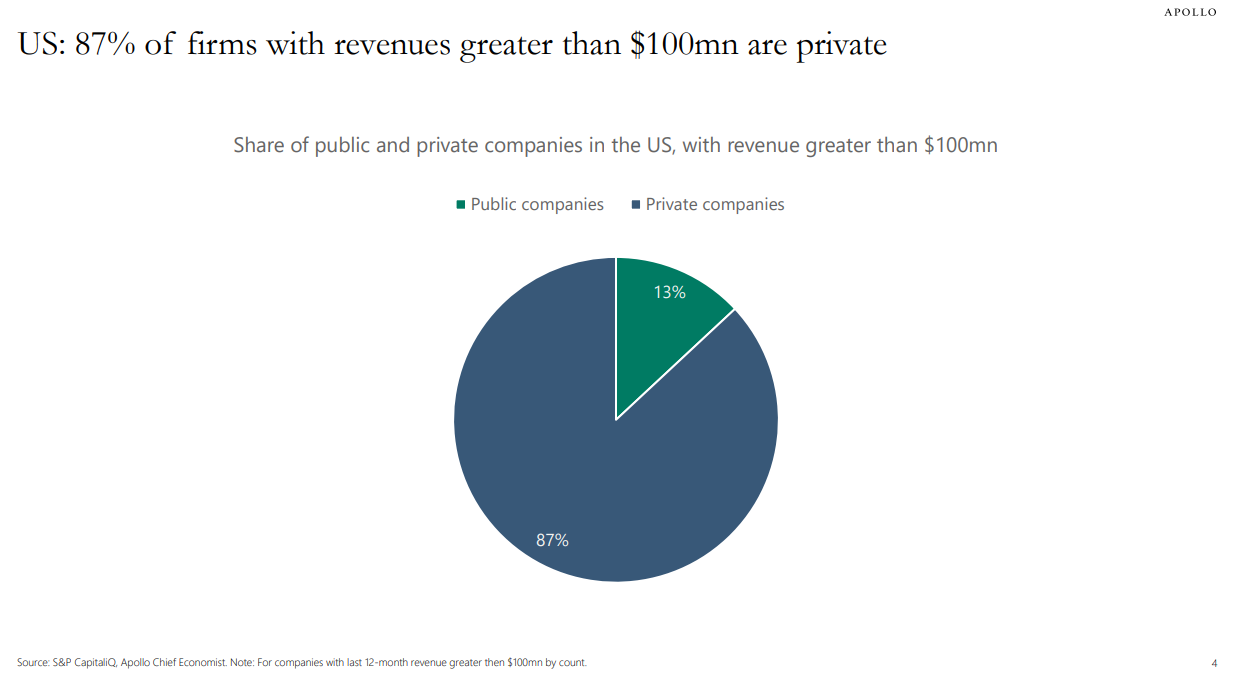
    You guys have recently quoted Slock in two podcast episodes that Private Equity Companies, those with over 100 million dollars in revenue make up 87 percent of that category versus only 13 percent of publicly traded company fall into the 100 million in revenue category, and that number is only increasing.

    With that said, is this ONE of the reasons stock prices seem to continuously increase. As private equity companies continue to increase in number, there are less publicly traded companies therefore there is more money chasing the ever decreasing number of public companies?

    Here’s that stat from Apollo’s Torsten Slok:
    The Atlantic shared some data about the dwindling number of publicly traded stocks along with the corresponding growth in private equity investments:

    The publicly traded company is disappearing. In 1996, about 8,000 firms were listed in the U.S. stock market. Since then, the national economy has grown by nearly $20 trillion. The population has increased by 70 million people. And yet, today, the number of American public companies stands at fewer than 4,000. How can that be?

    One answer is that the private-equity industry is devouring them.

    In 2000, private-equity firms managed about 4 percent of total U.S. corporate equity. By 2021, that number was closer to 20 percent. In other words, private equity has been growing nearly five times faster than the U.S. economy as a whole.

    Private equity managed less than $1 billion in the mid-1970s.  Today it’s more than $4 trillion. There is more than $2.5 trillion in dry powder alone globally:
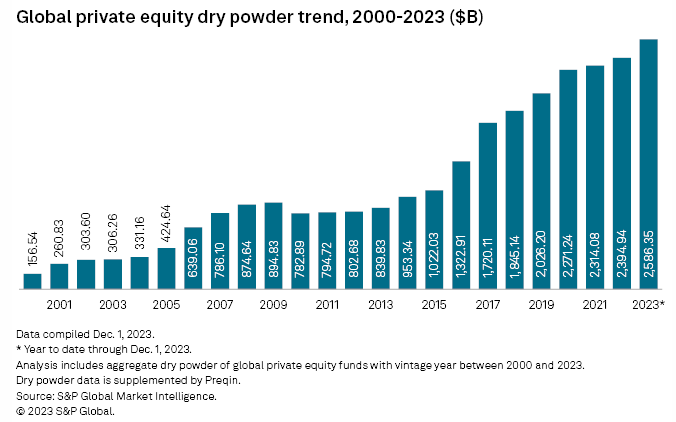
    Private equity is a big part of the U.S. and global economy now.

    Here’s a look at the shrinking number of public stocks in the U.S. via Barron’s:

    Demo

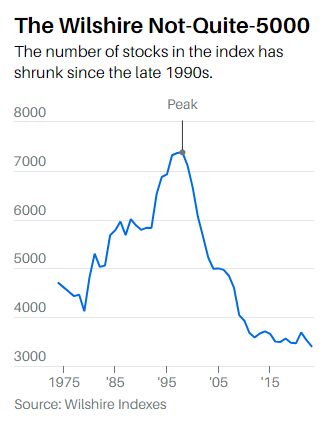
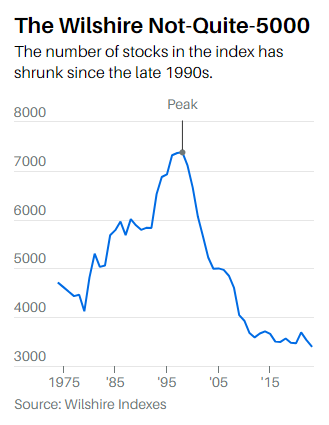
    We’ve gone from more than 7,000 stocks in the mid-1990s to more like 3,500 now. The number of public companies has been more than halved.

    The Wilshire 5000 is more like the Wilshire 3500. The Russell 3000 currently has only 2,668 stocks, while the Russell 2000 has just 1,665 stocks.

    We’ve reached the point where the indexes feel like false advertising.

    From a purely supply and demand perspective, it would make sense that more dollars chasing fewer stocks would drive up prices.

    But there’s more going on here. You also have to look at the types of companies that have gone away.

    That spike in new corporations during the 1990s was something of an aberration of the dot-com bubble. It was mostly tiny micro-cap companies.

    Vanguard shared the data on this with Institutional Investor a few years ago:

    Rowley says the proportion of large-cap, mid-cap, and small-cap companies that make up overall market capitalization is very consistent going back to 1979. He says many analysts have made 1996, which had a record number of public companies, a de facto anchor point. However, the late 1990s markets were at a high point, with many companies eager to go public and cash in on rich valuations.

    “If you look at the general trend in history, there’s an increase in the number of public companies leading up to 1996, and there’s been a decrease down from that point,” says Rowley. “But again, it’s almost exclusively the domain of micro-cap stocks.”

    In 1979, there were 2,044 public micro-cap companies. In 1997, there were 4,193, and in 2014 there were 1,549. But they are a small part of the publicly traded universe. In 1979 and 1997, micro caps represented 3 percent of the market. In 2014, micro-caps represented 2 percent of the market. Micro-caps fell to 1 percent by 2016.

    Most of those micro-cap companies from the 1990s ended up going out of business because they had no business model or fundamentals. They were looking to cash in on the euphoria at a time when there wasn’t as much VC or PE money sloshing around.

    And micro-cap companies are a sliver of the U.S. stock market from a market cap perspective.

    Holding ten one-dollar bills doesn’t put you in a better position than the person holding a single one-hundred-dollar bill.

    Sure, there are some smaller companies investors have missed out on because of more venture capital money, M&A and buyout activity. But you could argue the remaining companies are now even higher quality because of this.

    Michael Mauboussin wrote a paper about the shrinking number of stocks back in 2017 making this exact argument. This was the main takeaway from that report:

    As a result, listed companies today are on average larger, older, and more profitable than they were 20 years ago. Further, they operate in industries that are generally more concentrated. The overall size and maturity of listed companies means they are more likely to pay out cash to shareholders in the form of dividends and share buybacks than companies were in the past.

    We speculate that the maturation of listed companies has also contributed to informational efficiency in the stock market. Gaining edge in older and well established businesses is likely more difficult than it is in young businesses with uncertain outlooks. In turn, the greater efficiency may be one of the catalysts for the shift that investors are making from active to indexed or rule-based strategies.

    It makes sense this has created an environment where it’s now harder to outperform the market.

    There are many reasons the stock market has been going up over time.

    The number of stocks listed on the exchange is not one of them.

    We discussed this question on the latest edition of Ask the Compound:


    Barry Ritholtz joined me on the show this week to answer questions about the actual inflation rate, how fiduciary duty works, worries about U.S. government debt and if we will see a flood of homes hit the market when baby boomers begin dying off.

    Further Reading:
    The Rebirth of the IPO

    View original article here

    Share. Facebook Twitter LinkedIn Email Reddit
    Previous ArticleTrump Spokesperson’s 1-Word Description Of His Message Has Critics Very, Very Confused
    Next Article France’s Travel & Tourism broke all records last year

    Related Posts

    Animal Spirits: The Stock Market is Too Big to Fail

    November 26, 2026
    Read More

    Talk Your Book: Stop Handing the IRS Your Yield

    November 24, 2026
    Read More

    Mysterious XRP Ledger Metric Spikes 3,062.1%: What Does This Function Do? – BitRss

    November 23, 2026
    Read More
    Add A Comment

    Leave A Reply Cancel Reply

    Demo
    Top Posts

    Former FBI, CIA Head Has ‘Serious Concerns’ With Trump Cabinet Picks

    December 28, 2024437

    Emirates to operate next-gen A350 on the third daily service to Cape Town

    January 14, 2026261

    AAVE Price Prediction: Target $215-225 by Mid-January 2025 as Technical Indicators Signal Bullish Momentum

    December 15, 2025240

    Wall Street Slumps As Alphabet, Qualcomm And Other Tech Stocks Fall

    February 7, 2026212
    Don't Miss
    Lifestyle

    Can You Freeze Stuffing? See What Food Experts Say

    By Staff WriterNovember 26, 202631 Mins Read

    The turkey is carved, the table is a mess, and there is still a full…

    Read More

    Stop Using AI as an Excuse for Layoffs. Here’s How to Use AI to Retain Talent Instead

    November 26, 2026

    The Key AI Terms You Should Know

    November 26, 2026

    Animal Spirits: The Stock Market is Too Big to Fail

    November 26, 2026
    Stay In Touch
    • Facebook
    • Twitter
    Demo
    Find More
    Trending News
    • Can You Freeze Stuffing? See What Food Experts Say
    • Stop Using AI as an Excuse for Layoffs. Here’s How to Use AI to Retain Talent Instead
    • The Key AI Terms You Should Know
    • Animal Spirits: The Stock Market is Too Big to Fail
    • A Closer Look at Student Mental Health Funding in New Jersey
    • CRM for political campaigns: Key terms and FAQs answered
    • 1Password said hackers broke into its internal systems, but customer passwords are safe
    • U.S. airlines retire long-haul first class, but business class grows
    • Black Friday and Cyber Monday 2026 Tech Deals Live Blog
    • My Husband Became My Caretaker. It Ruined Our Marriage.
    Other News
    • Business
    • Feel Good
    • Finance
    • Fitness
    • Health
    • Investment
    • Lifestyle
    • Marketing
    • Politics
    • Small Business
    • Technology
    • Top Stories
    • Travel
    About Us

    Small Business Minder brings together business and related news from around the world in one place. Follow us for all the business news you'll need.

    Facebook X (Twitter)
    Our Picks

    Can You Freeze Stuffing? See What Food Experts Say

    November 26, 2026

    Stop Using AI as an Excuse for Layoffs. Here’s How to Use AI to Retain Talent Instead

    November 26, 2026
    Most Popular

    Former FBI, CIA Head Has ‘Serious Concerns’ With Trump Cabinet Picks

    December 28, 2024437

    Emirates to operate next-gen A350 on the third daily service to Cape Town

    January 14, 2026261
    Categories
    © 2026 Small Business Minder
    • Home
    • Get In Touch

    Type above and press Enter to search. Press Esc to cancel.

    Ad Blocker Enabled!
    Ad Blocker Enabled!
    Our website is made possible by displaying online advertisements to our visitors. To get the most from our site, please disable your Ad Blocker.