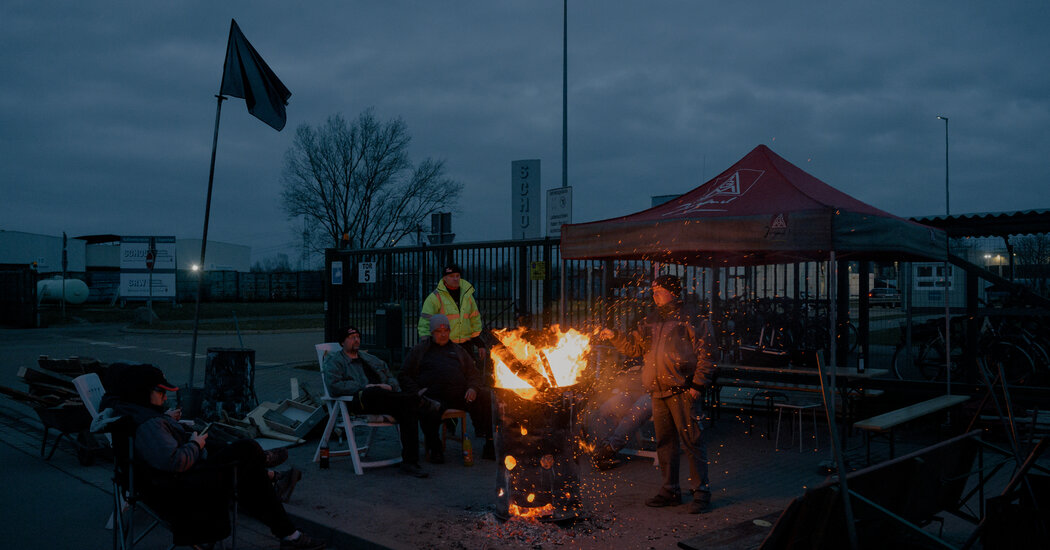

For those striking at the gates of the SRW scrap metal plant, just outside Germany’s eastern city of Leipzig, time can be counted not just in days — 136 so far — but in the thousands of card games played, the liters of coffee imbibed and the armfuls of firewood burned.
Or it can be measured by the length of Jonny Bohne’s beard. He vows not to shave until he returns to the job he has held for two decades. Wearing his red union baseball cap and tending the blaze inside an oil drum, Mr. Bohne, 56, looks like a scruffy Santa Claus.
The dozens of workers at the SRW recycling center say their strike has become the longest in postwar German history — a dubious honor in a nation with a history of harmonious labor relations. (The previous record, 114 days, was held by shipyard workers in the northern city of Kiel who struck in the 1950s.)
While monthslong strikes may be commonplace in some other European countries like Spain, Belgium or France, where workers’ protests are something of a national pastime, Germany has long prided itself on nondisruptive collective bargaining.
A wave of strikes this year has Germans asking whether that is now changing. By some measures, the first three months of 2024 have had the most strikes in the country in 25 years.
Striking workers have brought railways and airports to a standstill. Doctors have walked out of hospitals. Bank employees left work for days.
“Germany — strike nation?” a recent headline in the German magazine Der Spiegel asked. Jens Spahn, deputy leader of the conservative Christian Democrats in the Parliament, denounced a “strike madness” that he said risked paralyzing the country.
The strikes are the latest chapter in the story of how Germany, the “economic miracle” of the 20th century, looks at risk of becoming a cautionary tale for the 21st.
Long the economic powerhouse of Europe, Germany is now the slowest-growing among the 20 countries using the euro. It went into recession in 2023 and is forecast to stagnate in 2024. Under the weight of soaring energy prices and falling production, the country last year suffered its highest inflation in 50 years.
The burden has fallen most heavily on its low- and middle-income workers. Since 2022, their real wages, according to a recent study, have shrunk more than at any time since World War II.
At the same time, Germany is facing an ever more severe shortage of labor and an aging population, with officials estimating there will be a shortage of seven million workers by 2035. That spells trouble for the generous welfare system German citizens have long depended on.
It is a unique moment of opportunity for workers, at a very vulnerable moment for the national economy.
“Germany is coming more slowly out of the crisis than expected,” Robert Habeck, the economy minister, said last week, criticizing what he called “a bit too much striking.”
“We really can’t afford this,” he said.

For decades, Germany’s economy chugged along profitably, underpinned by exports to China and cheap gas from Russia. But Moscow’s invasion of Ukraine prompted Europe to wean itself off the Russian gas that powered German industry. And Beijing’s deepening “Made in China” strategy is turning a huge Asian market that once was a source of growth for Germany into an industrial rival.
The impact on Germany has been worse than elsewhere in Europe precisely because of its enormous manufacturing industry, which makes up a fifth of the country’s overall economic output — almost double that in France or Britain.
For lower-income workers, now bracing for a future less prosperous than the present, there is little to fall back on. Some 40 percent of households have little or no net savings, said Marcel Fratzscher, president of the German Institute for Economic Research.
“The concerns, dissatisfactions and the fears of young people are fully justified — and of course of the parents who fear for their kids,” he said.
“People had been trusting that social welfare could provide, “ he added. “It can no longer provide what it used to.”
At the metal scrap plant, workers like Mr. Bohne take shifts to maintain their 24-hour strike outside the main gates, warming themselves inside construction containers or around makeshift firepits fueled with scrap wood.
The stoppages have forced the plant to halt night shifts, and only one of the four production lines is operating. The strikers, who want an 8 percent pay raise, are feeling emboldened.
“You notice the solidarity has become stronger,” said Christoph Leonardt, 35, one of the picketing workers.
Yet the issue is not only about pay. Workers are also demanding better working conditions, the ability to plan work shifts and vacations long in advance, a better work-life balance and fewer hours.
“The worker has become more self-assured,” said Katrin Heller, a 61-year-old security worker who marched with hundreds of striking colleagues in Day-Glo vests through the Berlin airport’s gleaming new departure hall last week, forcing flights to be canceled.
“We know we have value to the employers so we expect to be treated fairly,” she said. Officially, airport security workers are demanding a 15 percent raise to keep up with inflation, but many seemed more frustrated with shift schedules that force them to stand for up to six hours without a break.
Robert Wegener, 56, a security screener for 19 years, warned that jobs like his were no longer attractive to younger people: “If we don’t get these extras, there’s not much incentive to work here.”
His employer, Securitas, agrees. Jonas Timm, a company spokesman, said recruiting had becoming increasingly difficult since the pandemic, when he began noticing a “change in mentality” about shift work.
Many employers have expressed frustrations that more job applicants, for example, demand shorter hours or four-day work weeks.
Analysts are not in agreement as to why Germans want to work less, but many say that a major problem is Germany’s tax system, which taxes income far more heavily than it does private wealth, disproportionately affecting low- and middle-income workers.
Clemens Feust, president of the Ifo Institute for Economic Research, says working full time can be more costly than staying at home. An Ifo study showed that, because of the way taxes are structured for married couples, a family with one partner working full time and the other working part time had more income at the end of the month than two full-time working parents.
“The fact that it’s not worth working in our middle income brackets is really a problem,” he said.
As striking workers flex their might, the costs to the overall economy risk piling up as critical infrastructure across Germany grinds to a halt.
According to an industry group, the one-day strike at airports in Berlin and Hamburg last week grounded some 570 flights and affected 90,000 travelers.
The Kiel Institute for the World Economy has estimated that the train conductors’ strikes cost the German economy about 100 million euros per day.
Mr. Feust said such costs were often made up as companies and affected travelers made adjustments. The more serious damage, he said, is the economic mood.
“This is more about psychology,” he said, particularly in a time when Germany feels polarized by both economic struggles and political ones, including the war in Ukraine and the resurgence of the far right. “It leads to a heightened sense of crisis.”
Striking workers say they, too, are looking for a feeling of security as much as increased pay.
“We need more reliability, and we need to be able to plan in the long term,” Mr. Bohne said.
Only then, he said, will he shave his beard.