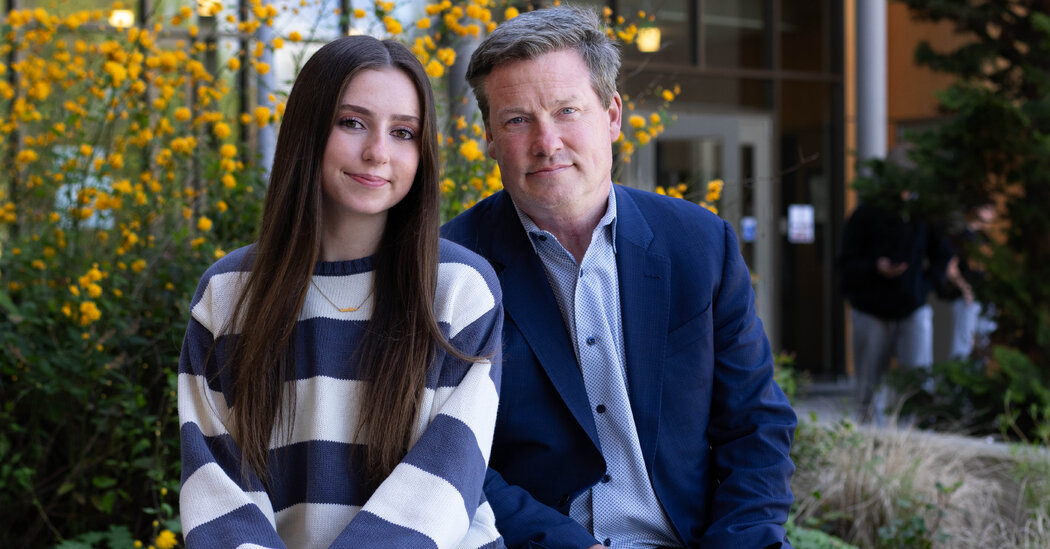

Caroline Mullet, a ninth grader at Issaquah High School near Seattle, went to her first homecoming dance last fall, a James Bond-themed bash with blackjack tables attended by hundreds of girls dressed up in party frocks.
A few weeks later, she and other female students learned that a male classmate was circulating fake nude images of girls who had attended the dance, sexually explicit pictures that he had fabricated using an artificial intelligence app designed to automatically “strip” clothed photos of real girls and women.
Ms. Mullet, 15, alerted her father, Mark, a Democratic Washington State senator. Although she was not among the girls in the pictures, she asked if something could be done to help her friends, who felt “extremely uncomfortable” that male classmates had seen simulated nude images of them. Soon, Senator Mullet and a colleague in the State House proposed legislation to prohibit the sharing of A.I.-generated sexuality explicit depictions of real minors.
“I hate the idea that I should have to worry about this happening again to any of my female friends, my sisters or even myself,” Ms. Mullet told state lawmakers during a hearing on the bill in January.
The State Legislature passed the bill without opposition. Gov. Jay Inslee, a Democrat, signed it last month.
States are on the front lines of a rapidly spreading new form of peer sexual exploitation and harassment in schools. Boys across the United States have used widely available “nudification” apps to surreptitiously concoct sexually explicit images of their female classmates and then circulated the simulated nudes via group chats on apps like Snapchat and Instagram.
Now, spurred in part by troubling accounts from teenage girls like Ms. Mullet, federal and state lawmakers are rushing to enact protections in an effort to keep pace with exploitative A.I. apps.
Since early last year, at least two dozen states have introduced bills to combat A.I.-generated sexually explicit images — known as deepfakes — of people under 18, according to data compiled by the National Center for Missing & Exploited Children, a nonprofit organization. And several states have enacted the measures.
Among them, South Dakota this year passed a law that makes it illegal to possess, produce or distribute A.I.-generated sexual abuse material depicting real minors. Last year, Louisiana enacted a deepfake law that criminalizes A.I.-generated sexually explicit depictions of minors.
“I had a sense of urgency hearing about these cases and just how much harm was being done,” said Representative Tina Orwall, a Democrat who drafted Washington State’s explicit-deepfake law after hearing about incidents like the one at Issaquah High.
Some lawmakers and child protection experts say such rules are urgently needed because the easy availability of A.I. nudification apps is enabling the mass production and distribution of false, graphic images that can potentially circulate online for a lifetime, threatening girls’ mental health, reputations and physical safety.
“One boy with his phone in the course of an afternoon can victimize 40 girls, minor girls,” said Yiota Souras, chief legal officer for the National Center for Missing & Exploited Children, “and then their images are out there.”
Over the last two months, deepfake nude incidents have spread in schools — including in Richmond, Ill., and Beverly Hills and Laguna Beach, Calif.
Yet few laws in the United States specifically protect people under 18 from exploitative A.I. apps.

That is because many current statutes that prohibit child sexual abuse material or adult nonconsensual pornography — involving real photos or videos of real people — may not cover A.I.-generated explicit images that use real people’s faces, said U.S. Representative Joseph D. Morelle, a Democrat from New York.
Last year, he introduced a bill that would make it a crime to disclose A.I.-generated intimate images of identifiable adults or minors. It would also give deepfake victims, or parents, the right to sue individual perpetrators for damages.
“We want to make this so painful for anyone to even contemplate doing, because this is harm that you just can’t simply undo,” Mr. Morelle said. “Even if it seems like a prank to a 15-year-old boy, this is deadly serious.”
U.S. Representative Alexandria Ocasio-Cortez, another New York Democrat, recently introduced a similar bill to enable victims to bring civil cases against deepfake perpetrators.
But neither bill would explicitly give victims the right to sue the developers of A.I. nudification apps, a step that trial lawyers say would help disrupt the mass production of sexually explicit deepfakes.
“Legislation is needed to stop commercialization, which is the root of the problem,” said Elizabeth Hanley, a lawyer in Washington who represents victims in sexual assault and harassment cases.
The U.S. legal code prohibits the distribution of computer-generated child sexual abuse material depicting identifiable minors engaged in sexually explicit conduct. Last month, the Federal Bureau of Investigation issued an alert warning that such illegal material included realistic child sexual abuse images generated by A.I.
Yet fake A.I.-generated depictions of real teenage girls without clothes may not constitute “child sexual abuse material,” experts say, unless prosecutors can prove the fake images meet legal standards for sexually explicit conduct or the lewd display of genitalia.
Some defense lawyers have tried to capitalize on the apparent legal ambiguity. A lawyer defending a male high school student in a deepfake lawsuit in New Jersey recently argued that the court should not temporarily restrain his client, who had created nude A.I. images of a female classmate, from viewing or sharing the pictures because they were neither harmful nor illegal. Federal laws, the lawyer argued in a court filing, were not designed to apply “to computer-generated synthetic images that do not even include real human body parts.” (The defendant ultimately agreed not to oppose a restraining order on the images.)
Now states are working to pass laws to halt exploitative A.I. images. This month, California introduced a bill to update a state ban on child sexual abuse material to specifically cover A.I.-generated abusive material.
And Massachusetts lawmakers are wrapping up legislation that would criminalize the nonconsensual sharing of explicit images, including deepfakes. It would also require a state entity to develop a diversion program for minors who shared explicit images to teach them about issues like the “responsible use of generative artificial intelligence.”
Punishments can be severe. Under the new Louisiana law, any person who knowingly creates, distributes, promotes or sells sexually explicit deepfakes of minors can face a minimum prison sentence of five to 10 years.
In December, Miami-Dade County police officers arrested two middle school boys for allegedly making and sharing fake nude A.I. images of two female classmates, ages 12 and 13, according to police documents obtained by The New York Times through a public records request. The boys were charged with third-degree felonies under a 2022 state law prohibiting altered sexual depictions without consent. (The state attorney’s office for Miami-Dade County said it could not comment on an open case.)
The new deepfake law in Washington State takes a different approach.
After learning of the incident at Issaquah High from his daughter, Senator Mullet reached out to Representative Orwall, an advocate for sexual assault survivors and a former social worker. Ms. Orwall, who had worked on one of the state’s first revenge-porn bills, then drafted a House bill to prohibit the distribution of A.I.-generated intimate, or sexually explicit, images of either minors or adults. (Mr. Mullet, who sponsored the companion Senate bill, is now running for governor.)
Under the resulting law, first offenders could face misdemeanor charges while people with prior convictions for disclosing sexually explicit images would face felony charges. The new deepfake statute takes effect in June.
“It’s not shocking that we are behind in the protections,” Ms. Orwall said. “That’s why we wanted to move on it so quickly.”