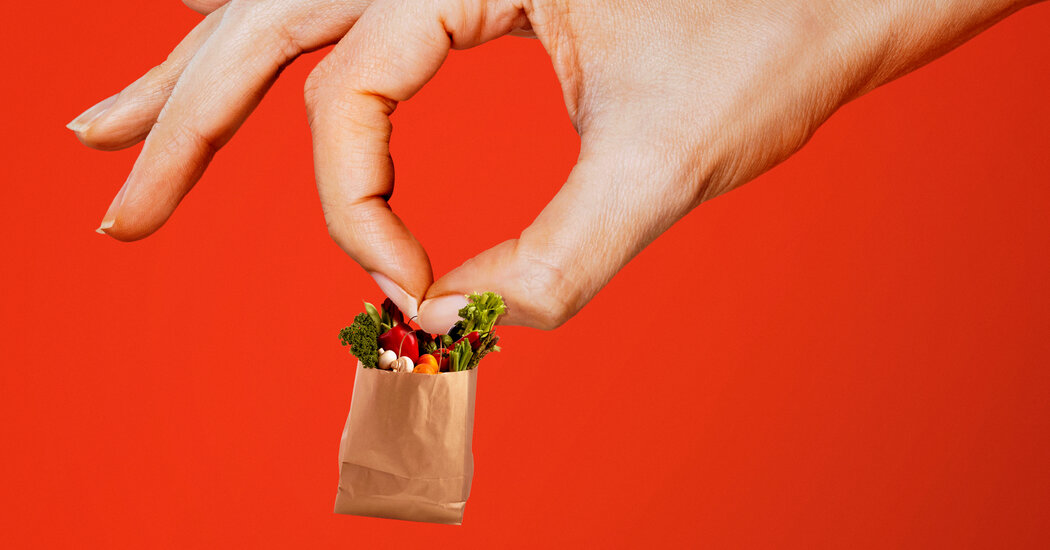

Grocery store shoppers are noticing something amiss. Air-filled bags of chips. Shrunken soup cans. Diminished detergent packages.
Companies are downsizing products without downsizing prices, and consumer posts from Reddit to TikTok to the New York Times comments section drip with indignation at the trend, widely known as “shrinkflation.”
The practice isn’t new. Sellers have been quietly shrinking products to avoid raising prices for centuries, and experts think it has been an obvious corporate strategy since at least 1988, when Chock Full o’Nuts cut its one-pound coffee canister to 13 ounces and its competitors followed suit.
But outrage today is acute. President Biden tapped into the angst in a recent video. (“What makes me the most angry is that ice cream cartons have actually shrunk in size, but not in price,” he lamented.) Companies themselves are blasting the practice in marketing gimmicks. One Canadian chain unveiled a growflation pizza. (“In pizza terms,” the company’s news release quipped, “a larger slice of the pie.”)
But how does shrinkflation work, economically? Is it happening more often in the United States, and if so, does that mean official data are failing to capture the true extent of inflation? Below is an explainer of the trend — and what it means for your wallet.
Shrinkflation was rampant in 2016.
It might be hard to believe, but shrinkflation appears to be happening less often today than it was a few years ago.
The government adjusts official inflation data to account for product downsizing, and the data collectors who monitor for size adjustments caught fewer instances of shrinking household goods and groceries in 2023 than a few years earlier.
Downsizing was frequent back in 2016, when overall inflation was low. It became rarer after the start of the pandemic in 2020, and more recently it has begun returning to prepandemic levels, analysts from the Bureau of Labor Statistics said. (The economists noted that the set of products being measured changed somewhat over the years, making comparisons across time more a rough approximation than an exact science.)
But the magnitude for some products is more extreme now.
Even if downsizing is not happening as often, shrinkflation today is having a big impact in a few key categories, including sweets, detergent and toilet paper.
From 2019 to 2023, shrinkage added about 3.6 percentage points to inflation for products like paper towels and toilet paper, up from 1.2 percentage points from 2015 to 2019. Shrinkflation has also contributed more heavily to price increases in both candy and cleaning products in recent years.
For snacks, shrinking sizes added 2.6 percentage points to inflation, roughly in line with how much they contributed from 2015 to 2019. The government has not yet released an analysis on how much shrinkflation contributed to overall inflation from 2019 to 2023.
While ‘shrinkflation’ gets measured, ‘skimpflation’ does not.
Shrinking itself is captured in official inflation data, but another sneaky force that costs consumers is getting missed in the statistics. Companies sometimes use cheaper materials to save on costs in a practice some call “skimpflation.” That is much harder for the government to measure.
If your paper towel roll costs the same but you’re getting fewer sheets — shrinkflation — that shows up clearly as a unit cost increase that is added to official inflation. If your paper towels are the same size but are suddenly made of worse material — skimpflation — the government does not record that as inflation.
In fact, food and household products broadly are not directly adjusted for quality changes other than size and weight, government statisticians said. So if your microwave dinner brand starts using vegetable instead of olive oil, or if your formerly resealable package loses its zipper, that won’t show up.

Companies do this because it works.
Companies choose to shrink their products rather than charge more for a simple reason: Consumers often pay more attention to prices than sizes.
When quantity goes down, “people might notice, but often, they don’t,” said John Gourville, a professor at Harvard Business School. “You don’t get sticker shock.”
In one famous example, Dannon used to sell yogurts in larger containers than its competitor Yoplait — eight ounces versus six. Consumers were convinced that Dannon’s yogurt was more expensive, not picking up on the fact that it was simply bigger. Eventually, Mr. Gourville said, the company caved and shrank its packaging.
“Sales of Dannon’s yogurt, which declined immediately after the size reduction, have since rebounded,” The Times reported in 2003. “And Dannon is now pocketing a larger profit on every cup of yogurt it sells.”
Not all size changes are created equal. Some can be surreptitious, like increasing the size of an indentation in the bottom of a jar or shaving the corners from a bar of soap. Consumers have a particularly difficult time recognizing size changes when they happen along three dimensions, said Nailya Ordabayeva, an associate professor at Dartmouth’s Tuck School of Business who has studied consumer responses.
“The brain is hard-wired to do simpler heuristics,” she explained.
Plus, she noted, consumers might be willing to accept smaller quantities or even prefer them in some cases. Junk food products have at times shrunk to get down calorie counts, for example.
Still, consumers might push back.
When companies are merely looking after their profits — not their consumers — some pricing experts worry that persistent shrinkflation could drive shoppers away.
When raw material costs were climbing and inflation was in the headlines, consumers most likely understood that companies needed to pass some of those increases along. They may even have preferred smaller products to bigger price tags, several experts said.
But now, overall inflation has been cooling: After peaking at 9.1 percent in July 2022, it had eased to 3.1 percent as of January. And consumers might be less willing to accept shrinkflation now that firms are facing less severe cost pressures, especially because food company profits have been — and in many cases remain — high.
They may simply feel ripped off.
“I can see consumers becoming more and more aware of the existence of shrinkflation,” said Jun Yao, a marketing lecturer at Macquarie University in Australia who has studied the trend.
And as more chains and online retailers post unit costs, shoppers may be more attuned to size changes, Mr. Yao said, an awareness that could beat back against future shrinkage.
The practice, he said, “can backfire — and damage the brand image.”