
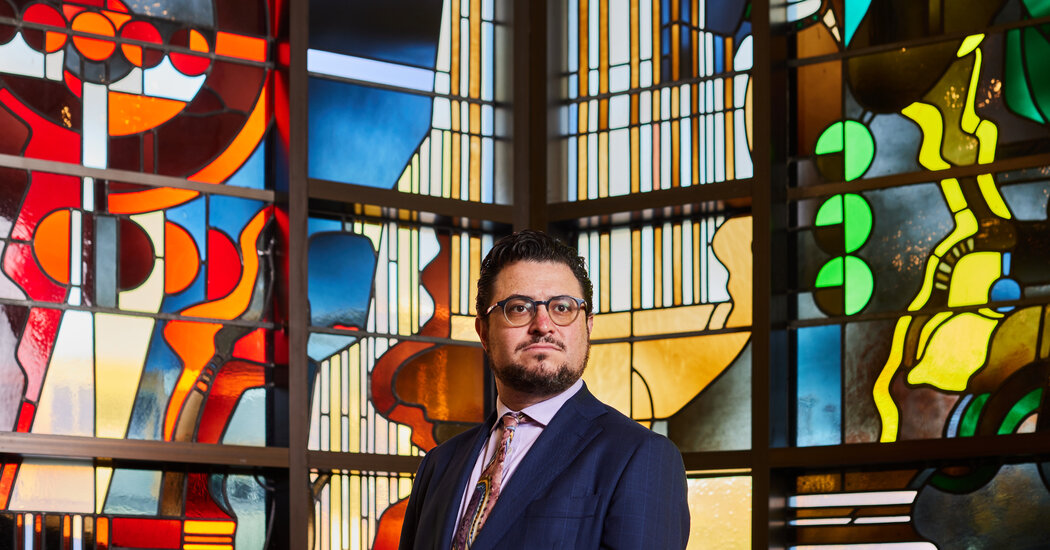

To members of his synagogue, the voice that played over the speakers of Congregation Emanu El in Houston sounded just like Rabbi Josh Fixler’s.
In the same steady rhythm his congregation had grown used to, the voice delivered a sermon about what it meant to be a neighbor in the age of artificial intelligence. Then, Rabbi Fixler took to the bimah himself.
“The audio you heard a moment ago may have sounded like my words,” he said. “But they weren’t.”
The recording was created by what Rabbi Fixler called “Rabbi Bot,” an A.I. chatbot trained on his old sermons. The chatbot, created with the help of a data scientist, wrote the sermon, even delivering it in an A.I. version of his voice. During the rest of the service, Rabbi Fixler intermittently asked Rabbi Bot questions aloud, which it would promptly answer.
Rabbi Fixler is among a growing number of religious leaders experimenting with A.I. in their work, spurring an industry of faith-based tech companies that offer A.I. tools, from assistants that can do theological research to chatbots that can help write sermons.
For centuries, new technologies have changed the ways people worship, from the radio in the 1920s to television sets in the 1950s and the internet in the 1990s. Some proponents of A.I. in religious spaces have gone back even further, comparing A.I.’s potential — and fears of it — to the invention of the printing press in the 15th century.
Religious leaders have used A.I. to translate their livestreamed sermons into different languages in real time, blasting them out to international audiences. Others have compared chatbots trained on tens of thousands of pages of Scripture to a fleet of newly trained seminary students, able to pull excerpts about certain topics nearly instantaneously.
But the ethical questions around using generative A.I. for religious tasks have become more complicated as the technology has improved, religious leaders say. While most agree that using A.I. for tasks like research or marketing is acceptable, other uses for the technology, like sermon writing, are seen by some as a step too far.
Jay Cooper, a pastor in Austin, Texas, used OpenAI’s ChatGPT to generate an entire service for his church as an experiment in 2023. He marketed it using posters of robots, and the service drew in some curious new attendees — “gamer types,” Mr. Cooper said — who had never before been to his congregation.
The thematic prompt he gave ChatGPT to generate various parts of the service was: “How can we recognize truth in a world where A.I. blurs the truth?” ChatGPT came up with a welcome message, a sermon, a children’s program and even a four-verse song, which was the biggest hit of the bunch, Mr. Cooper said. The song went:
As algorithms spin webs of lies
We lift our gaze to the endless skies
Where Christ’s teachings illuminate our way
Dispelling falsehoods with the light of day

Mr. Cooper has not since used the technology to help write sermons, preferring to draw instead from his own experiences. But the presence of A.I. in faith-based spaces, he said, poses a larger question: Can God speak through A.I.?
“That’s a question a lot of Christians online do not like at all because it brings up some fear,” Mr. Cooper said. “It may be for good reason. But I think it’s a worthy question.”
The impact of A.I. on religion and ethics has been a touch point for Pope Francis on several occasions, though he has not directly addressed using A.I. to help write sermons.
Our humanity “enables us to look at things with God’s eyes, to see connections, situations, events and to uncover their real meaning,” the pope said in a message early last year. “Without this kind of wisdom, life becomes bland.”
He added, “Such wisdom cannot be sought from machines.”
Phil EuBank, a pastor at Menlo Church in Menlo Park, Calif., compared A.I. to a “bionic arm” that could supercharge his work. But when it comes to sermon writing, “there’s that Uncanny Valley territory,” he said, “where it may get you really close, but really close can be really weird.”
Rabbi Fixler agreed. He recalled being taken aback when Rabbi Bot asked him to include in his A.I. sermon, a one-time experiment, a line about itself.
“Just as the Torah instructs us to love our neighbors as ourselves,” Rabbi Bot said, “can we also extend this love and empathy to the A.I. entities we create?”
Rabbis have historically been early adopters of new technologies, especially for printed books in the 15th century. But the divinity of those books was in the spiritual relationship that their readers had with God, said Rabbi Oren Hayon, who is also a part of Congregation Emanu El.
To assist his research, Rabbi Hayon regularly uses a custom chatbot trained on 20 years of his own writings. But he has never used A.I. to write portions of sermons.
“Our job is not just to put pretty sentences together,” Rabbi Hayon said. “It’s to hopefully write something that’s lyrical and moving and articulate, but also responds to the uniquely human hungers and pains and losses that we’re aware of because we are in human communities with other people.” He added, “It can’t be automated.”
Kenny Jahng, a tech entrepreneur, believes that fears about ministers’ using generative A.I. are overblown, and that leaning into the technology may even be necessary to appeal to a new generation of young, tech-savvy churchgoers when church attendance across the country is in decline.
Mr. Jahng, the editor in chief of a faith- and tech-focused media company and founder of an A.I. education platform, has traveled the country in the last year to speak at conferences and promote faith-based A.I. products. He also runs a Facebook group for tech-curious church leaders with over 6,000 members.
“We are looking at data that the spiritually curious in Gen Alpha, Gen Z are much higher than boomers and Gen X-ers that have left the church since Covid,” Mr. Jahng said. “It’s this perfect storm.”
Some churches have already started to subtly infuse their services and websites with A.I.
The chatbot on the website of the Father’s House, a church in Leesburg, Fla., for instance, appears to offer standard customer service. Among its recommended questions: “What time are your services?”
The next suggestion is more complex.
“Why are my prayers not answered?”
The chatbot was created by Pastors.ai, a start-up founded by Joe Suh, a tech entrepreneur and attendee of Mr. EuBank’s church in Silicon Valley.
After one of Mr. Suh’s longtime pastors left his church, he had the idea of uploading recordings of that pastor’s sermons to ChatGPT. Mr. Suh would then ask the chatbot intimate questions about his faith. He turned the concept into a business.
Mr. Suh’s chatbots are trained on archives of a church’s sermons and information from its website. But around 95 percent of the people who use the chatbots ask them questions about things like service times rather than probing deep into their spirituality, Mr. Suh said.
“I think that will eventually change, but for now, that concept might be a little bit ahead of its time,” he added.
Critics of A.I. use by religious leaders have pointed to the issue of hallucinations — times when chatbots make stuff up. While harmless in certain situations, faith-based A.I. tools that fabricate religious scripture present a serious problem. In Rabbi Bot’s sermon, for instance, the A.I. invented a quote from the Jewish philosopher Maimonides that would have passed as authentic to the casual listener.
For other religious leaders, the issue of A.I. is a simpler one: How can sermon writers hone their craft without doing it entirely themselves?
“I worry for pastors, in some ways, that it won’t help them stretch their sermon writing muscles, which is where I think so much of our great theology and great sermons come from, years and years of preaching,” said Thomas Costello, a pastor at New Hope Hawaii Kai in Honolulu.
On a recent afternoon at his synagogue, Rabbi Hayon recalled taking a picture of his bookshelf and asking his A.I. assistant which of the books he had not quoted in his recent sermons. Before A.I., he would have pulled down the titles themselves, taking the time to read through their indexes, carefully checking them against his own work.
“I was a little sad to miss that part of the process that is so fruitful and so joyful and rich and enlightening, that gives fuel to the life of the Spirit,” Rabbi Hayon said. “Using A.I. does get you to an answer quicker, but you’ve certainly lost something along the way.”