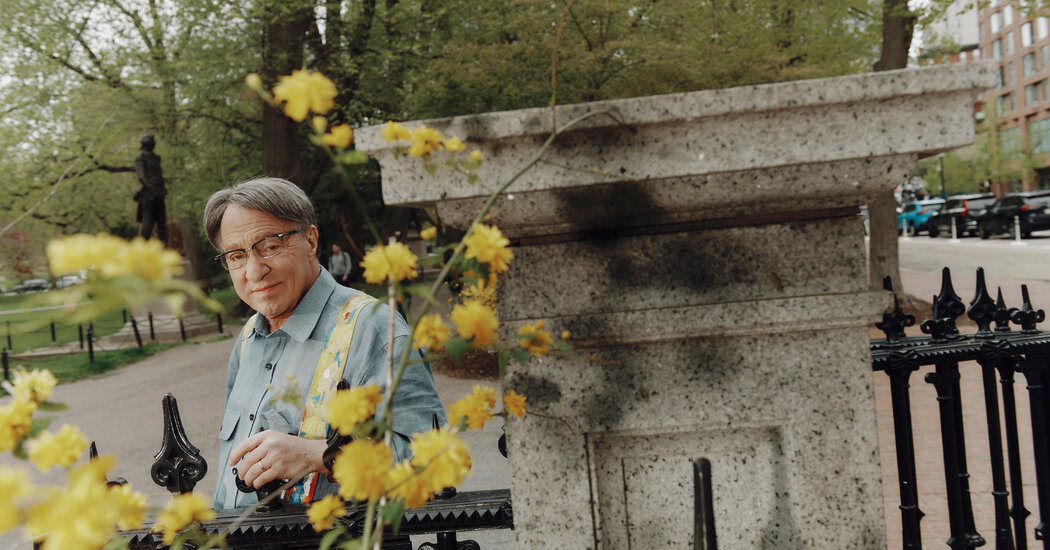

Sitting near a window inside Boston’s Four Seasons Hotel, overlooking a duck pond in the city’s Public Garden, Ray Kurzweil held up a sheet of paper showing the steady growth in the amount of raw computer power that a dollar could buy over the last 85 years.
A neon-green line rose steadily across the page, climbing like fireworks in the night sky.
That diagonal line, he said, showed why humanity was just 20 years away from the Singularity, a long hypothesized moment when people will merge with artificial intelligence and augment themselves with millions of times more computational power than their biological brains now provide.
“If you create something that is thousands of times — or millions of times — more powerful than the brain, we can’t anticipate what it is going to do,” he said, wearing multicolored suspenders and a Mickey Mouse watch he bought at Disney World in the early 1980s.
Mr. Kurzweil, a renowned inventor and futurist who built a career on predictions that defy conventional wisdom, made the same claim in his 2005 book, “The Singularity Is Near.” After the arrival of A.I. technologies like ChatGPT and recent efforts to implant computer chips inside people’s heads, he believes the time is right to restate his claim. Last week, he published a sequel: “The Singularity Is Nearer.”
Now that Mr. Kurzweil is 76 years old and is moving a lot slower than he used to, his predictions carry an added edge. He has long said he plans to experience the Singularity, merge with A.I. and, in this way, live indefinitely. But if the Singularity arrives in 2045, as he claims it will, there is no guarantee he will be alive to see it.
“Even a healthy 20-year-old could die tomorrow,” he said.
But his prediction is not quite as outlandish as it seemed in 2005. The success of the chatbot ChatGPT and similar technologies has encouraged many prominent computer scientists, Silicon Valley executives and venture capitalists to make extravagant predictions about the future of A.I. and how it will alter the course of humanity.
Tech giants and other deep-pocketed investors are pumping billions into A.I. development, and the technologies are growing more powerful every few months.
Many skeptics warn that extravagant predictions about artificial intelligence may crumble as the industry struggles with the limits of the raw materials needed to build A.I., including electrical power, digital data, mathematics and computing capacity. Techno-optimism can also feel myopic — and entitled — in the face of the world’s many problems.
“When people say that A.I. will solve every problem, they are not actually looking at what the causes of those problems are,” said Shazeda Ahmed, a researcher at the University of California, Los Angeles, who explores claims about the future of A.I.
The big leap, of course, is imagining how human consciousness would merge with a machine, and people like Mr. Kurzweil struggle to explain how exactly this would happen.
Born in New York City, Mr. Kurzweil began programming computers as a teenager, when computers were room-size machines. In 1965, as a 17-year-old, he appeared on the CBS television show “I’ve Got a Secret,” performing a piano piece composed by a computer that he designed.
While still a student at Martin Van Buren High School in Queens, he exchanged letters with Marvin Minsky, one of the computer scientists who founded the field of artificial intelligence at a conference in the mid-1950s. He soon enrolled at the Massachusetts Institute of Technology to study under Dr. Minsky, who had become the face of this new academic pursuit — a mix of computer science, neuroscience, psychology and an almost religious belief that thinking machines were possible.

When the term artificial intelligence was first presented to the public during a 1956 conference at Dartmouth College, Dr. Minsky and the other computer scientists gathered there did not think it would take long to build machines that could match the power of the human brain. Some argued that a computer would beat the world chess champion and discover its own mathematical theorem within a decade.
They were a bit too optimistic. A computer would not beat the world chess champion until the late 1990s. And the world is still waiting for a machine to discover its own mathematical theorem.
After Mr. Kurzweil built a series of companies that developed everything from speech recognition technologies to music synthesizers, President Bill Clinton awarded him the National Medal of Technology and Innovation, the country’s highest honor for achievement in tech innovation. His profile continued to rise as he wrote a series of books that predicted the future.
Around the turn of the century, Mr. Kurzweil predicted that A.I. would match human intelligence before the end of the 2020s and that the Singularity would follow 15 years later. He repeated these predictions when the world’s leading A.I. researchers gathered in Boston in 2006 to celebrate the field’s 50th anniversary.
“There were polite snickers,” said Subbarao Kambhampati, an A.I. researcher and Arizona State University professor.
A.I. began to rapidly improve in the early 2010s as a group of researchers at the University of Toronto explored a technology called a neural network. This mathematical system could learn skills by analyzing vast amounts of data. By analyzing thousands of cat photos, it could learn to identify a cat.
It was an old idea dismissed by the likes of Dr. Minsky decades before. But it started to work in eye-opening ways, thanks to the enormous amounts of data the world had uploaded onto the internet — and the arrival of the raw computing power needed to analyze all that data.
The result, in 2022, was ChatGPT. It had been driven by that exponential growth in computing power.
Geoffrey Hinton, the University of Toronto professor who helped develop neural network technology and may be more responsible for its success than any other researcher, once dismissed Mr. Kurzweil’s prediction that machines would exceed human intelligence before the end of this decade. Now, he believes it was insightful.
“His prediction no longer looks so silly. Things are happening much faster than I expected,” said Dr. Hinton, who until recently worked at Google, where Mr. Kurzweil has led a research group since 2012.
Dr. Hinton is among the A.I. researchers who believe that the technologies driving chatbots like ChatGPT could become dangerous — perhaps even destroy humanity. But Mr. Kurzweil is more optimistic.
He has long predicted that advances in A.I. and nanotechnology, which could alter the microscopic mechanisms that control the way our bodies behave and the diseases that afflict them, will push back against the inevitability of death. Soon, he said, these technologies will extend lives at a faster rate than people age, eventually reaching an “escape velocity” that allows people to extend their lives indefinitely.
“By the early 2030s, we won’t die because of aging,” he said.
If he can reach this moment, Mr. Kurzweil explained, he can probably reach the Singularity.
But the trends that anchor Mr. Kurzweil’s predictions — simple line graphs showing the growth of computer power and other technologies over long periods of time — do not always keep going the way people expect them to, said Sayash Kapoor, a Princeton University researcher and co-author of the influential online newsletter “A.I. Snake Oil” and a book of the same name.
When a New York Times reporter asked Mr. Kurzweil if he was predicting immortality for himself back in 2013, he replied: “The problem is I can’t get on the phone with you in the future and say, ‘Well, I’ve done it, I have lived forever,’ because it’s never forever.” In other words, he could never be proved right.
But he could be proved wrong. Sitting near the window in Boston, Mr. Kurzweil acknowledged that death comes in many forms. And he knows that his margin of error is shrinking.
He recalled a conversation with his aunt, a psychotherapist, when she was 98 years old. He explained his theory of life longevity escape velocity — that people will eventually reach a point where they can live indefinitely. She replied: “Can you please hurry up with that?” Two weeks later, she died.
Though Dr. Hinton is impressed with Mr. Kurzweil’s prediction that machines will become smarter than humans by the end of the decade, he is less taken with the idea that the inventor and futurist will live forever.
“I think a world run by 200-year-old white men would be an appalling place,” Dr. Hinton said.

Audio produced by Patricia Sulbarán.