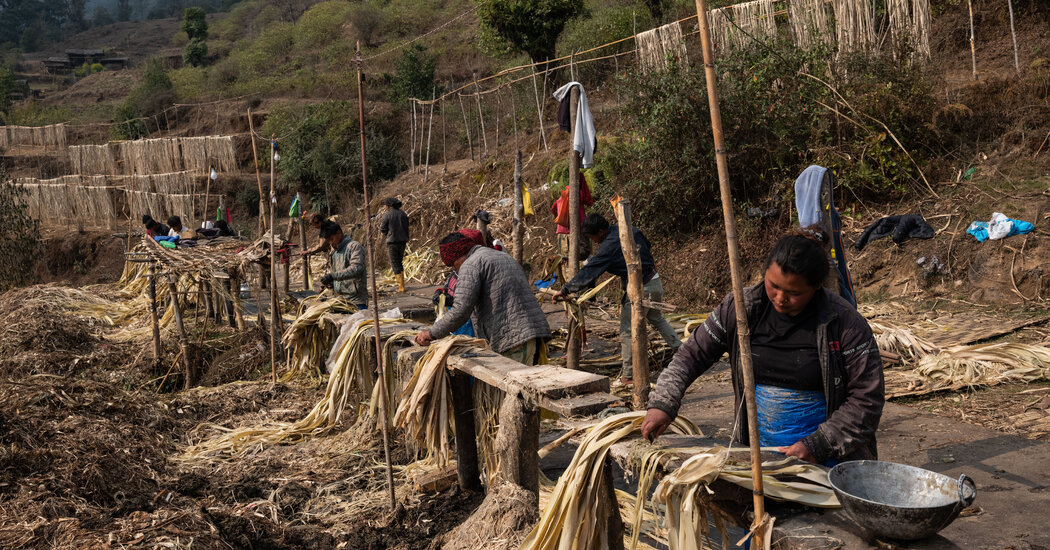

The views are spectacular in this corner of eastern Nepal, between the world’s highest mountains and the tea estates of India’s Darjeeling district, where rare orchids grow and red pandas play on the lush hillsides.
But life can be tough. Wild animals destroyed the corn and potato crops of Pasang Sherpa, a farmer born near Mount Everest. He gave up on those plants a dozen years ago and resorted to raising one that seemed to have little value: argeli, an evergreen, yellow-flowering shrub found wild in the Himalayas. Farmers grew it for fencing or firewood.
Mr. Sherpa had no idea that bark stripped from his argeli would one day turn into pure money — the outgrowth of an unusual trade in which one of the poorest pockets of Asia supplies a primary ingredient for the economy in one of the richest.
Japan’s currency is printed on special paper that can no longer be sourced at home. The Japanese love their old-fashioned yen notes, and this year they need mountains of fresh ones, so Mr. Sherpa and his neighbors have a lucrative reason to hang on to their hillsides.
“I hadn’t thought these raw materials would be exported to Japan or that I would make money from this plant,” Mr. Sherpa said. “I’m now quite happy. This success came from nowhere, it grew up from my courtyard.”
Headquartered 2,860 miles away in Osaka, Kanpou Incorporated produces paper used by the Japanese government for official purposes. One of Kanpou’s charitable programs had been scouting the foothills of the Himalayas since the 1990s. It went there to help local farmers dig wells. Its agents eventually stumbled onto a solution for a Japanese problem.
Japan’s supply of mitsumata, the traditional paper used to print its bank notes, was running low. The paper starts with woody pulp from plants of the Thymelaeaceae family, which grow at high altitude with moderate sunshine and good drainage — tea-growing terrain. Shrinking rural populations and climate change were driving Japan’s farmers to abandon their labor-intensive plots.
Kanpou’s president at the time knew that mitsumata had its origins in the Himalayas. So, he wondered: Why not transplant it? After years of trial and error, the company discovered that argeli, a hardier relative, was already growing wild in Nepal. Its farmers just needed tutoring to meet Japan’s exacting standards.
A quiet revolution got underway after earthquakes devastated much of Nepal in 2015. The Japanese sent specialists to the capital, Kathmandu, to help Nepali farmers get serious about making the stuff of cold, hard yen.
Before long, the instructors went up to Ilam district. In the local Limbu tongue, “Il-am” means “twisted path,” and the way there does not disappoint. The road from the nearest airport gets so rough that the first jeep needs changing out halfway — for an even more rugged four-wheel-drive.
By then, Mr. Sherpa had already gotten into the business and was producing 1.2 tons of usable bark a year, cutting his own argeli and boiling it in wooden boxes.
The Japanese taught him to steam off its bark instead, using plastic bundles and metal pipes. Next comes an arduous process of stripping, beating, stretching and drying. The Japanese also taught their Nepali suppliers to harvest each crop just three years after planting, before the bark reddens.
This year, Mr. Sherpa has hired 60 local Nepalis to help him process his harvest and expects to earn eight million Nepali rupees, or $60,000, in profit. (The average annual income in Nepal is about $1,340, according to the World Bank.) Mr. Sherpa hopes to produce 20 of the 140 tons that Nepal will be shipping to Japan.
That’s a majority of the mitsumata needed to print yen, enough to fill about seven cargo containers, winding downhill to the Indian port of Kolkata, to sail 40 days to Osaka. Hari Gopal Shreshta, the general manager of Kanpou’s Nepal arm, oversees this trade, inspecting and buying neatly tied bales in Kathmandu.

“As a Nepali,” said Mr. Shreshta, who is fluent in Japanese, “I feel proud of managing raw materials to print the currency of rich countries like Japan. That’s a great moment for me.”
It is an important moment for the yen, too. Every 20 years, the world’s third-most-traded currency goes in for a redesign. The current notes were first printed in 2004 — their replacements will hit cashiers in July.
The Japanese love their beautiful bills, with their elegant, understated designs in moiré printed on tough, off-white plant fiber instead of cotton or polymer.
The country’s attachment to hard currency makes it an outlier in East Asia. Less than 40 percent of payments in Japan are processed by cards, codes or phones. In South Korea, the figure is about 94 percent. But even for Japan, life is increasingly cashless; the value of its currency in circulation most likely peaked in 2022.
Japan’s central bank reassures everyone with a yen for yen that there are still enough physical notes to go around. The bank notes, if they were all stacked in one place, would stand 1,150 miles high, or 491 times as tall as Mount Fuji.
Before they found the yen trade, Nepali farmers like Mr. Sherpa had been looking for ways to migrate. Crop-hungry boars were just one problem. The lack of decent jobs was the killer. Mr. Sherpa said he had been ready to sell his land in Ilam and move, maybe to work in the Persian Gulf.
Years ago, Faud Bahadur Khadka, now a contented 55-year-old argeli farmer, had a bitter experience as a laborer in the Gulf. He went to Bahrain in 2014, promised a job at a supply company, but ended up working as a cleaner. Nonetheless, two of his sons went to work in Qatar.
Mr. Khadka says he is glad that “this new farming has somehow helped people to get both money and employment.” And he is hopeful: “If other countries also use Nepali crops to print their currencies,” he said, “that will stop the flow of Nepali migrating to Gulf nations and India.”
The warm feeling is mutual. Tadashi Matsubara, the current president of Kanpou, said, “I would love for people to know how important Nepalis and their mitsumata is to the Japanese economy. Honestly, the new bank notes would not have been possible without them.”
Kiuko Notoya contributed reporting from Tokyo.