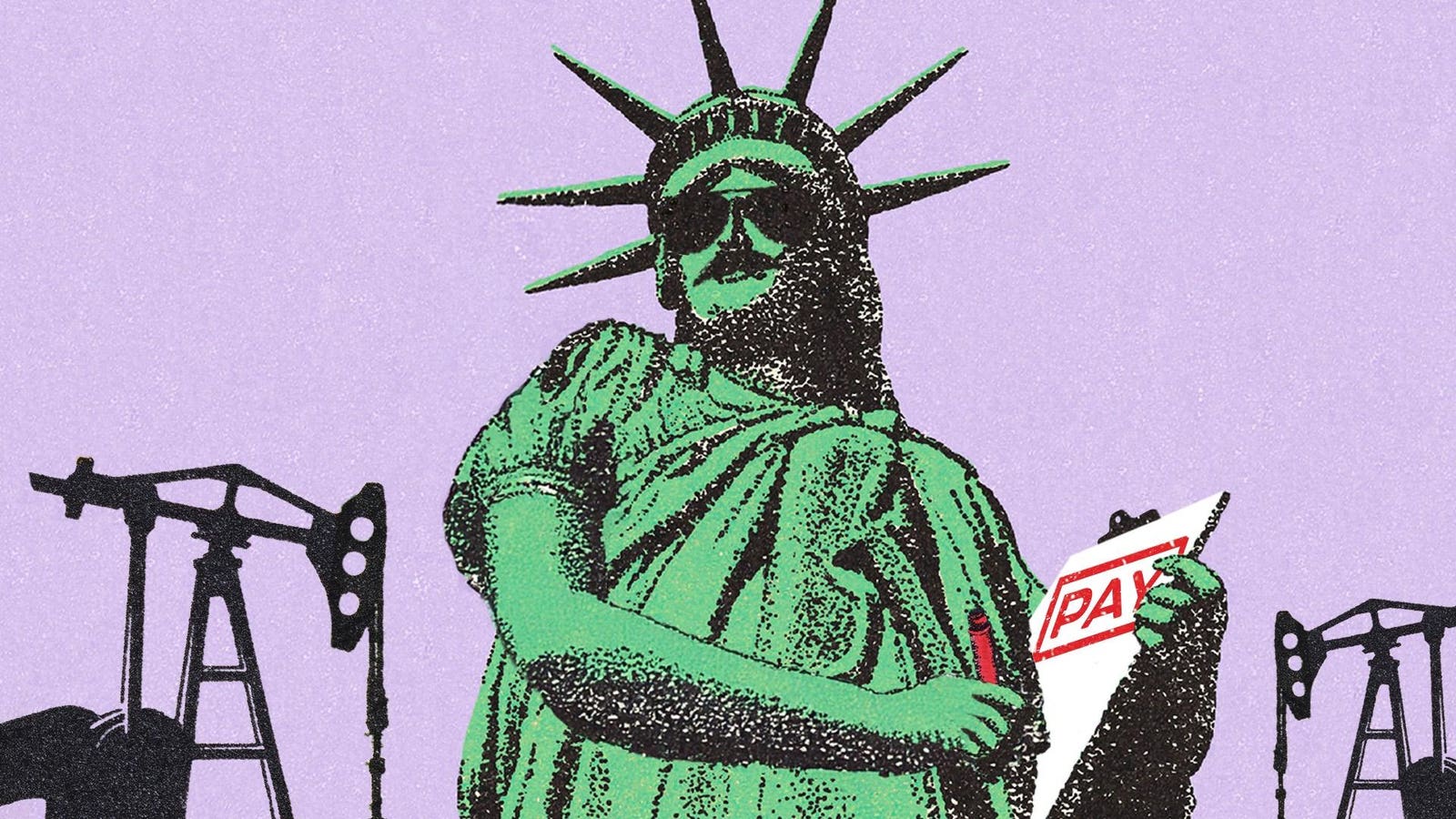

Albany’s grand idea: tackle the climate crisis by extracting cash from other parts of the globe.
By William Baldwin, Senior Contributor
State budgets are strained and tax hikes might make voters angry or businesses inclined to leave. Solution: Send the bills for climate control, such as flood control projects, out of state.
In December New York Governor Kathy Hochul signed a bill imposing a collective $75 billion assessment on Big Oil, the money to be paid in mostly equal annual installments over 24 years. The money is to go into a “superfund” pot for environmental remediation. Contributions are to come from any company that does business in New York and had worldwide fossil fuel sales between 2000 and 2018 giving rise to more than 500,000 tons of carbon dioxide.
Oil companies will not be paying up without a fight. The battleground is the U.S. Constitution, which has four provisions that come into play. Says Joseph Bishop-Henchman, a lawyer at the National Taxpayers Union Foundation: “New York has given a lot for constitutional lawyers to work with.”
The law is modeled on one enacted last summer by Vermont. Similar proposals are under consideration in the legislatures of California, Maryland and Massachusetts. Evidently these states either are concerned the incoming Trump administration won’t be doing enough to preserve the planet or else are just hungry for revenue. Los Angeles is on fire. Having oil companies pick up the tab is an appealing idea.
Will fossil fuel producers just pass the cost along in higher prices in New York? No, predicted economist Joseph Stiglitz last fall, giving a boost to fans of the superfund bill. He’s probably right. Unlike a gasoline tax collected at the pump, the superfund assessment owed is not a function of the fuel being burned now by New Yorkers. No, it’s determined by activity in other places in past times. That displacement in space and time gets to the essence of the law’s conflict with the Constitution.
There are, at a minimum, seven things that will interfere with New York’s planned revenue raising.
Problem #1: Ex Post
The Constitution forbids states to enact ex post facto laws, those that impose penalties for actions that took place before the laws were enacted. The provision limits criminal but not civil inflictions. Key question: Are these assessments fines (criminal) or taxes (civil)? That will be debated. A hint of the punitive flavor can be found in a cheerleading news account of the enactment that ran in the New York Times. It was headlined “Hochul Signs Law That Penalizes Companies for Greenhouse Gas Emissions.”
Problem #2: Retroactivity
The Fourteenth Amendment decrees that states may not “deprive any person of life, liberty or property without due process of law.” This creates an issue for a law like New York’s, says Donald Kochan, a professor at George Mason University and director of its Law & Economics Center. “Individuals need to be able to plan their affairs,” he says, and to incorporate costs in their decision making. “None of that works if government can retroactively change the rules of the game.”
Law and economics work hand in hand. What is just and prospective is more likely to change behavior and be economically rational.
New York charges an annual registration fee of $69 for a two-ton car. The state would be within its rights to kick the fee up to $169 for gas cars while leaving it at $69 for electric ones. That might motivate you to switch to a Tesla. But what if the state decides today that you owe another $100 a year for the car you drove between 2000 and 2018, and sends a bill for $1,900? You would have the basis for a constitutional challenge.
Problem #3: Extraterritorial Reach
A third piece of the Constitution is relevant, the clause saying that Congress is the one to regulate interstate and foreign commerce. States can pass rules that affect interstate commerce, but they can’t do it in a way that would potentially compete with another state’s rules.
Two years ago the Supreme Court took up a case involving the California law banning sales of pork from pigs raised in tight cages. Pork producers objected that one state was in effect legislating a national standard for husbandry, since it would be impractical to set up separate supply chains for California and non-California meat. The court upheld the law. Important here: Producers could comply by not selling into California. California did not assert the right to stop an Iowa farmer from shipping offending bacon into Michigan.

Contrast a 1982 case in which the Supreme Court overturned a corporate takeover rule that Illinois wanted to apply to a Connecticut-based company incorporated in Delaware. Collisions among states would have been inevitable if Illinois-style legislation were permitted.
In the superfund law New York claims dominion over global petroleum production. That raises a constitutional issue.
Problem #4: Disproportionate Tax
If the superfund assessment is a tax rather than a fine, the sky is not the limit. There has to be a relation to activity inside New York’s borders.
Apple has a store on Fifth Avenue in Manhattan. That gives New York the right to collect an income tax on the California-based company. But it can tax only a percentage of Apple’s worldwide income. The percentage has to relate to some measure of Apple’s New York presence, such as assets, employees or sales.
If states could assess more than their fair shares of a company’s income, the combined burden for a multistate company would be more than for a similarly profitable company with all its business inside one state. The result would be a burden on interstate commerce, which the commerce clause forbids.
New York is free to levy a $3 billion a year tax on fuel sales in New York. But that would be unpopular, so instead it aims to export the tax burden to other places. This looks unconstitutional to Kochan, the law professor at George Mason. “They’re trying to find a pocket they can pick,” he says.
Problem #5: Legislated Verdict
The superfund fee is styled as a recovery of damages from climate change. The legislature, that is, has found that petroleum companies have committed a tort.
If a tort suit were filed in court, the state would provide evidence that carbon dioxide causes floods and the defendants would have an opportunity to provide evidence that it doesn’t. These defendants never got their day in court, says Richard Epstein, who teaches law at New York University. The state, he says, “is trying to get the benefit of a trial without having a trial.” He sees what New York is doing as handing down a judicial verdict by legislative fiat, a violation of due process.
Problem #6: Causation
There’s another element of due process, Kochan says: “You have to prove that the defendant committed a wrong and that the wrong is the proximate cause of the injury.”
Who damaged the atmosphere? Isn’t it the fellow who turned up the heat or got behind the wheel of a gas-powered car?
If Exxon Mobil is deemed responsible because it supplied fuel to the perpetrator, then there is no limit to the industries whose pockets can be picked to compensate for society’s ills. Liquor stores would have to pay for accidents caused by drunks. Cable companies would owe for frauds taking place over the internet.
Problem #7: Preemption
Another part of the Constitution says that it, and federal laws that comply with it, are the supreme law of the land. Sometimes state law is additive to federal law, as in the sale of meat in California. But state law can’t conflict with federal law or occupy a field preempted by federal statutes.
Honolulu has filed a fraud case against oil companies. The claim is that it was fraudulent for the industry not to note that carbon dioxide causes warming, and that if petroleum suppliers had mentioned this they would have told consumers something that consumers didn’t know, and that if the consumers had only known they would have bought less gasoline, and that then the sea wouldn’t be rising on Hawaii’s beaches.
Epstein rolls his eyes at this chain of logic. But even if it made sense, he says, the Honolulu lawsuit runs up against the fact that Congress has, with the Clean Air Act, preempted the field of air pollution control.
In an amicus brief filed last year, Epstein and another law professor beg the Supreme Court to review a decision by Hawaii’s highest court to let the fraud lawsuit proceed. The oil industry’s petition for certiorari was due to be discussed by the justices in mid-January. Epstein expects them to take the case. If they do, and if they rule against Honolulu on preemption grounds, then oil companies won’t have to work very hard to kill the New York superfund assessment. It will be close to dead.
More From Forbes:
MORE FROM FORBES