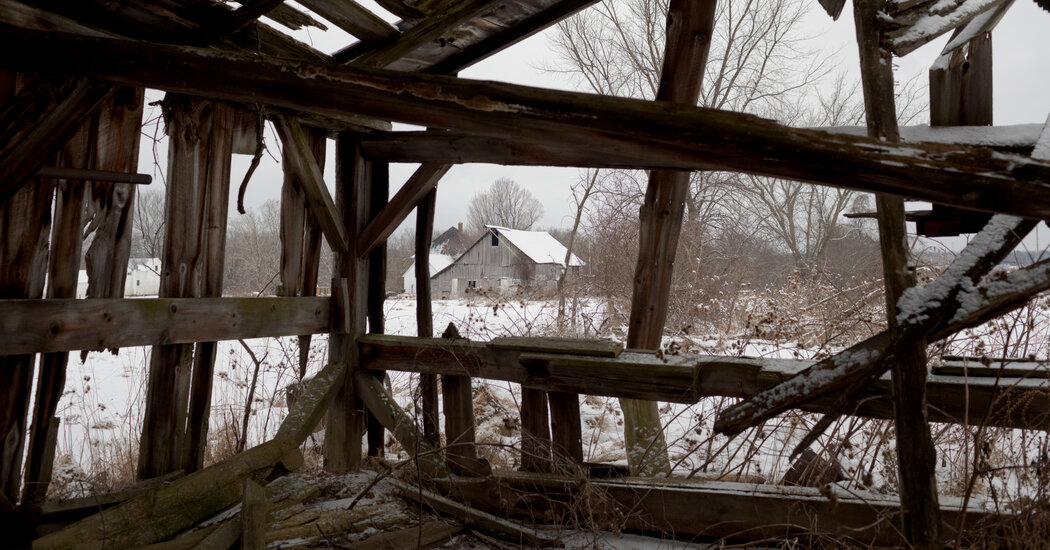

In a dilapidated farm shed in New York’s rural North Country, the belongings of a migrant family who quietly took shelter one night were still visible months later: some clothing and children’s shoes, stiffened by the cold and a thin blanket of snow.
Thomas Brassard recalled his surprise when he saw the family — a husband, wife and two children — emerge from the shed as he started his truck in the early morning.
They asked him in broken English if he could give them a ride to the nearest city. He apologetically told them he couldn’t help and then placed a call to the Border Patrol, which quickly detained them.
It has become a familiar scene here in Champlain, N.Y., nestled on the state’s border with Canada, so much so that the mayor keeps knit hats and gloves in the trunk of her car to hand out to the migrants she encounters.
“The weather is so severe you just can’t survive,” said Janet McFetridge, the village’s mayor. “Border Patrol is working extremely hard to save people’s lives because that’s what it’s come down to.”
As migrants continue to overwhelm the southern border in record numbers, a growing wave is trying an alternative route into the United States: across the less fortified, more expansive Canadian border.
Rather than deal with an arduous journey through the Darién Gap in Panama and a near-certain encounter with the Border Patrol, migrants from as far as Mexico, India and Venezuela who have the wherewithal have been flying to Canada — taking advantage of border crossings without any imposing walls or fences.
Yet perilous conditions have led to repeated rescues of migrants who get stranded in dark woods or have to be treated for hypothermia. At least a dozen migrants — families, children, a pregnant mother — have died attempting to cross in the past two years, their frozen bodies recovered from rivers and forests.
Officials at the northern border recorded 191,603 encounters with people crossing into the United States in 2023, a 41 percent increase from 2022 — though still a small number in comparison with the more than two million people apprehended on the southern border last year.
And while the vast majority of those migrants presented themselves at official ports of entry to request asylum, a growing number were caught after crossing illegally into the United States, sometimes guided by smugglers.
More than 12,200 people were apprehended crossing illegally from Canada last year, a 241 percent jump from the 3,578 arrested the previous year. Most of them were Mexicans, who can fly to Canada without a visa and may prefer the northern border to avoid the cartels that exploit migrants in their country.
The phenomenon has transformed a 295-mile border area along northern New York, Vermont and New Hampshire into a hot spot of migration: About 70 percent of the illegal crossings in 2023 happened on this stretch, known as the Swanton Sector.
Robert Garcia, the chief patrol agent in charge of the Swanton Sector, said in a social media post on Friday that the 3,100 people apprehended in the sector since October — more than the past four fiscal years combined — hailed from 55 countries.
Clinton County, N.Y., a rural swath of farms and small towns just south of Quebec Province, has emerged as one of the main passageways for migrants heading south, unsettling some residents and local officials.

“It’s a hard thing to do for freedom,” Mr. Brassard said in a recent interview on his fiancée’s farm, less than a mile south of the border. He expressed some slight remorse about turning the family in. “It was actually sad,” he said, “because the kids said thank you and stuff.”
People like Mr. Brassard have increasingly spotted migrants marching across their fields and backyards, or lugging suitcases down dark back roads. After crossing from Canada, some migrants shelter from the frigid cold inside residents’ barns and garages, sometimes unnoticed except for the motion-activated deer hunting cams that capture them in the dead of night.
Dale Tetreault, 57, a third-generation dairy farmer, said that three migrants from Guatemala recently took refuge in one of his milk houses. One of his workers, who is Latin American and spoke with them in Spanish, told him the migrants had just crossed from Canada and were looking for work.
Mr. Tetreault called the Border Patrol, which showed up within minutes to pick them up.
“I understand where they’re coming from and how horrible it has to be to make that kind of venture to get here, to try to find a place where you can find a good life,” Mr. Tetreault said as he stood by one of his rows of 1,200 cows last month. “But on the other side, it’s like, I’m not going to accidentally house the wrong people either, you know what I mean? It’s damned if you do, damned if you don’t.”
About a dozen residents who live just south of the border expressed mixed opinions about the influx of migrants, with most expressing sympathy in interviews with The New York Times. But many said the encounters with strangers on their property had made them uneasy. Others said they felt indifferent, largely unbothered as long as the migrants kept to themselves.
Residents in Clinton County, which leans conservative but has voted Democratic in the last presidential elections, had become accustomed to a northward migration, with refugees passing through on their way to claim asylum in Canada.
That pattern exploded in 2017 — when thousands of asylum seekers began crossing the county on their way to Canada because they feared deportation under the Trump presidency — and continues to this day. Quebec’s leader warned in January that the crush of asylum seekers was leading the province to a “breaking point,” and Canadian officials are considering implementing a visa requirement for Mexican travelers.
But the increasing number of migrants moving south into the United States has created a two-way flow that has overwhelmed and frustrated local officials in New York’s North Country. They argue it is straining local law enforcement resources, forcing Border Patrol agents to respond to too many calls and putting migrants at risk.
“The northern border has been pretty much ignored,” said Assemblyman Billy Jones, a Democrat who represents Clinton County, saying that the federal government was “failing on immigration, and they’re failing the people that live along the border.”
U.S. Customs and Border Protection officials said in a statement that the country had forged a close working relationship with Canada “to facilitate lawful crossings through ports of entry and to counter irregular migration, including in the Swanton Sector.”
“C.B.P. continuously adjusts to shifting trends while continuing to call on Congress to provide the resources and personnel necessary to sustain and improve our border security along all our borders,” an agency spokeswoman said in a statement.
The illegal crossings are sometimes facilitated by new human smuggling operations, often based outside New York, which advertise their services on social media and charge migrants thousands of dollars to get them into the country from Canada, often leaving them indebted to the smugglers.
Federal prosecutors in Syracuse have filed a series of cases aimed at taking down smuggling enterprises, detailing in court documents how smugglers — both American and foreign — help guide migrants through woods and coordinate drivers with out-of-state plates to pick them up once they get through.
The arrests come as numerous migrants have died attempting to cross treacherous conditions, sometimes lured by smugglers.
In January 2022, an Indian family of four — including a 11-year-old girl and 3-year-old boy — was found frozen to death just feet from the border in Manitoba, Canada. A year later, the bodies of eight people — an Indian family and a Romanian family — were recovered from the St. Lawrence River in Quebec. All were trying to cross into the United States.
In January 2023, Fritznel Richard, 44, a Haitian man traveling to the United States, was found frozen to death in the woods of a border municipality in Quebec. The next month, Jose Leos Cervantes, 45, from Mexico, collapsed and died shortly after walking into Vermont.
And on Dec. 14, authorities found the body of a 33-year-old woman from Mexico who was five months pregnant in the Great Chazy River in Champlain. The woman, Ana Vasquez Flores, had traveled from Quebec and was trying to reunite with her husband in the United States.
Shortly after, American prosecutors accused a Colombian man living in Canada of selling his smuggling services on TikTok to Ms. Vasquez Flores and her husband, and charging them $2,500 to guide her across the border via text messages. The man was arrested and extradited to the United States.
Portions of the U.S.-Canadian border — which at 5,525 miles is the longest international border in the world — are separated by natural barriers, such as the Great Lakes. But much of the border, especially in northeastern New York, is flat and barren, dotted with just woods or open fields where simple stone markers delineate the boundary.
Many migrants crossing illegally into the United States, officials said, are cutting through traversable woods that may still be perilous. Temperatures regularly drop below zero on cold winter nights, making it dangerously cold for those without adequate clothing. And the woods can be pocked with streams, ponds and swamps that freeze quickly.
Border Patrol officials said they have conducted 15 rescue missions in which 37 individuals were rescued along the northern border since October 2022.
David Favro, the Clinton County sheriff, whose department has been involved in some of the missions, said migrants regularly get disoriented in the forest or fall into freezing waters and suffer hypothermia, sometimes losing toes.
“They get lost in the woods,” Mr. Favro said in an interview in his office. “They lose sense of what direction they’re actually going in. They actually walk in circles for hours at a time.”
Mr. Favro, a Republican who supports tightening the nation’s immigration laws, said that Border Patrol needed “more boots on the ground.” The northern border has about 2,200 Border Patrol agents, according to federal officials.
Migrants who cross successfully into the United States are routinely apprehended by Border Patrol agents, who find them using sensors, thermal camera systems and even drones, or by responding to calls from residents.
“We were going to turn ourselves in, but they spotted us first,” said Liam Parra, 22, a Venezuelan migrant who arrived from Canada two weeks ago with a friend, Albert Colina, 24.
Both men had crossed from New York into Canada nearly a year ago seeking work. They found seasonal jobs in construction and packaging fruits in Niagara Falls, Canada, but decided to return to the United States this year, with hopes of reaching Orlando, Fla., after that work dried up.
“Canada is beautiful and all,” Mr. Colina said in Spanish. “But when the snow arrives, the work goes away.”
Crossing back into the United States, in their case, was surprisingly simple: They traveled to Montreal, rode a one-hour Uber to a wooded area of the border and walked over in a matter of minutes, they said.
Like many migrants, Mr. Parra and Mr. Colina were briefly detained by U.S. immigration officials. They underwent a criminal-background check and were then let go on parole — a status that allows migrants without visas to live and work in the United States temporarily as they await their court dates.
Once they were released, a taxi driver charged them $120 for a 20-minute ride from the border to Plattsburgh, N.Y., the largest city in Clinton County. The inflated taxi fare left them without enough money to afford the $90 tickets for a bus to New York City, stranding them in Plattsburgh.
For over a week, they wandered the city, waiting for money transfers from friends or trying unsuccessfully to persuade Greyhound bus drivers to give them a free ride. The two men, along with other migrants from Colombia and Haiti, slept at the local airport — a two-hour walk from downtown — or at roadside motels where county officials are required to put up people without shelter when temperatures drop below 32 degrees.
For the majority of migrants, Plattsburgh is a steppingstone in their journey north to Canada or south to larger cities, including New York City, a five-hour bus ride away, as well as final destinations as far as Arkansas and Seattle.
But many migrants seen on a visit to Plattsburgh last month were seemingly stuck in the city, passing time at a gas station and bus stop that serves as a de facto meeting point for migrants. Most had hoped to cross into Canada but were turned away by Canadian immigration officials, who have become strict about the documentation migrants need to claim asylum.
One migrant in Plattsburgh, Javier Semeco, 34, from Colombia, hugged his 8-year-old boy as he haggled with a taxi driver who was trying to charge him $70 for a short ride to the Canadian border. Using a translation app on the driver’s phone, they settled on $25, the only cash Mr. Semeco said he had.
Canadian officials turned Mr. Semeco away at the border hours later. He was forced to walk for hours with his young son along a snowy highway back to Plattsburgh.
After traveling for months from Venezuela and across the Mexican border to reunite with his sister in Canada, Dennys Ortega, 58, was also turned away at northern border.
Mr. Ortega had sought to claim asylum by proving he had family members in Canada; his sister, Damarys, says she has lived there for 40 years and is a Canadian citizen. But immigration officials said they found minor inconsistencies in his story and rejected his claim, according to immigration documents he was given.
Without much money or a place to live and possessing few English skills, Mr. Ortega was left to wonder what had gone wrong and what he would do next.
“They denied him his right,” said his sister, who drove to Plattsburgh from Quebec to meet him at a diner two days later. “They just left him out in the cold.”
Audio produced by Patricia Sulbarán .