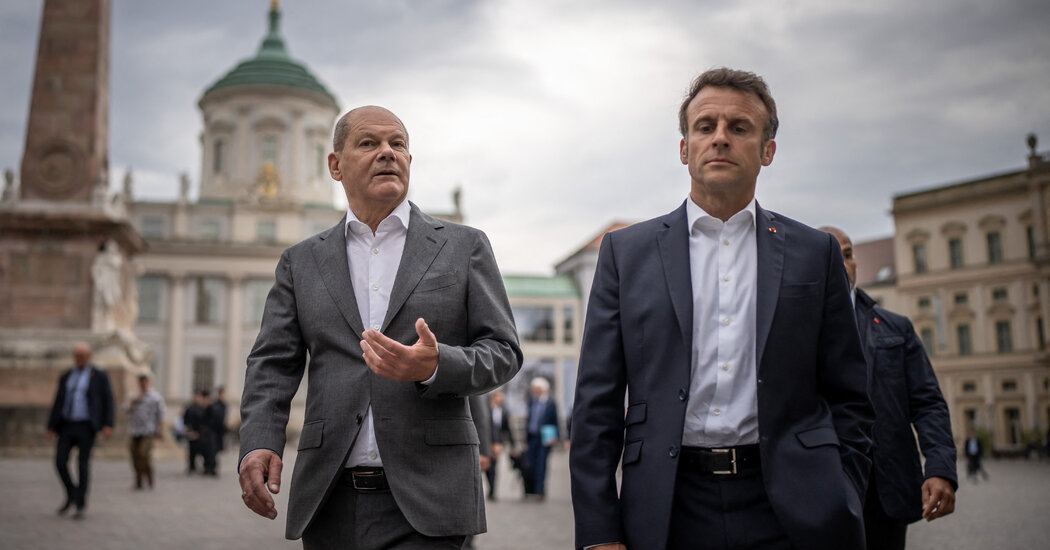

It was a private dinner in a Parisian garden on the Boulevard St. Germain, meant to cement the important personal relationship between the leaders of France and Germany.
After the meal on July 4, 2022, Chancellor Olaf Scholz said “Merci beaucoup” in a Twitter post praising “close exchanges.” But on the way out, President Emmanuel Macron muttered to a confidant: “This is not going to be easy.”
It is hardly a secret that the dealings between the two men have been anything but easy. Barely disguised insults between them in recent days have pointed to deeper differences over Ukraine, how to confront and contain an aggressive Russia and how to manage an increasingly polarized United States.
This week, while visiting Prague, Mr. Macron repeated his refusal to rule out Western troops in Ukraine, a suggestion that surprised his allies who want to avoid a direct confrontation with Russia. Germany, especially, pushed back. Mr. Macron replied in kind.
“Europe clearly faces a moment when it will be necessary not to be cowards,” Mr. Macron said, a jab Berlin took as an insult to its postwar history after the Nazi trauma.
The German defense minister, Boris Pistorius, responded: “We don’t need, really, from my perspective at least, discussions about boots on the ground or having more courage or less courage.”
The Franco-German relationship has been built since 1945 on a necessary reconciliation decreed by historical fate. It remains central to the cohesion of Europe and European ability to act as a global power. But the bond seems to be fraying at this combustible moment marked by a European war and uncertainty over America’s future commitment to Europe.
There could scarcely be a worse time for such estrangement at the heart of Europe. Yet Mr. Macron and Mr. Scholz, far from displaying unity of purpose and European leadership in their commitment to resist President Vladimir V. Putin of Russia, have taken to bickering over which country is really helping Ukraine most.
Their latest tensions reflect divergent personal styles as well as clashing national interests informed by domestic politics.
Both men were surprising leaders, even if they came to power in different ways. Mr. Macron upended traditional French politics and dreamed of leading a resurgent Europe, whereas there was nothing revolutionary in the ascent of Mr. Scholz, a steady, stubborn Social Democrat lawyer who now manages an uneasy three-party coalition.
Yet their victories gave both the conviction that they are “the smartest person in the room and that they are right when others are wrong,” said Camille Grand, a former French and NATO official now with the European Council on Foreign Relations. “Ego is always a part of politics, but it makes them more difficult for their partners to manage on the international scene.”
Their responses to Russia’s aggression have become part of their awkward relationship. Mr. Macron spoke in the summer of 2022 about not humiliating Russia and creating a European security order that included Moscow. He has since changed his views.
In response to Russian advances in a Ukraine running low on ammunition, and Russian disinformation designed to affect the European parliamentary elections in June, Mr. Macron now speaks openly about the danger Moscow presents to Europe, especially as the possibility of another Trump presidency becomes more real.
Mr. Macron is comfortable as a provocateur. He sees himself as a disrupter of lazy thinking, evident in his suggestion that sending Western troops to Ukraine “should not be ruled out.”

The taboo-breaking remark infuriated Mr. Scholz, who is seen by Mr. Macron as cautious to a fault and too reliant on a United States no longer willing to spend large amounts of money on Ukraine.
Mr. Macron believes that rigid limits to the Western military response give Mr. Putin effective carte blanche, and he worries that Mr. Scholz may not fully grasp the importance of Europe committing completely to a united defense needed for years of confrontation with Moscow.
Mr. Scholz, on the other hand, is wary about directly confronting Russia, even as Germany has provided far greater financial and military aid to Ukraine than France. The postwar German abhorrence of any hint of revived militarism after the Nazi trauma is deep-seated; the chancellor’s approach reflects this.
Germany is skeptical of collective European responses to Russia and thinks European “strategic autonomy” — a favorite phrase of Mr. Macron’s — implies too radical an emancipation from Washington.
Mr. Scholz has bound himself less to France than to the Biden administration’s caution over confronting a Russian leader who has threatened to use nuclear weapons. Germany has refused to supply Ukraine with long-range missiles that could strike deep into Russia or offer Ukraine accession talks to join NATO.
Mr. Macron last month said defeating Russia should be the Western objective, rejecting the preferred German formulation that Russia must not win. To the Germans, his grand pronouncements on the war and his lofty designs for Europe often lack a road map for how to get there.
“Macron’s effort to push a new sense of urgency is very welcome, but it’s not concrete,” said Ulrich Speck, a German analyst. “It doesn’t translate into action, and we see no emergency plan for Europe to deal with the real crisis now in Ukraine.”
An official close to Mr. Macron, who requested anonymity in keeping with French diplomatic protocol, said that, while the two leaders may have differences of opinion on some topics, they still collaborate on a daily basis and are committed to French-German unity.
The “French-German couple” has always been central to European decision-making, even as the leaders have often had difficult relations. Former Chancellor Angela Merkel of Germany made fun of the gait and gesticulations of the ebullient Nicolas Sarkozy, a former French president, even if they came together over the 2008 E.U. financial crisis.
After Mr. Macron spoke of NATO’s “brain death” in 2019, she lambasted him over dinner. “I understand your desire for disruptive politics,” Ms. Merkel said then. “But I’m tired of picking up the pieces. Over and over, I have to glue together the cups you have broken so that we can then sit down and have a cup of tea together.”
Mr. Scholz seems to share some of the same weariness with Mr. Macron’s willingness to break the china when more political discretion might be in order.
Paris has pledged only about 3 percent of the 17.1 billion euros worth of arms promised to Ukraine by Germany. But France says it is delivering weapons that can transform the battlefield, like long-range Scalp cruise missiles, while Germany balks at sending its most advanced long-range cruise missile, the Taurus.
After a meeting in Paris of European leaders late last month to discuss Ukraine, Mr. Macron ridiculed allies for refusing to send tanks, fighter jets and long-range missiles to Ukraine, saying that they instead offered “sleeping bags and helmets” at the outset of the war.
The remark was considered a thinly veiled barb at Mr. Scholz. and was doubly resented because France has been hesitant at times over arms deliveries. But then Mr. Macron went a step further, saying the hitherto unsayable — that putting Western troops on the ground in the war was not impossible.
Rather than sending Mr. Putin a message of new resolve and “strategic ambiguity” about how far Western countries would go to defend Ukraine, as Mr. Macron wanted, his comments prompted unambiguous rejection from allies, including Mr. Scholz.
The alliance had agreed “that there would be no ground troops on Ukrainian soil, no soldiers sent there from European states or NATO states,” Mr. Scholz said in a direct rebuke to Mr. Macron, comments echoed by his counterparts in Poland, Italy and the Czech Republic.
The next day, the deputy chancellor, Robert Habeck, a Green, said tartly: “I’m pleased that France is thinking about how to increase its support for Ukraine, but if I could give it a word of advice — supply more weapons.”
French officials tried to explain that Mr. Macron was speaking of Western troops to train Ukrainians, not combat troops, but the damage was done.
Many in Germany saw Mr. Macron’s statements as ignoring both historic German sensitivities about war and the country’s strategic vulnerability. Germany is not a nuclear power.
“A French president might think about this in a more liberal way than a German chancellor can,” said Nils Schmid, the foreign policy spokesman in parliament for Mr. Scholz’s Social Democrats. “It would have been better not to open this debate in public, as he knew that the chancellor was very much against it — so it was clear that Germany would speak out.”
It was “typical Macron,” said Claudia Major of the German Institute for International and Security Affairs. “Good ideas are done in such a bad way that it kills the good idea.”
Domestic politics in both countries are not helping as the European Parliament election approaches in June. Mr. Macron, in his new boldness against Russia, is confronting his main rival parties on the far right and far left, both of which have in the past expressed pro-Russian sympathies.
Mr. Scholz, facing the same European elections and three important state elections this year, has by contrast presented himself as the “peace chancellor,” recognizing that most Germans support Ukraine but fear an escalation in the war.
Since the two countries put an end to repetitive wars in 1945 and embarked together down the road to the European Union, the relationship between France and Germany has always been too big to fail. But it has rarely been harder to bring harmony to the bond that changed postwar Europe. It may require a new commitment to diplomacy by both leaders.
“This is not the way you behave in this kind of crisis,” Ms. Major said.
Steven Erlanger and Erika Solomon reported from Berlin and Roger Cohen from Paris.