
Close Menu

    Subscribe to Updates

    Get the latest creative news from FooBar about art, design and business.

    What's Hot

    JD Vance’s Brazenly False New Trump Defense Goes Off The Rails

    April 16, 2026

    Loss Of Smell May Be A Sign Of Alzheimer’s, Study Shows

    April 16, 2026

    The Complete AI Research Workflow: From Prompt Discovery to Content Creation

    April 16, 2026
    Facebook X (Twitter) Instagram
    Trending
    • JD Vance’s Brazenly False New Trump Defense Goes Off The Rails
    • Loss Of Smell May Be A Sign Of Alzheimer’s, Study Shows
    • The Complete AI Research Workflow: From Prompt Discovery to Content Creation
    • Amazon-backed X-energy files to raise up to $800M in IPO
    • 32 Game-Changing Travel Products
    • Here’s What Could Happen If You Refuse To Pay Taxes To Protest Trump And The Iran War
    • RED Price Prediction: Rejection at $0.18 Sets Up 30% Drop to $0.11
    • U.S. Shuts Down Iran’s Maritime Trade Despite Optimism For More Peace Talks
    Facebook X (Twitter)
    SBM Global News
    Demo
    • Home
    • Top Stories
      • Politics
    • Business
      • Small Business
      • Marketing
    • Finance
      • Investment
    • Technology

      Amazon-backed X-energy files to raise up to $800M in IPO

      April 16, 2026
      Read More

      Tkxel – Company Profile – AllBusiness.com

      April 15, 2026
      Read More

      Amazon to buy Globalstar for $11.57B in bid to flesh out its satellite biz

      April 15, 2026
      Read More

      Bridge Format AIQ – Company Profile

      April 14, 2026
      Read More

      Trump officials may be encouraging banks to test Anthropic’s Mythos model

      April 13, 2026
      Read More
    • Lifestyle
      • Travel
    • Feel Good
    • Get In Touch
    SBM Global News
    Demo
    Home»Top Stories»Locust Swarms Could Expand Their Range in a Hotter, Stormier World
    Top Stories

    Locust Swarms Could Expand Their Range in a Hotter, Stormier World

    By Staff WriterFebruary 15, 20244 Mins Read
    Facebook Twitter LinkedIn Reddit Email
    #image_title
    Share
    Facebook Twitter LinkedIn Pinterest Email

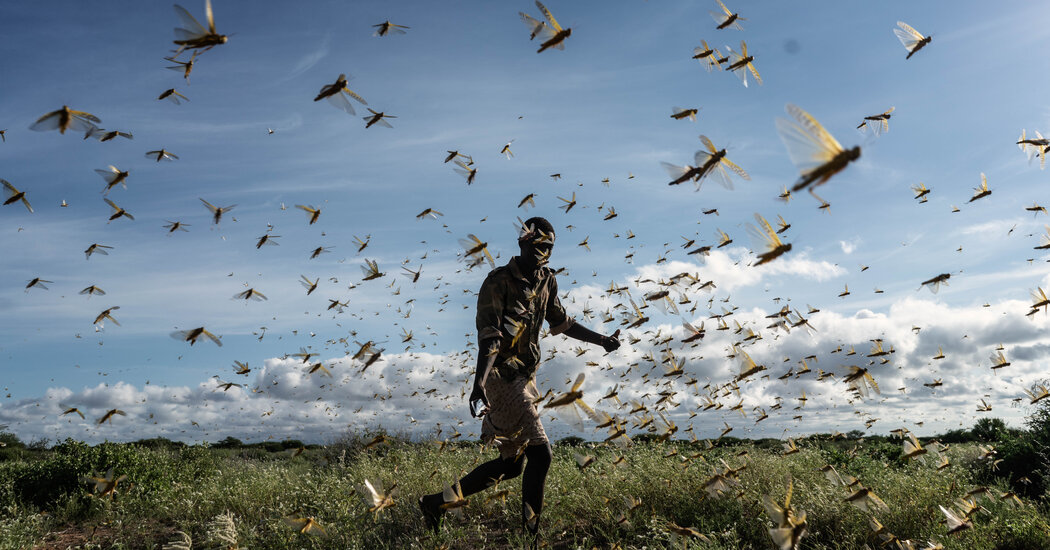
    Rising temperatures could expand the area of the globe under threat from crop-devouring locusts by up to 25 percent in the coming decades, a new study found, as more places experience the cycles of drought and torrential rain that give rise to biblical swarms of the insects.

    Desert locusts for millenniums have been the scourge of farmers across northern Africa, the Middle East and South Asia. They love hot, dry conditions, but they need the occasional downpour to moisten the soil in which they incubate their eggs.

    Human-caused warming is heating up the locusts’ home turf and intensifying sporadic rains there. That is exposing new parts of the region to potential infestations, according to the study, which was published Wednesday in the journal Science Advances.

    “Given that these countries often serve as global breadbaskets and are already grappling with climate-driven extremes like droughts, floods and heat waves, the potential escalation of locust risks in these regions could exacerbate existing challenges,” said Xiaogang He, one of the study’s authors and an assistant professor of civil and environmental engineering at the National University of Singapore.

    Other scientists cautioned, however, that climate change is also affecting locust threats in another important way. When they are not gathering by the tens of millions and laying waste to whole landscapes, these insects lead meek, solitary lives in arid zones. As the planet warms, some of these areas could become too hot and dry even for the locusts, leaving smaller territories in which they can multiply and congregate.

    This might make it easier to use pesticides to stop outbreaks before they can morph into all-out plagues, said Christine N. Meynard, a researcher at the National Research Institute for Agriculture, Food and Environment in Montpellier, France. “If you can focus on fewer areas” for fighting locusts, “it’s a lot better,” said Dr. Meynard, who wasn’t involved in the new study.

    Locust invasions might be best known as a form of divine punishment, but scientists have long understood that the insects’ lives are linked intimately with weather, climate and ecology.

    For long stretches of time, desert locusts stay scattered and out of sight in dry places including the Sahara and the Sahel in Africa and the Thar Desert in India and Pakistan. When it rains, their eggs flourish and so does the surrounding vegetation, giving the hatchlings lots to munch on.

    As the land dries out again, they begin to convene in the spots where greenery remains. They then take flight in swarms to search for more food, darkening skies and gobbling up crops across some of the poorest places on the planet.

    In 2019, the worst locust infestations in a generation began descending on a stretch of the globe from East Africa to central India. The United Nations Food and Agriculture Organization and its partner agencies undertook a vast operation to protect crops and livestock and to secure food supplies for tens of millions of people.

    Dr. He and his colleagues used mathematical modeling to examine how climate factors shape the way locust invasions unfold across large areas. They found that the timing of seasonal rains across the region can cause far-flung places to be at disproportionate risk of experiencing swarms at the same time.

    India and Morocco, for instance, are thousands of miles apart. And yet locust plagues are highly likely to be synchronized in the two countries, the researchers found. Similarly for Pakistan and Algeria. “Concurrent locust infestations have the potential to trigger widespread crop failures, jeopardizing global food security,” Dr. He said.

    Based on what he and his colleagues determined about how rainfall, temperatures, soil moisture and winds affect where locusts end up, they also predicted how global warming might change the picture.

    They estimated that the pests’ total range could expand by 5 percent to 25 percent before 2100, depending on how much warmer the planet gets. Some places that don’t have locusts today could start seeing them in the coming decades, the researchers found. These include areas of Afghanistan, India, Iran and Turkmenistan.

    Demo

    A different species, the South American locust, plagues farms in Argentina, Bolivia, Brazil, Paraguay and Uruguay. Other research has predicted that warming will increase the geographic range of that pest, too.

    Climate and ecology aside, Dr. Meynard and other researchers see sociopolitical conditions as another important factor behind locust risks. In conflict-ravaged Yemen, for instance, pest populations were able to grow unchecked in recent years, which might have worsened the outbreaks in 2019 and 2020.

    More stable countries have improved their monitoring and management of locusts, Dr. Meynard said. “There has been some progress, definitely,” she said.

    View original article here

    Share. Facebook Twitter LinkedIn Email Reddit
    Previous ArticleHouse Republican Majority Shrinks Again as Congress Faces Critical Issues
    Next Article When Ash Wednesday Falls on Valentine’s Day, Love and Death Compete

    Related Posts

    Opinion | And the Award for Best Performance at the State of the Union Goes to …

    March 11, 2024
    Read More

    Ramadan 2024: Crescent Moon Sightings Determine Start Times

    March 11, 2024
    Read More

    The Blue Waters of San Andres, an Island Belonging to Colombia, Are Stunning

    March 11, 2024
    Read More
    Add A Comment

    Leave A Reply Cancel Reply

    Demo
    Top Posts

    Former FBI, CIA Head Has ‘Serious Concerns’ With Trump Cabinet Picks

    December 28, 2024435

    Emirates to operate next-gen A350 on the third daily service to Cape Town

    January 14, 2026256

    AAVE Price Prediction: Target $215-225 by Mid-January 2025 as Technical Indicators Signal Bullish Momentum

    December 15, 2025240

    Ventive Hospitality Joins Green Fins: Strong ESG Lift

    February 17, 2026211
    Don't Miss
    Politics

    JD Vance’s Brazenly False New Trump Defense Goes Off The Rails

    By Staff WriterApril 16, 20263 Mins Read

    Vice President JD Vance’s latest defense of President Donald Trump got hit with a quick…

    Read More

    Loss Of Smell May Be A Sign Of Alzheimer’s, Study Shows

    April 16, 2026

    The Complete AI Research Workflow: From Prompt Discovery to Content Creation

    April 16, 2026

    Amazon-backed X-energy files to raise up to $800M in IPO

    April 16, 2026
    Stay In Touch
    • Facebook
    • Twitter
    Demo
    About Us

    Small Business Minder brings together business and related news from around the world in one place. Follow us for all the business news you'll need.

    Facebook X (Twitter)
    Our Picks

    JD Vance’s Brazenly False New Trump Defense Goes Off The Rails

    April 16, 2026

    Loss Of Smell May Be A Sign Of Alzheimer’s, Study Shows

    April 16, 2026
    Most Popular

    Former FBI, CIA Head Has ‘Serious Concerns’ With Trump Cabinet Picks

    December 28, 2024435

    Emirates to operate next-gen A350 on the third daily service to Cape Town

    January 14, 2026256
    © 2026 Small Business Minder
    • Home
    • Get In Touch

    Type above and press Enter to search. Press Esc to cancel.

    Ad Blocker Enabled!
    Ad Blocker Enabled!
    Our website is made possible by displaying online advertisements to our visitors. To get the most from our site, please disable your Ad Blocker.