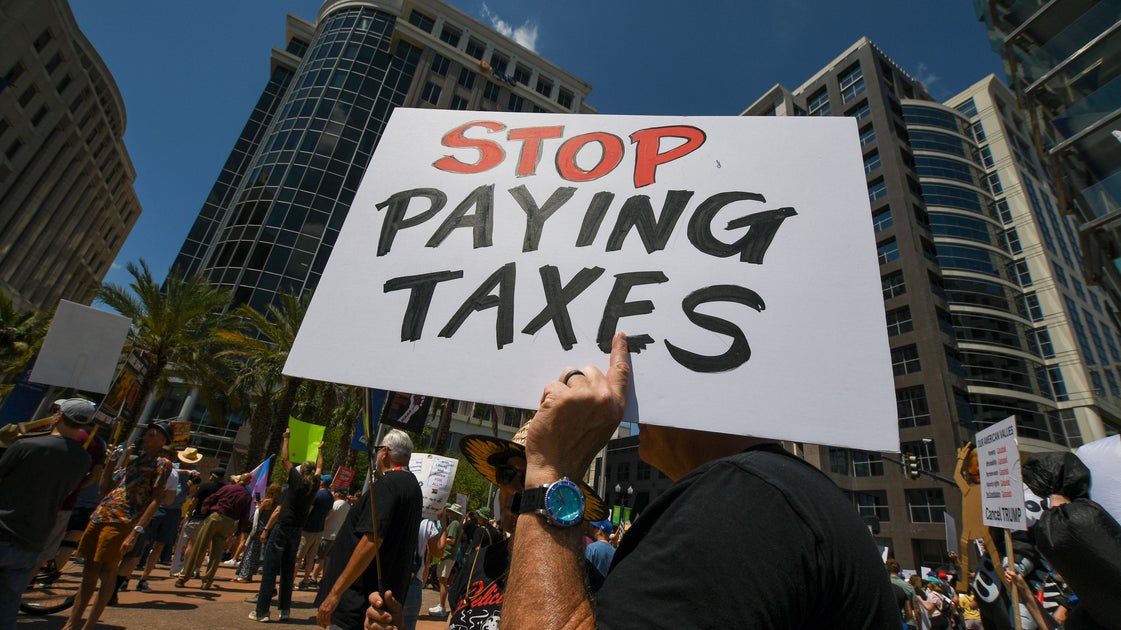

Federal taxes are due on April 15, but a growing number of Americans are refusing to pay as an act of resistance against President Donald Trump’s administration.
Attorney Rachel Cohen is one of them. Cohen is an organizer who has been pepper-sprayed and tear-gassed for protesting Immigration and Customs Enforcement’s violent deportations. This year, she decided she needed to withhold payment of her federal tax dollars as another form of protest.
“I found myself sitting questioning, how on earth I could hold the truth of ‘I think this is worth bodily harm to protest and resist,’ and also ‘I’m going to turn over thousands of dollars that will go in part to funding this,’” Cohen told HuffPost. Cohen was already planning to do this before the U.S.-Israel attacks on Iran in March. However, she said the ongoing Iran war “really affirmed my decision.”
She posted about her decision not to pay over $8,800 in federal income taxes publicly on social media and her Substack. “I’m not encouraging anyone else to do this,” Cohen said, but the lack of knowledge over this type of protest “was why I decided to talk about this publicly.”

Kayla Bartkowski via Getty Images
Approximately half of the United States’ discretionary budget goes to “defense,” including at the Department of Defense and the Department of Homeland Security, according to war research published by Brown University. For tax resisters, using taxpayers’ dollars to fund military government spending is a morally unconscionable act under Trump’s administration.
The idea of war tax resistance goes back to the Founding Fathers and has risen during times of war, but there is a surging new interest in it this year. Lincoln Rice is a coordinator at the National War Tax Resistance Coordinating Committee, which was founded in 1982 and offers free educational resources on what happens if people withhold their federal tax dollars. Shortly after Trump’s second inauguration, Rice said NWTRCC’s website had a “personal record” of 110,000 unique visitors.
“Last tax season, it was typical for around 100 to 200 to show up” to an informational session, Rice said. “And this tax season, it has been between 200 to 500, which is significantly more.”
Under Trump’s leadership, frustrated Americans are reaching new breaking points. For some people, the U.S. support of Israel’s invasion of Gaza was their tipping point, Rice said. For others, it was the Elon Musk-led Department of Government Efficiency, or the U.S. ousting of Venezuelan President Nicolás Maduro. In the past six months, Rice said the “biggest drivers” of tax resistance have been the killings of U.S. citizens in Minneapolis by federal immigration enforcement and now, the U.S.-Israel war against Iran.
“With every new action of the Trump administration… they’ll say, ‘This is the last straw,’” Rice said.

NurPhoto via Getty Images
There Can Be Serious Consequences If You Join The War Tax Resistance Movement
Conscientious objection to military service is legal, but electing not to pay your federal taxes on those same grounds is not.
Though not common, the Internal Revenue Service has garnished some war tax resisters’ wages, which is when the agency tells your employer that they require a certain percentage of your salary to be used to cover your debt. In other cases, they have levied bank accounts for failing to pay taxes.

“When they do that, they can take up to the entire amount of the account, up until the amount of the tax due,” Rice explained.
After peace activist Randy Kehler refused to pay federal taxes for years in protest against military spending, the IRS seized his house in 1989. Willful failure to pay taxes can also result in jail time, although this is rare.
When asked by HuffPost about the consequences for people who are refusing to pay taxes to resist Trump’s policies, the federal agency answered by directing HuffPost to its website on “frivolous tax arguments,” and quoted a 1991 court decision against a person who knowingly did not pay his taxes, which states in part: “Like moths to a flame, some people find themselves irresistibly drawn to the tax protester movement’s illusory claim that there is no legal requirement to pay federal income tax. And, like moths, these people sometimes get burned.”
The IRS will also charge interest on your outstanding balances for every month you don’t pay. Once your overdue penalties and interest total more than $66,000, you cannot renew your passport. The financial penalties for failing to file are much worse than failing to pay, so many tax resisters will still file federal taxes even when they don’t pay them.
“It’s an expensive protest,” said Minnie Sage, the program director of Tax-Aid, a nonprofit that provides free tax services to the San Francisco Bay Area. “I don’t recommend it. I think you’re causing a bigger disruption in your financial life… There are other ways to protest.”
Sage noted that if you have several years of returns you need to file this year, you could be forfeiting any refund you could get by choosing not to pay your taxes.
Rice noted that war tax resisters typically pay their state taxes even if they do not pay their federal taxes, because doing so is not as morally objectionable. “States have police forces…but generally speaking, they’re not invading countries,” Rice said.
And states are also more litigious than the IRS and “often have less restrictions around the type of collection and enforcement they’re allowed to do,” Rice said. “They’re much more likely and much more aggressive when it comes to criminal prosecution.”
Some Tax Resisters Say The Risks Are Worth It
But despite the legal and financial risks, tax resistance is still worth it to those who see this as a necessary act of civil disobedience.
Kat Olson is a volunteer with National Tax Strike, a group that spreads tax-resistance education materials, and is not paying what she owes in federal taxes for the first time this year. For her, the risk of paying taxes with “a madman in the White House” is too high, citing fatal ICE shootings as her tipping point.
Last September, after Trump launched Operation Midway Blitz in Chicago, ICE agents fatally shot Silverio Villegas González in a neighborhood where Olson’s husband grew up. “That could have been my family,” Olson said. As a result, Olson engaged in what tax protesters dub “W-4 resistance,” in which salaried employees stop the withholding of federal income taxes from their paychecks.
Sage said if you choose not to withhold any of your money for federal taxes over the year, “just know you’re going to have a big tax bill at the end.” The additional risk of this lack of withholding could also be an Underpayment of Estimated Tax penalty later on, too.
But for tax resisters like Olson, this protest is needed for societal change to happen.
“I was nervous throughout the whole year, but now that it’s come time to make that decision to not pay my taxes, I feel very resolute,” Olson said. If her wages do get garnished, she will cross that bridge, but it’s not her biggest concern. “I barely have anything in savings. Like, what more do we have to lose?” she said.
“I can take a sternly worded [IRS] letter. That does not scare me,” Olson said. “What scares me is my neighbors being taken out of their homes.”